
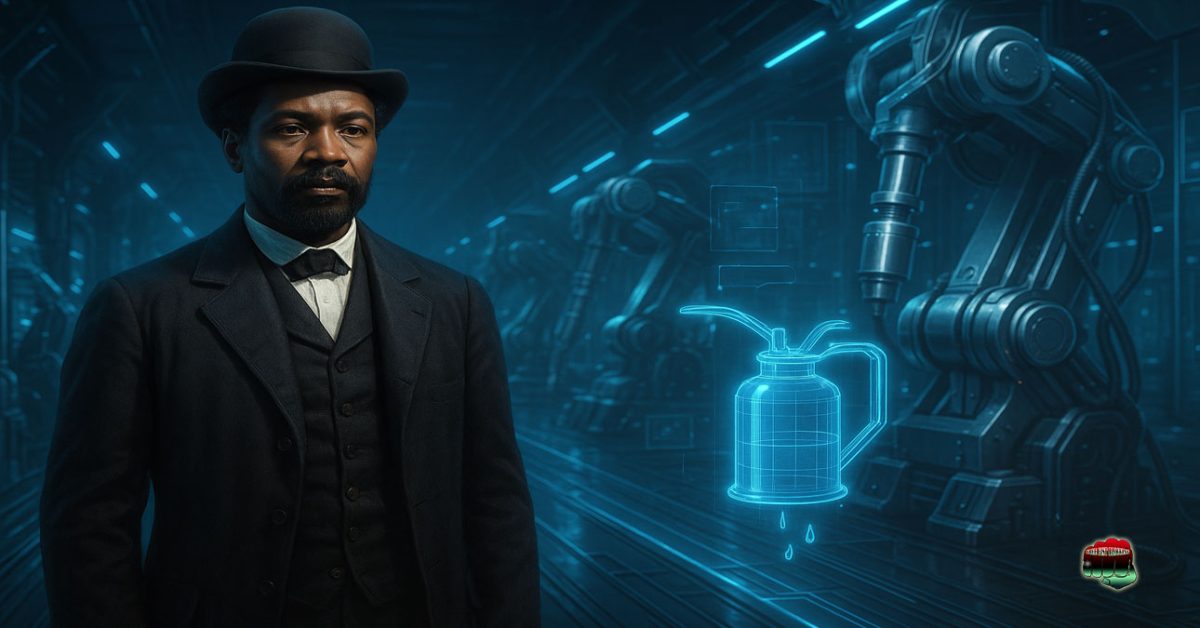
How Elijah McCoy Built the Modern World While History Looked Away
An InnerKwest Investigative Essay
By InnerKwest Editorial Desk | December 4, 2025
The Machine That Never Slept
Every generation inherits a myth about progress.
In America, one of the most seductive myths is that innovation is an equal-opportunity altar — that brilliance alone determines who gets remembered.
But history tells a sharper truth.
Some names rise.
Other names are erased, covered over, footnoted, absorbed into the machinery they created.
Elijah McCoy was one of those names.
Today we live inside a world ruled by automation — from factory lines that never sleep, to container ports that hum through the night, to robotics systems synchronizing global commerce, to the AI membranes now emerging in our century’s quiet backrooms.
But before all of that — before cybernetics, industrial robotics, predictive maintenance, humanoids, drones, and the autonomous systems economy — there was a single device that made perpetual motion possible.
A small cup of oil.
A drip timed with a piston.
A self-sustaining logic housed inside simple metal.
The McCoy Lubricator.
It is not dramatic.
It is not glamorous.
But it is the hinge on which the modern world quietly turned.
The Forgotten Blueprint of Autonomy
When Elijah McCoy patented his 1872 Automatic Lubricating Cup, he engineered something the industrial world had never seen:
- a closed-loop mechanical routine
- a self-regulating actuator
- a subsystem that performed work without human intervention
- an integrated maintenance solution inside the machine’s own motion
This was the first step toward automation — not the factory robot, not the assembly line, not the computer — but the principle that machines could sustain themselves.
McCoy’s invention eliminated the need for workers to climb onto hot locomotives to manually oil pistons. Engines could now run longer, harder, and faster. The entire logic of uptime changed.
A machine became, for the first time, a partner in its own survival.
That leap — from human-dependent operation to autonomous operations — is what underwrites every modern robotic and automated system.
McCoy didn’t just lubricate engines.
He lubricated civilization’s path into the future.
Yet most textbooks mention him only in passing — if at all.
Why?
A Mind Too Early, A Country Too Late
Elijah McCoy was born in 1844 to formerly enslaved parents who fled Kentucky through the Underground Railroad. His parents, determined that their son would outrun the limits set for him, sent him to Scotland to study mechanical engineering — a rare achievement for any North American at the time, and all but unheard of for a Black man.
He returned to the United States with formal training, credentials, and mastery.
But the railroad companies saw only his skin.
They offered him no engineering post.
Instead, he was hired as a fireman and oilman — shoveling coal, lubricating engines by hand, doing the labor of the very machines whose future he would transform.
His brilliance was undeniable.
His opportunities, intentionally constrained.
The friction between those two forces — genius and injustice — often births revolutions.
McCoy looked at the machine he serviced every day and understood what the industrial world did not:
human intervention was the bottleneck.
The future would belong to machines that could care for themselves.
He designed the solution in silence.
He patented it in persistence.
Industry adopted it out of necessity.
But they rarely adopted him.
The erasure began quietly.
Then structurally.
Then culturally.
When white engineers produced inferior knockoffs, companies demanded, “Give us the real McCoy.”
The phrase endured. His name did not.
Automation Built on Borrowed Brilliance
To understand the magnitude of McCoy’s contribution, we must examine the ecosystem his invention unlocked.
Before McCoy:
- locomotives stopped constantly for lubrication
- factories suffered catastrophic downtime
- machine labor could not meaningfully scale
- heat, friction, and mechanical wear limited economic ambition
After McCoy:
- continuous operation became the new industrial norm
- interstate commerce expanded at unprecedented speed
- factories ran 24 hours a day
- cost-per-unit plummeted
- the Second Industrial Revolution accelerated
These are not small ripples.
These are structural inflection points — the kind economists attribute to game-changing systems.
McCoy’s autonomous mechanism became:
- the precursor to predictive maintenance
- the foundation for assembly-line continuity
- the seed of cybernetic thinking (machines regulating themselves)
- the precondition for robotics (systems operating beyond human endurance)
Whenever a robot arm performs 100,000 cycles without overheating…
Whenever an autonomous vehicle regulates its own temperature or mechanics…
Whenever AI-driven machinery optimizes itself for efficiency…
They echo McCoy.
His logic is embedded in every autonomous system from Detroit to Shenzhen.
But in classrooms?
Silence.
In engineering histories?
Footnotes.
In mainstream narratives?
Absent.
This is not an academic omission.
It is a cultural injury.
Why Was He Erased?
Here is the difficult truth.
Elijah McCoy’s erasure was not accidental.
It was systemic.
1. The Industrial Age was built atop racial exclusion.
Black inventors often saw their patents bought, buried, or separated from their names so industry could use the innovations without crediting the source.
2. McCoy contradicted the narrative of who gets to define American progress.
A Black engineer being foundational to the mechanized world challenged the mythology of white industrial genius.
3. Corporate America preferred the product, not the person.
His devices were celebrated.
His identity was suppressed.
His royalties were limited.
His legacy — detached.
4. Historians curated the story they wanted to tell.
Every field has gatekeepers.
Industrial history’s gatekeepers did not make room for a Black innovator who built the spine of automation.
Injustice shapes memory.
Memory shapes culture.
Culture shapes the stories we pass forward.
Elijah McCoy fell through the cracks on purpose.
When a Nation Forgets Its Architects, It Misunderstands Its Machines
We cannot talk about automation, robotics, or the AI era without talking about who laid the first bricks.
When we erase foundational Black innovators, we distort the genealogy of human progress.
We teach children that brilliance has a particular color, a certain complexion, a predetermined origin point.
This harms:
- innovation
- identity
- aspiration
- national truth
- global understanding of contribution
And it blinds us to the interconnected nature of genius.
Elijah McCoy’s legacy invites us to see automation not as an inevitability but as a human story — born from perseverance, shaped by exclusion, propelled by necessity, and matured by vision.
The Prophetic Undercurrent: A Lesson for Our Age of AI
Here is where the past speaks to the present.
Automation began when a Black engineer solved a problem the world refused to acknowledge.
Today, AI is transforming society with similar patterns:
- The creators are not always the ones credited.
- The labor is often unseen.
- The ethics trail the implementation.
- The narrative is written by those with power, not necessarily truth.
McCoy’s story warns us that technology without justice becomes exploitation.
And history without honesty becomes myth.
As the world steps into autonomous robotics, AGI membranes, and self-governing digital systems, we would be wise to recall the lessons of the man whose invention made all of this possible.
We must ask:
Who gets remembered?
Who gets erased?
And who built the system that now builds the world?
Restoring the Missing Architect
To restore Elijah McCoy is not merely to celebrate a Black engineer.
It is to restore accuracy to the story of innovation.
It is to acknowledge:
- the father of autonomous machine logic
- the originator of continuous self-maintaining mechanical systems
- the visionary whose design unlocked the scale of modern industry
He did not invent automation alone.
But without him, automation would not have arrived when it did.
His work is not a footnote — it is a foundation.
And foundations deserve names.
The Real McCoy — Finally, Fully Seen
The world demanded the real McCoy because only his invention worked as promised.
It was authentic.
It was reliable.
It was unmatched.
Perhaps the phrase was prophetic.
Because the real McCoy — the man — is finally being acknowledged for what he was:
The erased architect of automation.
The hidden engineer behind industrial continuity.
The genius whose work made the modern world possible.
And from this point forward, his name belongs not in the shadows of history, but in its architecture.
The Call Forward
We close with this truth:
A nation cannot build a just future while standing on an incomplete past.
Elijah McCoy deserves restoration.
He deserves curriculum.
He deserves recognition in every field that grew from the seed he planted.
He deserves to be spoken as a pillar of engineering, not a trivia question.
For automation is not just a mechanical evolution.
It is a human one.
And its architect — the real architect — deserves to be known.
Let the record stand corrected.
Elijah McCoy built the logic of the machine world.
Now the world must finally speak his name.
Support InnerKwest: Powering Truth & Excellence with Bitcoin
At InnerKwest.com, we are committed to delivering impactful journalism, deep insights, and fearless social commentary. Your Bitcoin contributions help us execute with excellence, ensuring we remain independent and continue to amplify voices that matter.
Support our mission—send BTC today!
🔗 Bitcoin Address: 3NM7AAdxxaJ7jUhZ2nyfgcheWkrquvCzRm© 2026 InnerKwest®. All Rights Reserved | Haki zote zimehifadhiwa | 版权所有.
InnerKwest® is a registered trademark of Inputit™ Platforms Inc. Global
No part of this publication may be reproduced, distributed, or transmitted in any form or by any means without prior written permission. Unauthorized use is strictly prohibited.
Thank you for standing with us in pursuit of truth and progress!