
Before Industrialization, Capitalism Was Tested on an Island
By InnerKwest Intelligence Desk | March 2026
SERIES | Hidden Foundations of Global Power
Part I — Madeira: Engineering Capitalism
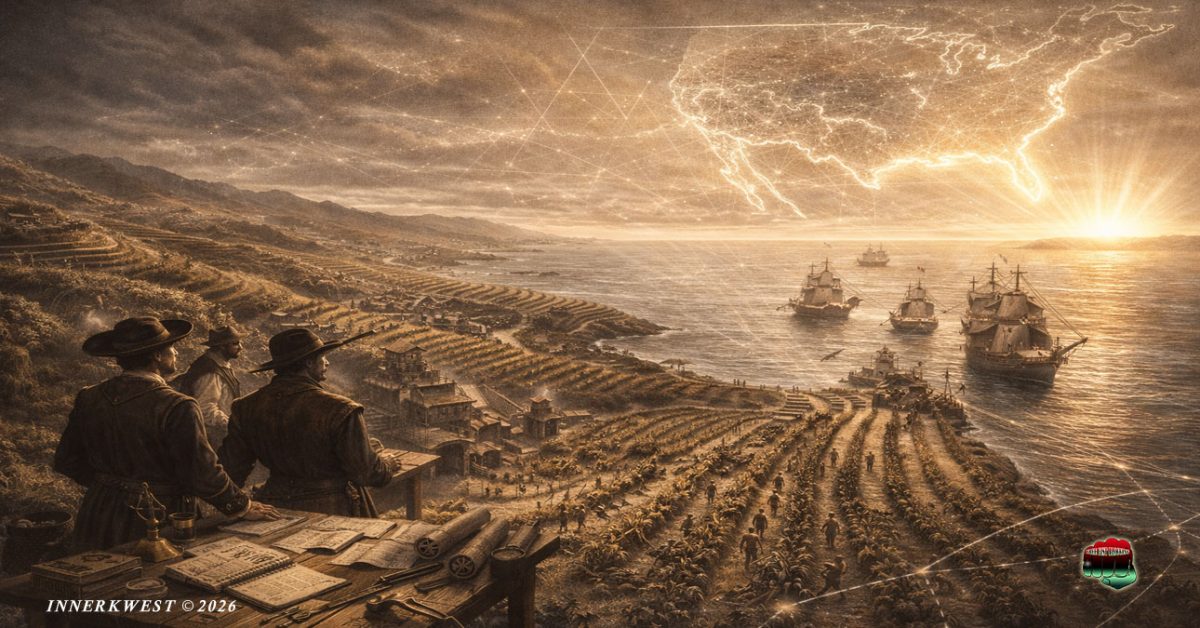
Long before factories reshaped Europe or financial markets defined global power, a small Atlantic island became the proving ground for an economic system that would transform the world. In the 15th century, Madeira — colonized by Portugal — pioneered a new model combining land ownership, forced labor, capital investment, and export-driven production. What emerged there was not merely colonial agriculture, but an early architecture of capitalism itself. The systems refined on Madeira would migrate across the Atlantic, shaping Brazil, the Caribbean plantation economy, Haiti’s revolutionary upheaval, and ultimately the foundations of modern global wealth.
An Empty Island and an Imperial Opportunity
When Portuguese navigators claimed Madeira around 1419, the island was uninhabited but strategically positioned along emerging Atlantic trade routes.
Unlike older European economies structured around feudal obligation, Madeira allowed something new: economic experimentation without entrenched social constraints.
Portuguese authorities granted vast tracts of land to investors and nobles under a system designed explicitly for profit generation rather than subsistence settlement.
The island became a controlled economic laboratory.
Sugar: The Commodity That Changed Everything
Sugar transformed Madeira into one of Europe’s earliest export economies.
Demand across Europe surged as sugar shifted from luxury medicine to elite consumption good. Meeting that demand required unprecedented agricultural scale and organization.
Madeiran producers introduced:
- large monocrop plantations
- centralized processing mills
- coordinated shipping logistics
- reinvestment of commercial profits
Agriculture became industrial in structure centuries before mechanized industry existed.
Profit — not tradition — governed production.
The Introduction of Enslaved Labor
To sustain intensive sugar cultivation, Portuguese settlers introduced enslaved labor to Madeira, drawing increasingly from West Africa through expanding Atlantic trade networks.
Labor itself became commodified.
Human beings were integrated into accounting systems alongside land and equipment — valued according to productivity and output.
This fusion of land, labor, and capital marked a decisive break from medieval economic organization.
Madeira helped normalize an economic logic that prioritized efficiency, scalability, and return on investment.
The Plantation System Is Born
On Madeira, European financiers, merchants, and colonial administrators developed what historians now recognize as the plantation complex.
Its defining characteristics included:
- concentrated land ownership
- coerced labor forces
- export-oriented monoculture
- transnational financing
- maritime insurance and risk-sharing
This system linked Europe, Africa, and Atlantic trade decades before the Americas became central to imperial competition.
Capitalism, in practice, began offshore.
From Madeira to the Atlantic World
Madeira’s success produced replication.
As soil exhaustion and competition reduced profitability, Portuguese and later European powers exported the model elsewhere:
- São Tomé
- Brazil
- Barbados
- Jamaica
- Saint-Domingue (later Haiti)
Each expansion scaled production — and human exploitation — further.
By the 18th century, Caribbean colonies operated economic systems whose institutional DNA traced directly back to Madeira.
Finance, Risk, and the Architecture of Capital
Madeira also accelerated financial innovation.
Long-distance trade required:
- credit networks
- investment partnerships
- maritime insurance
- commodity speculation
- reinvestment cycles
European merchants increasingly financed overseas production rather than local agriculture.
Capital detached from geography.
Profit became global.
The Economic Engine Behind Empire
The plantation economy generated extraordinary wealth flows into European capitals, helping finance:
- naval expansion
- commercial banking growth
- urban development
- imperial competition
Atlantic capitalism transformed European states into global powers.
Yet its origins lay not in factories or stock exchanges, but in agricultural systems engineered on distant islands.
The Human Cost Embedded in the System
The efficiencies pioneered in Madeira carried profound human consequences.
Forced labor regimes expanded across the Atlantic world, embedding racial hierarchy and coercion into economic structures that would endure for centuries.
The same system that generated wealth also institutionalized dispossession, displacement, and inequality.
Modern economic prosperity and historical injustice emerged from the same architecture.
From Madeira to Haiti — and Beyond
The historical continuity is striking:
Madeira refined plantation capitalism.
Caribbean colonies scaled it.
Haiti’s revolution disrupted it.
The collapse of colonial empires reshaped global power.
The modern economic order did not arise suddenly during industrialization.
It evolved through experimentation, expansion, resistance, and transformation across the Atlantic system.
Why This Origin Story Matters Today
Understanding Madeira re-frames contemporary debates about globalization, inequality, and development.
Modern supply chains, capital mobility, and resource extraction follow patterns first established in early Atlantic economies.
The structures governing wealth accumulation today are not accidental.
They are historical inheritances.

The Question History Leaves Behind
Capitalism is often narrated as a triumph of innovation and industry.
Less frequently acknowledged is where its operational model was first engineered — on an island where profit, empire, and coerced labor converged.
The modern economic order did not begin in boardrooms or factories.
It began at sea, on Atlantic frontiers where new systems of power were tested long before the world understood their consequences.
History remembers outcomes.
InnerKwest examines origins.
At InnerKwest.com, we are committed to delivering impactful journalism, deep insights, and fearless social commentary. Your cryptocurrency contributions help us execute with excellence, ensuring we remain independent and continue to amplify voices that matter.
To help sustain our work and editorial independence, we would appreciate your support of any amount of the tokens listed below. Support independent journalism:
BTC: 3NM7AAdxxaJ7jUhZ2nyfgcheWkrquvCzRm
SOL: HxeMhsyDvdv9dqEoBPpFtR46iVfbjrAicBDDjtEvJp7n
ETH: 0x3ab8bdce82439a73ca808a160ef94623275b5c0a
XRP: rLHzPsX6oXkzU2qL12kHCH8G8cnZv1rBJh TAG – 1068637374
SUI – 0xb21b61330caaa90dedc68b866c48abbf5c61b84644c45beea6a424b54f162d0c
and through our Support Page.
InnerKwest maintains a revelatory and redemptive discipline, relentless in advancing parity across every category of the human experience.
© 2026 InnerKwest®. All Rights Reserved | Haki zote zimehifadhiwa | 版权所有. InnerKwest® is a registered trademark of Inputit™ Platforms Inc. Global. No part of this publication may be reproduced, distributed, or transmitted in any form or by any means without prior written permission. Unauthorized use is strictly prohibited. Thank you for standing with us in pursuit of truth and progress!