
August 26, 2026
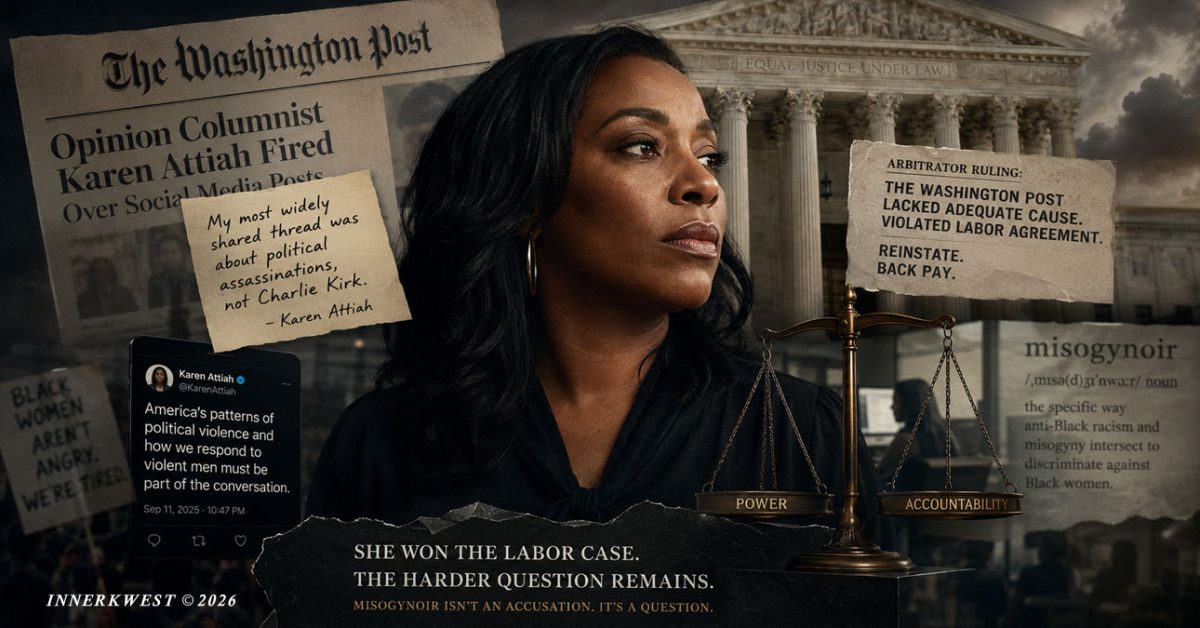
An arbitrator found that The Washington Post lacked sufficient cause to fire its longtime columnist. That resolves a labor dispute. It does not resolve the more difficult questions surrounding race, gender, speech, institutional power—and misogynoir.
By the InnerKwest Editorial Desk
Karen Attiah won.
That fact deserves to be stated plainly before attaching anything larger to it.
Nearly a year after The Washington Post fired the veteran opinion columnist following social-media posts made in the aftermath of conservative activist Charlie Kirk’s killing, private arbitrator Sarah Miller Espinosa ordered the newspaper to reinstate Attiah with full back pay and lost benefits. Espinosa found that the Post had failed to establish that Attiah committed “gross misconduct” and did not have “good and sufficient cause” to terminate her.
That is what has been established.
But the ruling leaves another question sitting uncomfortably on the table.
Why did Karen Attiah lose her job in the first place?
Answering that requires moving beyond the convenient political binaries surrounding the case. It requires examining what Attiah actually said, what the Post said she did, how severely the institution responded, and whether something deeper influenced the interpretation of her words.
It also introduces a word unfamiliar to many Americans:
Misogynoir.
Scholar Moya Bailey coined the term to describe the particular discrimination produced when anti-Black racism and misogyny intersect in the treatment of Black women and people perceived as Black women. It isn’t merely racism occurring alongside sexism. Bailey describes it as a distinctive, synergistic form of prejudice arising from both.
That does not prove that Karen Attiah experienced misogynoir at The Washington Post.
But her case gives us reason to ask the question.
And asking it properly requires evidence.
What Attiah Actually Said
The story is often compressed into a convenient sentence: The Washington Post fired Karen Attiah over comments about Charlie Kirk after he was assassinated.
That description isn’t entirely false.
It is also incomplete.
Following Kirk’s September 2025 killing, Attiah posted about political violence, race, gender and America’s responses to violent men. One of the posts cited in subsequent coverage rejected the idea that declining to engage in public mourning for a white man whom she believed had espoused violence was itself an endorsement of violence. Another discussed what she described as society’s tendency to “coddle violent white men.”
The Post interpreted the posts differently.
According to Attiah, the termination letter accused her of violating the newspaper’s social-media policies, harming the organization’s integrity and potentially endangering the physical safety of its staff. She was accused of gross misconduct.
Attiah disputed both the characterization and the prevailing public narrative.
Her most widely shared thread, she wrote after her dismissal, wasn’t primarily about Kirk. It concerned the earlier assassinations of Minnesota state legislator Melissa Hortman and her husband and what Attiah viewed as a broader American pattern involving political violence and gun deaths.
That distinction matters.
An institution certainly possesses a legitimate interest in protecting employees, enforcing workplace rules and determining what conduct is compatible with its standards.
Journalists do not acquire unlimited immunity from workplace consequences merely because they are journalists.
Neither does calling something “opinion” automatically place it beyond scrutiny.
The important question is therefore not whether the Post possessed the authority to maintain standards.
It is whether those standards justified this punishment for this conduct.
We now have an independent answer to at least part of that question.
They did not.
From Eleven Years to an Email
Attiah had worked at the Post for 11 years as an editor and columnist. She helped establish Global Opinions and had written extensively about international affairs, race, gender and culture. At the time of her dismissal, she was the newspaper’s only Black female opinion writer.
According to reporting on the arbitration decision, she also had no previous disciplinary record during those 11 years.
There was no gradual escalation of discipline.
There was no suspension followed by review.
There apparently wasn’t even a conversation before termination.
Attiah says she was fired by email.
That progression—or absence of one—is significant because the arbitrator reportedly found termination disproportionately severe and concluded that the newspaper had other available responses. Reporting on the ruling indicates that Espinosa noted alternatives including investigation or asking Attiah to remove the posts.
So the Attiah controversy has moved beyond the realm of people arguing on social media about whether they liked what she wrote.
The disciplinary action itself failed scrutiny.
That is important.
But it still does not prove discrimination.
This Is Where Misogynoir Enters the Conversation
Misogynoir is useful only if we resist turning it into a rhetorical shortcut.
Karen Attiah is Black.
Karen Attiah is a woman.
Karen Attiah was wrongfully terminated.
Those three statements do not automatically produce a fourth:
Karen Attiah was fired because she is a Black woman.
That conclusion requires evidence.
But discrimination rarely arrives with a memorandum announcing itself.
Institutional bias can operate through interpretation: who is perceived as threatening, who is considered angry, whose language is characterized as dangerous, who is given the benefit of context, whose mistakes are considered correctable and whose mistakes—or perceived mistakes—become evidence that the person must leave.
That is where the Attiah case becomes more complicated.
The Post reportedly interpreted her references to white men as prohibited disparagement based upon race and gender.
The arbitrator rejected that reasoning.
Reporting on the decision indicates that Espinosa concluded Attiah was discussing a subset of white men associated with hatred or violence rather than disparaging white men generally because they were white or male. The arbitrator also reportedly rejected the proposition that merely identifying someone’s race or gender constitutes discrimination.
That creates a fascinating inversion.
A Black woman whose professional work included writing about race and gender discussed race and gender.
The institution interpreted that speech as sufficiently egregious to constitute gross misconduct.
An arbitrator subsequently concluded that it wasn’t.
That doesn’t prove misogynoir.
But it certainly makes the question legitimate.
The Question Isn’t Whether Attiah Was Offensive
People are entitled to find Attiah’s commentary offensive, provocative, racially reductive or particularly inappropriate in the immediate aftermath of an assassination. Others may regard the same commentary as a legitimate, if uncomfortable, examination of race, gender and political violence. Those disagreements are unavoidable when evaluating the work of an opinion columnist, whose role necessarily includes advancing arguments that portions of the public will reject.
But public disagreement does not resolve the institutional question raised by Attiah’s firing. The relevant standard was not whether her words offended readers or generated controversy, but whether her conduct amounted to gross misconduct sufficient to justify terminating an employee who had spent 11 years at the newspaper. On that question, the arbitrator concluded that the Post had not established adequate grounds for dismissal.
The ruling settles an important part of the dispute without answering the more difficult question that follows from it. If Attiah’s conduct did not justify termination under the Post’s own labor agreement, what explains the severity of the response, and would another employee with a comparable record, performing comparable work and engaging in comparable speech have faced the same consequence?
That is where misogynoir becomes relevant—not as a conclusion attached to Attiah’s identity, but as a question about whether race and gender influenced the way her words were interpreted and the punishment ultimately imposed. Answering it requires something more persuasive than accusation or intuition. It requires comparison.
Find the Comparables
If the hypothesis is that race and gender influenced Attiah’s treatment, the strongest evidence will not come from another argument about race and gender. It will come from the Post’s own history of exercising disciplinary judgment. How has the newspaper responded when other opinion writers made controversial statements on social media, became the subject of public outrage, used inflammatory political language, discussed protected groups in provocative ways or otherwise tested the boundaries of its standards? Some may have been warned or privately counseled. Others may have deleted posts, apologized, been suspended or been given an opportunity to correct their conduct. What matters is whether employees in reasonably comparable circumstances were afforded options that Attiah was not before the newspaper resorted to termination.
The broader environment surrounding Charlie Kirk’s killing complicates that inquiry. Attiah was hardly the only person who suffered employment consequences for public commentary after his death. Employees in journalism, universities, corporations and government were fired, suspended or investigated as organizations confronted an unusually charged political moment. That context leaves open a credible alternative explanation: Attiah may not have been singled out because she was a Black woman at all, but instead caught in a much wider institutional reaction to speech surrounding Kirk’s assassination. A serious examination of misogynoir has to permit that possibility, because evidence capable of supporting a hypothesis must also be capable of weakening it.
Still, what happened at other organizations cannot establish whether the Post applied its own standards consistently. The more revealing comparison is inside the institution itself, among employees working under similar rules, performing comparable editorial functions and facing allegations of similarly objectionable conduct. If the Post routinely responded to those circumstances with termination, the argument that Attiah received exceptional treatment becomes substantially weaker. If comparable employees were instead warned, counseled, suspended or allowed to correct their conduct, her abrupt dismissal after 11 years takes on a different significance.
That distinction is important because it moves the question of misogynoir away from assumption and toward evidence. The issue is not simply whether other people have been fired for controversial speech. It is whether the same institution, applying the same standards to comparable conduct, reached comparable outcomes.
The Institution Was Also Changing
Attiah’s firing didn’t occur in an institutional vacuum.
The Post’s opinion operation was undergoing substantial change. Owner Jeff Bezos had announced in February 2025 that the opinion section would concentrate on “personal liberties and free markets.” The decision generated internal controversy and preceded significant changes within the section.
That context introduces another possibility.
Was Attiah’s dismissal primarily disciplinary?
Was it ideological?
Was it managerial?
Was it part of a broader repositioning of the Post?
Did race or gender affect how her words were interpreted?
Or did several of those forces intersect?
Organizations rarely make consequential decisions for one perfectly isolated reason.
That is precisely why labels should come after investigation rather than before it.
The Other Meaning of Free Expression
There is another uncomfortable dimension to this case.
News organizations regularly defend the importance of journalists challenging governments, corporations and powerful institutions.
That principle becomes more difficult when the institution being challenged is the journalist’s employer.
Attiah maintains that commenting on race, gender, violence and political culture wasn’t extracurricular behavior disconnected from her employment. It was substantially the work she had been hired to perform. Before arbitration, she argued that she was doing what she had long done as a public columnist addressing those subjects.
The arbitrator did not establish that journalists have an unlimited right to say whatever they choose.
She established something narrower and arguably more consequential:
The Post had rules.
The Post applied those rules.
And when that application was subjected to the dispute-resolution process contained in its labor agreement, the newspaper failed to justify the punishment it imposed.
That should concern anyone interested in institutional accountability regardless of their opinion of Attiah’s politics.
Misogynoir Should Not Become an Escape Hatch
There is an equal danger in reaching the conclusion too quickly. If every adverse consequence experienced by a Black woman is characterized as misogynoir, the term becomes difficult to test and ultimately loses some of its analytical value. Bailey’s concept deserves greater rigor than that. Misogynoir describes a particular interaction between anti-Black racism and misogyny, not the demographic coincidence of a Black woman experiencing an unfavorable outcome.
Applied to Attiah, the inquiry is therefore more demanding. It requires examining whether her assertiveness was interpreted differently because of who was expressing it, whether her discussion of race was transformed in the institutional reading into racial hostility, and whether language that might have been regarded as provocative or argumentative from another columnist was instead perceived as threatening or intolerable coming from her. The availability of corrective measures matters as well. If similarly situated employees were warned, counseled or otherwise given opportunities to resolve comparable disputes while Attiah was moved directly toward termination, that disparity would deserve explanation.
None of this establishes that misogynoir determined the Post’s decision. It identifies the evidence necessary to determine whether the concept belongs in the case at all. The distinction matters because legitimate inquiry cannot begin with the conclusion it is supposed to test. Treating misogynoir seriously means being willing to establish its presence through evidence—and equally willing to conclude that the evidence does not support it..
Three Cases, Not One
The Karen Attiah controversy is best understood as three overlapping cases.
The labor case asks whether the Washington Post possessed sufficient contractual grounds to fire her.
That question has been answered in arbitration: it did not.
The journalistic case asks how much latitude an opinion institution should give writers employed specifically to express controversial ideas, particularly when those ideas concern subjects within their established professional portfolio.
That debate remains open.
Then there is the institutional-bias case.
That asks whether Attiah’s race and gender affected how her speech was interpreted and how severely she was punished.
The arbitration ruling makes that question harder to dismiss.
It does not answer it.
And perhaps that is precisely where serious journalism should begin.
Karen Attiah Won. Now Test the Institution.
The easiest version of this story is partisan.
One side can say a progressive columnist said something offensive and deserved to lose her job.
The other can say a Black woman was silenced for telling uncomfortable truths.
Neither requires much investigation.
The more difficult proposition is also the more useful one.
An institution accused an employee of gross misconduct.
It imposed its most severe available employment sanction.
The employee challenged the decision through the mechanism established in the labor agreement.
The institution was required to defend its action before an independent arbitrator.
It failed.
Karen Attiah is therefore entitled to something more substantial than the observation that people disagree about her posts.
The termination itself has been tested.
Now the reasoning behind it deserves examination.
If misogynoir played no role, comparative evidence should help demonstrate that.
If race and gender had nothing to do with the severity of Attiah’s punishment, institutional records and comparable cases should support that conclusion.
If other opinion writers with similar employment histories received equally severe punishment for comparable conduct, put those cases on the table.
And if they didn’t?
Put that on the table too.
Because “misogynoir” should neither function as an accusation that ends the investigation nor as an uncomfortable word institutions can dismiss to avoid one.
It is a hypothesis about how power can operate at the intersection of race and gender.
Karen Attiah has already proved that The Washington Post could not substantiate the punishment it imposed upon her.
Whether something deeper explains why that punishment was imposed is a different question.
There is a straightforward way to begin answering it.
Show us the standard. Show us the comparables. Show us who received mercy, who received discipline and who received the door.
Then we can decide what to call it.

At InnerKwest.com, we are committed to delivering impactful journalism, deep insights, and fearless social commentary. Your cryptocurrency contributions help us execute with excellence, ensuring we remain independent and continue to amplify voices that matter.
To help sustain our work and editorial independence, we would appreciate your support of any amount of the tokens listed below. Support independent journalism:
BTC: 3NM7AAdxxaJ7jUhZ2nyfgcheWkrquvCzRm
SOL: HxeMhsyDvdv9dqEoBPpFtR46iVfbjrAicBDDjtEvJp7n
ETH: 0x3ab8bdce82439a73ca808a160ef94623275b5c0a
XRP: rLHzPsX6oXkzU2qL12kHCH8G8cnZv1rBJh TAG – 1068637374
SUI – 0xb21b61330caaa90dedc68b866c48abbf5c61b84644c45beea6a424b54f162d0c
and through our Support Page.
InnerKwest maintains a revelatory and redemptive discipline, relentless in advancing parity across every category of the human experience.
© 2026 InnerKwest®. All Rights Reserved | Haki zote zimehifadhiwa | 版权所有. InnerKwest® is a registered trademark of Inputit™ Platforms Inc. Global. No part of this publication may be reproduced, distributed, or transmitted in any form or by any means without prior written permission. Unauthorized use is strictly prohibited. Thank you for standing with us in pursuit of truth and progress!