
November 11, 2026
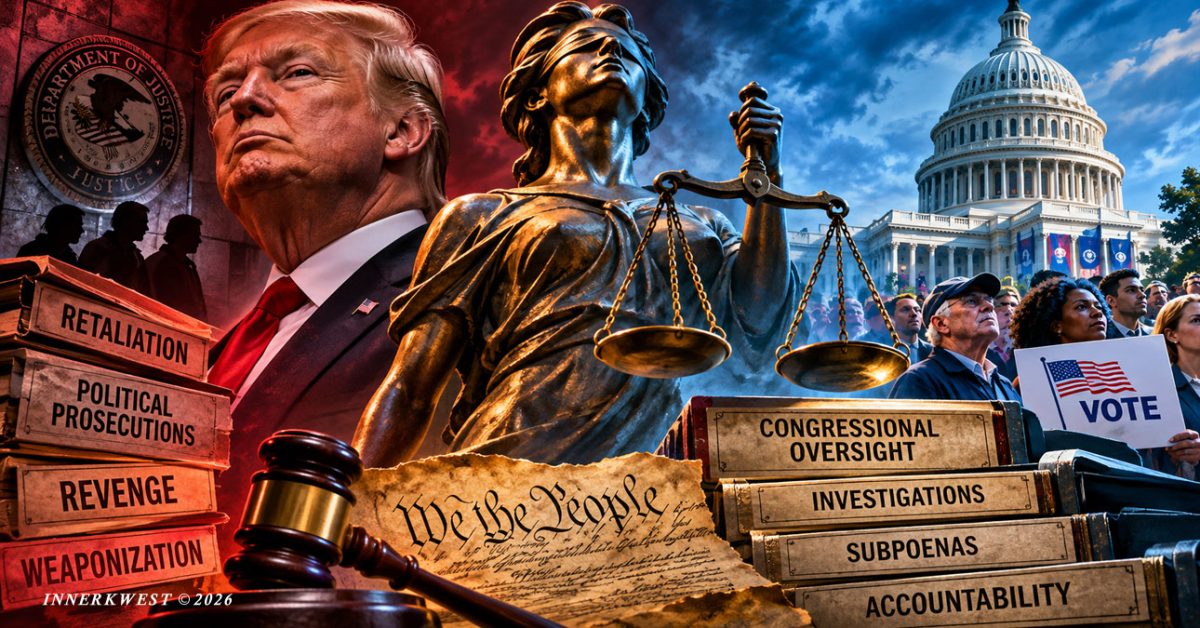
The American electorate has changed the balance of power in Washington. The question now is whether those entrusted with governing will recognize the constitutional consequences of that decision—or attempt to redefine accountability itself as an act of revenge.
By InnerKwest Special Investigations
There is a difference between seeking justice and settling a score.
The distinction should not require much explanation in a constitutional republic. Revenge begins with a grievance and searches for punishment. Accountability begins with conduct, examines the evidence, and determines whether consequences are warranted under established law.
One is personal. The other is institutional.
Yet American political discourse has arrived at a peculiar intersection where these two concepts are increasingly treated as interchangeable. Investigations are described as persecution. Oversight becomes harassment. Demands for records are characterized as threats. The language changes according to who possesses power and who is being asked to answer for its exercise.
The consequences extend beyond political theater.
When the authority to investigate is itself portrayed as an offense, the public is left with a difficult question: who, precisely, is permitted to hold the government accountable?
The November 2026 congressional elections have brought that question into unusually sharp focus.
Democrats won control of both the House of Representatives and the Senate, ending Republican control of Congress and changing the institutional relationship between the legislative and executive branches. The results reflected substantial voter dissatisfaction with the administration, including economic conditions, the war with Iran, and concerns about government corruption.
The voters did not produce a single written mandate explaining every reason for their decisions. Elections rarely do.
They did, however, produce a measurable result.
Congressional authority is changing hands.
What followed the election deserves as much scrutiny as the election itself.
A Decade of Declarations
Political threats do not become meaningless simply because they are delivered before cheering audiences.
During the 2016 presidential campaign, Donald Trump repeatedly entertained the prospect of imprisoning Hillary Clinton. At their October debate, he told her that she would be in jail if he were president.
Clinton was not convicted of a crime. She was not prosecuted over the email controversy that had dominated much of the campaign.
Trump subsequently moderated his position, but the language of punishment did not disappear from his political vocabulary.
In the years that followed, accusations of institutional corruption, politically motivated prosecution, and the misuse of federal law enforcement became recurring elements of his public argument.
By the 2024 election cycle, retribution had become an explicit theme. Trump presented himself as the instrument through which his supporters’ grievances would be answered.
There is a legitimate distinction between criticizing the conduct of government agencies and promising punishment for political adversaries. A candidate may reasonably argue that law enforcement has been misused. A president may order reviews of agency conduct within the limits of the law.
But the distinction becomes harder to maintain when the language of political retribution precedes the use of institutions capable of imposing criminal, financial, or professional consequences.
Intent cannot be established solely by a campaign speech.
Neither should a campaign speech be discarded when subsequent government actions invite comparison.
The public record deserves to be examined as a whole.
On January 20, 2025, the administration issued Executive Order 14147, Ending the Weaponization of the Federal Government.
The order directed senior officials to review allegations that the preceding administration had used federal investigative and enforcement powers against political opponents.
Its stated purpose was to correct abuses.
That purpose, considered independently, is not objectionable. A government that has misused its authority should be investigated, regardless of which party controlled it.
The difficulty lies in the standard applied.
Were investigations initiated because independently established evidence warranted them? Were officials given room to reach conclusions contrary to presidential expectations? Were comparable allegations evaluated under comparable standards?
Those are not partisan questions. They are questions about the integrity of the state.
A government cannot establish that it has ended the political misuse of law enforcement merely by declaring its predecessors guilty of that misuse.
Its own conduct must withstand examination.
When the Presidency Meets the Prosecutor
The Department of Justice occupies an unusual position in American government.
It belongs to the executive branch. The president appoints its leadership. Its prosecutorial authority, however, carries obligations that extend beyond the president’s political interests.
The distinction is fundamental.
Federal prosecutors represent the United States, not the personal grievances of the individual occupying the White House.
That principle does not prohibit investigations of former officials, political opponents, donors, or members of Congress. Public office does not confer immunity from criminal law.
But neither does political opposition supply evidence of a crime.
The administration’s pursuit of cases involving former FBI Director James Comey and New York Attorney General Letitia James placed these questions before the courts. The cases encountered a significant procedural obstacle when a federal judge ruled that the prosecutor responsible for bringing them had been unlawfully appointed.
The dismissals did not establish that the defendants were innocent of every underlying allegation. Nor did they amount to a judicial finding that the president had ordered retaliatory prosecutions.
They established something narrower and indispensable: prosecutorial authority must itself be lawfully constituted.
That requirement is not an inconvenience to be overcome in the pursuit of a desired defendant.
It is part of the law.
Other disputes over the removal of career officials and the independence of federal enforcement have raised related concerns. Each requires examination on its own facts. An adverse judicial ruling is not automatically proof of a comprehensive political conspiracy, just as a favorable ruling does not certify every motive behind an administration’s actions.
But a succession of disputes can reveal institutional questions that no single proceeding resolves.
How much pressure can a president exert on prosecutors before the distinction between public justice and political enforcement begins to erode?
What safeguards remain when the president publicly identifies the people he believes should be investigated?
And what happens when the same government that alleges political persecution against itself acquires the power to investigate those making allegations against it?
These questions were already present before November 3.
The election made them more immediate.
The confrontation was not confined to lawmakers preparing to assume congressional oversight authority.
The Justice Department had also pursued a separate investigation into an alleged conspiracy involving officials who previously investigated Donald Trump. The inquiry, reportedly accompanied by numerous subpoenas, had produced no criminal prosecutions by September 2026 and subsequently encountered significant leadership disruptions.
The administration maintained that it was examining potential governmental wrongdoing. Critics questioned whether the inquiry was another expression of the president’s longstanding grievances against those who had investigated him.
The distinction could not be resolved by either characterization.
What mattered was whether independently verifiable evidence established criminal conduct—and whether prosecutorial decisions were being made according to standards that would apply equally to individuals without a history of political conflict with the president.
The question was no longer whether political adversaries could be investigated. Of course they could.
It was whether political adversity itself had become the reason for investigation.
The Attempt to Reshape the Electorate’s Representation
There was another struggle unfolding before voters reached the polls.
It concerned not the prosecution of political opponents, but the boundaries of the districts through which Americans elect their representatives.
Congressional redistricting ordinarily follows the decennial census. Population changes require districts to be adjusted so that representation remains consistent with constitutional requirements.
The 2025–2026 campaign was different.
President Trump encouraged Republican-controlled states to undertake unusual mid-decade redistricting, seeking additional Republican congressional seats before an election in which control of the House was at risk.
State legislatures, not the president, possess the ordinary authority to draw congressional boundaries. But presidential political pressure can influence whether and how that authority is exercised.
Republicans redrew maps in several states. Democrats responded with their own efforts, most prominently in California.
Both parties have used partisan redistricting to pursue political advantage. That history should not obscure the specific sequence under examination: an incumbent president encouraged a coordinated mid-decade effort to improve his party’s prospects of retaining congressional power.
The purpose was not concealed.
The new maps were intended to produce additional Republican seats.
What happened next exposed the limitations of treating electoral geography as a reliable substitute for voter consent.
In Texas, Republicans sought to gain five Democratic-held seats through redesigned districts. They won only one of those targets, while Democrats captured two Republican-held seats.
The outcome was especially revealing in the Rio Grande Valley.
Districts had been configured around assumptions about the continued Republican support of Latino voters following the 2024 presidential election. Those assumptions did not hold. Democratic incumbents survived, and a Republican incumbent was defeated.
Redistricting strategists had calculated where voters were likely to stand.
Voters moved.
The distinction is more than rhetorical. A district can be designed around historical voting patterns, but its residents remain free to change their minds.
A political map is not a contract binding the electorate to its previous behavior.
Missouri supplied an even more direct answer.
There, a Trump-backed congressional map sought to divide the Kansas City area in a manner favorable to Republicans and disadvantageous to Democratic Representative Emanuel Cleaver.
Opponents challenged the plan through litigation and the state’s referendum process.
The courts prevented the disputed map from governing the November congressional election. Missouri voters then rejected the proposed boundaries through Proposition A, with approximately 62 percent voting against the plan.
The rejection was not an inference drawn from a candidate’s victory.
The map itself was placed before the electorate.
The electorate rejected it.
That result does not prove that opposition to gerrymandering was the principal reason Americans voted in large numbers nationwide. Inflation, war, presidential approval, candidate quality, and local circumstances all shaped the election.
Nor does the failure of Republican redistricting mean every redesigned district harmed Republican prospects. Some strategists maintain that their maps prevented even greater losses.
Those counterarguments deserve consideration.
Nevertheless, the larger political objective failed.
The administration’s party lost control of Congress.
And the struggle over district boundaries had become part of the broader contest over who would possess the authority to investigate the executive branch.
This is where redistricting becomes more than an election story.
Congress does not merely pass legislation. It authorizes spending, examines federal operations, demands records, holds hearings, and investigates matters connected to its constitutional responsibilities.
The composition of Congress therefore determines, in part, who can demand explanations from the presidency.
An effort to protect a congressional majority also has consequences for the oversight that majority may—or may not—exercise.
The connection does not establish that every redistricting decision was motivated by a desire to avoid investigation.
It establishes why the effort belongs in an inquiry about political power and accountability.
What the Voters Actually Said
Election results are often treated as if they contain a complete set of instructions.
They do not.
The 2026 midterms delivered a substantial change in congressional control. Democrats made gains in territory Republicans had considered secure. The outcome was widely interpreted as a rejection of important elements of the administration’s record.
But a voter who opposed the war in Iran may not have voted for the same reasons as a voter concerned about prices, corruption, immigration policy, or congressional independence.
Some voters undoubtedly wanted investigations. Others wanted lower living costs. Many may have wanted both.
It is a mistake to treat these concerns as mutually exclusive.
A congressional committee can examine alleged misuse of public money while another committee considers economic legislation. Oversight does not require the suspension of ordinary governance.
Nor does the pursuit of affordability require Congress to abandon its responsibility to investigate potential misconduct.
The question is one of institutional priorities, capacity, and discipline.
That question now confronts Democratic congressional leadership.
Chuck Schumer and Hakeem Jeffries have emphasized the economic concerns of working Americans while also expressing support for congressional oversight. Critics within and outside their party have questioned whether that approach adequately recognizes the political significance of the election.
The disagreement deserves more than a contest over who sounds sufficiently aggressive.
Congressional leadership is not measured solely by the number of investigations announced. Nor is restraint automatically evidence of wisdom.
A credible oversight program requires specific allegations, jurisdiction, document preservation, legally defensible subpoenas, competent investigators, public hearings where appropriate, and conclusions supported by evidence.
It also requires a willingness to investigate conduct that may implicate politically inconvenient people.
The electorate did not elect Congress to act as a private collection agency for political grievances.
Neither did it elect Congress to ignore possible wrongdoing because the resulting investigations might be called partisan.
The distinction is not difficult to state.
It may prove considerably harder to practice.
The Response After November 3
The administration’s immediate response to the prospect of Democratic oversight has introduced another dimension to the investigation.
Trump publicly indicated that he would accept the election results. That acknowledgment belongs in the record.
But accepting a vote tally and accepting the institutional consequences of an election are different matters.
On November 7, Trump directed the Justice Department to examine Democrats whom he accused of threatening administration officials, private individuals, and others through prospective investigations and impeachment proceedings.
He characterized the conduct as potentially criminal.
Attorney General Todd Blanche subsequently declined to rule out investigations of Democratic lawmakers. He argued that some statements by incoming congressional investigators went beyond legitimate oversight and amounted to threats or coercion.
The administration’s position is that congressional authority does not permit lawmakers to intimidate private citizens, donors, or executive officials merely because of their political associations.
That proposition, considered as a legal principle, is not unreasonable.
Congressional investigators do not possess unlimited power. An investigation pursued for an illegitimate purpose can raise serious constitutional and legal questions. Threats of unlawful punishment do not become acceptable merely because a member of Congress makes them.
But the reverse proposition is equally important.
The executive branch cannot convert constitutionally authorized oversight into a criminal offense simply because investigators announce their intention to scrutinize its conduct.
The difference turns on what was actually said, what was actually demanded, the legal authority for those demands, and whether evidence establishes an unlawful act.
An announcement that a committee intends to subpoena records is not inherently extortion.
A warning that officials may need legal counsel is not, by itself, proof of criminal intimidation.
An impeachment inquiry is not automatically legitimate because Congress undertakes it. Neither is it inherently illegitimate because the president objects.
The constitutional framework requires examination of conduct rather than the substitution of political descriptions for legal findings.
That framework is now being tested before the new congressional majority has even taken office.
The timing deserves attention.
The election occurred on November 3. Within days, the president was publicly calling for Justice Department scrutiny of lawmakers preparing to investigate his administration.
The administration says it is responding to threats.
Democrats say the administration is attempting to intimidate Congress.
Neither assertion should be accepted merely because its proponents repeat it.
The underlying statements, letters, proposed investigations, and applicable laws must be examined.
Yet the sequence itself is not disputed.
An incoming congressional majority announced prospective oversight. The executive branch responded by raising the possibility of criminal investigation of those preparing to conduct it.
That is a constitutional confrontation, regardless of which side ultimately prevails on any particular legal question.

The Difference Between an Investigation and a Threat
American government was not designed on the assumption that public officials would willingly investigate themselves.
The Constitution distributes authority among institutions whose interests will sometimes conflict.
Congress can investigate matters connected to its legislative responsibilities. The executive branch enforces federal law. Courts determine legal disputes within their jurisdiction.
These arrangements are imperfect, frequently contentious, and dependent upon the people entrusted with administering them.
But they rest on a principle that political loyalty cannot replace.
No institution possesses an unrestricted right to decide whether its own conduct may be examined.
Congress must remain within its constitutional authority. Prosecutors must comply with the law. Presidents must exercise their powers within constitutional boundaries.
Accountability therefore cannot be reduced to a question of who won the last election.
An electoral victory does not authorize punishment without evidence.
An electoral defeat does not create immunity from investigation.
And a president’s belief that his administration has been unfairly treated does not resolve whether subsequent investigations of his opponents are justified.
The evidence must do that work.
This is where the distinction between revenge and accountability becomes especially important.
Revenge can begin with the identity of the target and work backward toward a justification.
Accountability must begin with the conduct and proceed toward a conclusion that remains open until the evidence has been examined.
Revenge treats punishment as the objective.
Accountability treats lawful resolution as the objective, even when the resolution includes punishment.
Revenge is satisfied when an adversary suffers.
Accountability is satisfied when the facts are established, the law is applied, and the process remains legitimate.
The two can resemble each other from a distance. Both may involve investigations, public accusations, hearings, prosecutions, and severe consequences.
Their legitimacy cannot be determined by appearances alone.
Nor can it be determined by political vocabulary.
Calling an investigation revenge does not make it revenge.
Calling retaliation accountability does not make it accountability.
The conduct and the evidence must bear the weight of the description.
The Responsibility of the Incoming Congress
Democrats will assume control of Congress in January 2027 under circumstances that place unusual demands on institutional leadership.
They inherit an electorate dissatisfied with important aspects of national governance. They inherit an executive branch that has publicly challenged the legitimacy of some proposed oversight. They also inherit the ordinary obligations of a legislature confronting economic, domestic, and international problems.
There is no constitutional requirement that they choose between governing and investigating.
There is, however, a responsibility to distinguish legitimate investigation from political spectacle.
A congressional majority that announces punishment before examining evidence risks reproducing the very practices it claims to oppose.
A majority that declines to examine credible allegations because investigation might appear vindictive risks surrendering one of Congress’s essential functions.
Neither outcome serves the public.
The harder work lies between them.
It requires committees willing to follow evidence that may contradict their expectations. It requires leadership prepared to defend legitimate oversight without promising predetermined results. It requires public disclosure where lawful, protection for witnesses, and restraint where allegations cannot be substantiated.
It also requires an understanding that accountability is not measured by how many political adversaries are prosecuted.
An investigation that finds no wrongdoing may still fulfill a public purpose.
A prosecution that fails because the government violated procedural safeguards may reveal a failure of accountability within the prosecution itself.
And a documented abuse of authority cannot be excused because its exposure would embarrass a political party.
These standards should survive every election.
If they do not, accountability becomes merely another privilege temporarily possessed by the winners.
The Verdict and Its Aftermath
The November elections did not settle every dispute about the administration’s conduct.
They were not criminal trials. They did not adjudicate allegations of corruption, establish prosecutorial intent, or determine whether particular officials violated federal law.
They settled something else.
They determined who would control Congress.
The distinction matters because the American constitutional system does not require voters to prove a criminal case before changing their representatives.
They may remove political authority for reasons that would never constitute grounds for prosecution. Dissatisfaction, distrust, failed policy, economic hardship, and the desire for different leadership are sufficient electoral reasons.
Once the result is established, the institutions of government must operate within the new arrangement.
That does not require the president to agree with the voters’ choices. It does not require the administration to surrender its legal rights or abandon the defense of its officials.
It does require recognition that congressional oversight is an institutional power, not a favor granted by the presidency.
The recent confrontation raises a question that cannot be answered by campaign slogans or televised declarations of resolve.
Can an administration acknowledge that it lost congressional control while treating the anticipated exercise of congressional authority as a potential criminal threat?
The answer depends upon what conduct is being challenged and what evidence supports the challenge.
But the question must be asked.
So must another.
If a congressional majority possesses credible evidence of governmental misconduct, does its fear of being accused of revenge diminish its responsibility to investigate?
The Constitution provides no exemption from oversight based on the likelihood of political controversy.
Neither does it authorize investigators to disregard due process in the name of a popular mandate.
Both propositions can be true without carrying equal weight in every factual dispute.
The record must determine where the weight belongs.
For a decade, Americans have heard declarations about political enemies, institutional persecution, retribution, and the alleged weaponization of government. They have witnessed investigations, prosecutions, judicial interventions, electoral battles, and an extraordinary attempt to redraw congressional representation before a consequential midterm election.
They have now delivered a change in congressional power.
What remains is not a referendum on whether revenge is emotionally satisfying.
It is a test of whether the institutions of a constitutional republic can distinguish personal grievance from public duty.
That test applies to the presidency, the Justice Department, Congress, and the courts.
It applies to the officials demanding investigations and to those resisting them.
And it will not be passed by merely announcing allegiance to the rule of law.
The rule of law is demonstrated in the handling of evidence, the observance of legal limits, the protection of individual rights, and the willingness to accept conclusions that political interests may find inconvenient.
There is no guarantee that accountability will produce reconciliation.
There is no requirement that it spare the powerful.
There is only the obligation to ensure that the process belongs to the law rather than to the people seeking revenge through it.
The election has delivered its verdict on representation. The institutions must now demonstrate whether they can honor that verdict without confusing accountability with retaliation—or allowing the accusation of retaliation to become a shield against accountability.


At InnerKwest.com, we are committed to delivering impactful journalism, deep insights, and fearless social commentary. Your cryptocurrency contributions help us execute with excellence, ensuring we remain independent and continue to amplify voices that matter.
To help sustain our work and editorial independence, we would appreciate your support of any amount of the tokens listed below. Support independent journalism:
BTC: 3NM7AAdxxaJ7jUhZ2nyfgcheWkrquvCzRm
SOL: HxeMhsyDvdv9dqEoBPpFtR46iVfbjrAicBDDjtEvJp7n
ETH: 0x3ab8bdce82439a73ca808a160ef94623275b5c0a
XRP: rLHzPsX6oXkzU2qL12kHCH8G8cnZv1rBJh TAG – 1068637374
SUI – 0xb21b61330caaa90dedc68b866c48abbf5c61b84644c45beea6a424b54f162d0c
and through our Support Page.
InnerKwest maintains a revelatory and redemptive discipline, relentless in advancing parity across every category of the human experience.
© 2026 InnerKwest®. All Rights Reserved | Haki zote zimehifadhiwa | 版权所有. InnerKwest® is a registered trademark of Inputit™ Platforms Inc. Global. No part of this publication may be reproduced, distributed, or transmitted in any form or by any means without prior written permission. Unauthorized use is strictly prohibited. Thank you for standing with us in pursuit of truth and progress!