
Series: The Legitimacy Shift
Part 2 | Power Without Legitimacy
Legitimacy Is the Question the West Hesitates to Answer
By InnerKwest Intelligence Desk | February 2026
Calls to global governance reform are no longer confined to diplomatic forums or academic debate. As Africa’s demographic growth, resource centrality, and diplomatic leverage reshape global power dynamics, demands for structural inclusion have intensified. Yet efforts to reform institutions like the United Nations Security Council continue to stall. Western governments publicly acknowledge the need for modernization, but meaningful structural change remains elusive. The growing perception across the Global South is that resistance to reform is less about procedural complexity and more about preserving inherited influence.
History suggests that power rarely yields voluntarily.
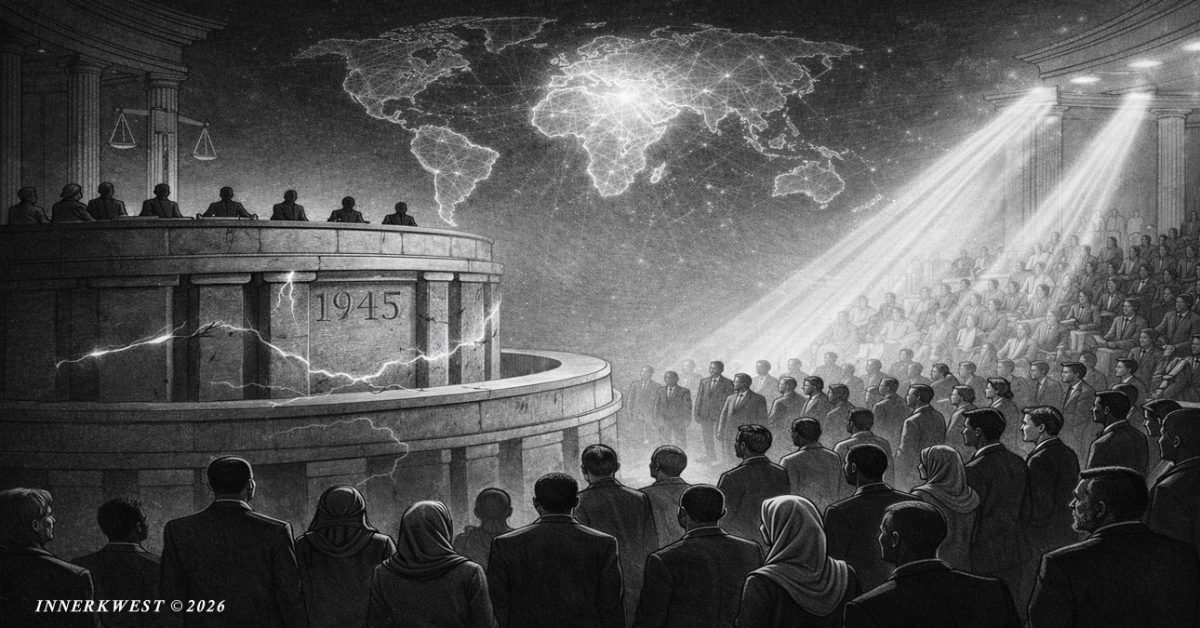
A Governance Structure Frozen in 1945
The modern international order emerged from the geopolitical realities following World War II. The permanent membership structure of the Security Council reflects the victors of that conflict rather than the distribution of power in the 21st century.
Today’s global landscape includes:
- 54 African states within the United Nations
- rising economic influence across Asia and the Global South
- demographic expansion concentrated outside Europe and North America
- resource supply chains anchored in developing regions
Despite these shifts, decision-making authority remains concentrated among five permanent powers.
Institutional inertia now collides with geopolitical reality.
Why Reform Threatens Strategic Influence
Western reluctance toward structural reform is often framed as procedural caution. Beneath the surface lie strategic considerations.
Permanent Security Council status provides:
- veto authority over international action
- influence over sanctions and interventions
- leverage in diplomatic negotiations
- legitimacy for global leadership roles
Expanding permanent membership — particularly with veto parity — dilutes concentrated authority.
For established powers, reform is not merely administrative.
It is re-distributive.
Security Architecture and Strategic Dependence
Western security frameworks remain deeply intertwined with global governance institutions. Military alliances, sanctions regimes, peacekeeping mandates, and conflict mediation all operate through structures shaped by Western leadership.
Reform raises questions about:
- operational control of peacekeeping mandates
- sanctions enforcement consistency
- intervention legitimacy frameworks
- voting coalitions on security matters
These concerns extend beyond symbolism into operational control.
Economic Order and Resource Access
Global governance institutions influence trade rules, development finance, sanctions policy, and resource access frameworks. As Africa’s strategic minerals become essential to the energy transition and advanced manufacturing, representation within governance systems intersects directly with economic security.
Western policymakers face a structural dilemma:
- expanding representation strengthens legitimacy
- preserving influence safeguards economic security
Balancing these priorities has slowed reform momentum.
Procedural Arguments and the Politics of Delay
Western governments frequently cite procedural complexity as the primary barrier to reform. Institutional change requires broad consensus, charter amendments, and alignment among permanent members.
These obstacles are real.
But procedural barriers also function as delay mechanisms.
Reform is acknowledged in principle while postponed in practice.
A Multi-polar World Redefines Leverage
As the global system shifts toward multi-polarity, Western influence increasingly operates through coalition-building rather than unilateral authority.
China expands infrastructure financing.
Russia deepens security partnerships.
Regional blocs across Africa, Asia, and Latin America coordinate economic strategies.
Gulf states secure food and logistics networks.
In this environment, resistance to reform risks accelerating alternative governance frameworks outside Western influence.
Legitimacy vs. Authority
Global governance rests on two pillars:
authority — the power to act
legitimacy — the acceptance of that power
Resistance to reform preserves authority but may erode legitimacy.
Across the Global South, perceptions of exclusion increasingly shape diplomatic alignment, trade partnerships, and multilateral cooperation.
A governance system perceived as structurally inequitable invites circumvention.
Africa’s Position Is Structural, Not Symbolic
Africa’s demand for representation is not a symbolic appeal. It reflects structural realities:
- a quarter of the world’s future population
- critical resource supply chains
- expanding regional markets
- peacekeeping burden-sharing
- growing diplomatic coordination
Reform debates increasingly center not on whether Africa deserves representation, but whether global institutions can maintain legitimacy without it.
The Risk of Parallel Institutions
When established institutions fail to evolve, parallel systems emerge.
Alternative financial frameworks, regional security alliances, and multilateral development institutions have already expanded outside traditional Western-led structures.
Resistance to reform may accelerate this fragmentation.
Global governance could become plural rather than unified.
Reform as Preservation, Not Surrender
Western resistance is often framed as defense of stability. Yet history suggests that institutions endure by adapting to structural change, not resisting it.
Reform does not require abandonment of influence. It requires recalibration aligned with contemporary realities.
The choice facing Western powers is not between dominance and decline.
It is between adaptation and erosion of legitimacy.

The Question That Will Not Disappear
Global governance reform is no longer a theoretical debate. It is an unfolding geopolitical negotiation shaped by demographics, resources, and legitimacy.
Resistance may delay reform.
It cannot prevent structural change.
The international order is entering a phase where representation, equity, and legitimacy will determine its durability.
Power can resist reform.
Power can resist reform — but without legitimacy, it cannot endure.
At InnerKwest.com, we are committed to delivering impactful journalism, deep insights, and fearless social commentary. Your cryptocurrency contributions help us execute with excellence, ensuring we remain independent and continue to amplify voices that matter.
To help sustain our work and editorial independence, we would appreciate your support of any amount of the tokens listed below. Support independent journalism:
BTC: 3NM7AAdxxaJ7jUhZ2nyfgcheWkrquvCzRm
SOL: HxeMhsyDvdv9dqEoBPpFtR46iVfbjrAicBDDjtEvJp7n
ETH: 0x3ab8bdce82439a73ca808a160ef94623275b5c0a
XRP: rLHzPsX6oXkzU2qL12kHCH8G8cnZv1rBJh TAG – 1068637374
SUI – 0xb21b61330caaa90dedc68b866c48abbf5c61b84644c45beea6a424b54f162d0c
and through our Support Page.
InnerKwest maintains a revelatory and redemptive discipline, relentless in advancing parity across every category of the human experience.
© 2026 InnerKwest®. All Rights Reserved | Haki zote zimehifadhiwa | 版权所有. InnerKwest® is a registered trademark of Inputit™ Platforms Inc. Global. No part of this publication may be reproduced, distributed, or transmitted in any form or by any means without prior written permission. Unauthorized use is strictly prohibited. Thank you for standing with us in pursuit of truth and progress!