
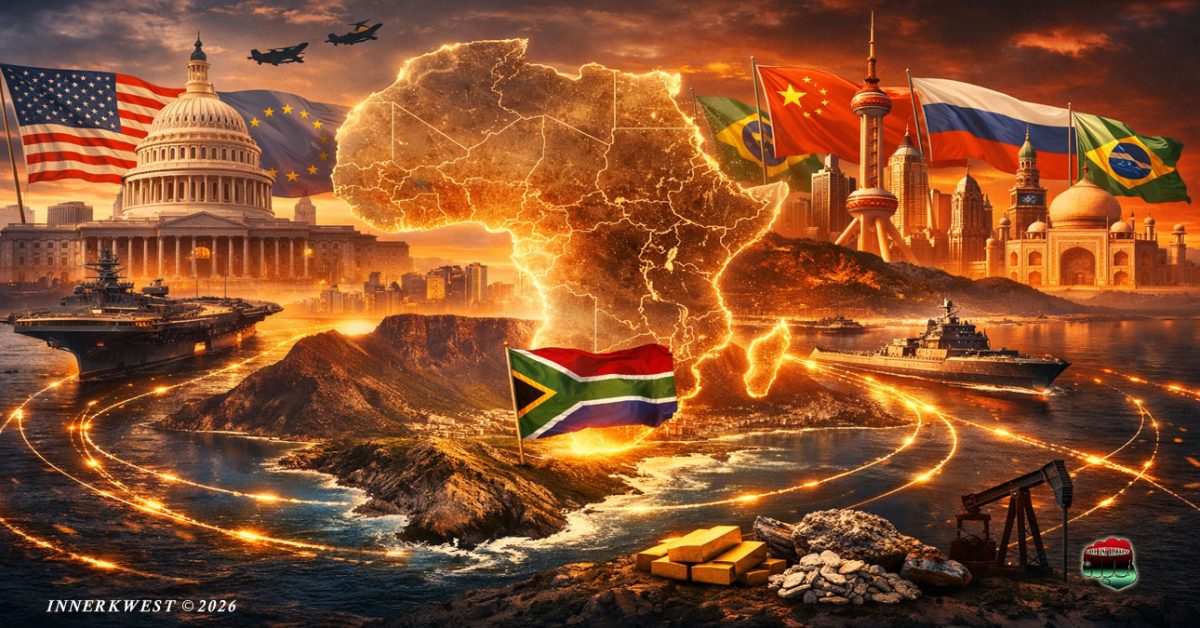
What appeared to be a diplomatic dispute may actually reveal a larger strategic contest over South Africa’s place in a rapidly shifting global order.
By InnerKwest Intelligence Desk | March 14, 2026
When the United States ambassador to South Africa publicly confirmed that Washington had presented Pretoria with five policy requests, the remarks quickly ignited diplomatic tension. South Africa’s government summoned the envoy for clarification, while political observers debated whether the comments represented a breach of diplomatic convention.
But the controversy surrounding the statement may obscure a deeper geopolitical story.
The episode reflects a growing strategic contest over South Africa’s alignment in a rapidly evolving global order—one in which Africa’s most industrialized economy increasingly finds itself positioned between Western alliances and the rising influence of the Global South.
A Diplomatic Signal Disguised as Policy Requests
According to the ambassador’s remarks, the United States had raised five policy concerns with the government of South Africa roughly a year earlier. While framed diplomatically as requests rather than formal demands, the issues collectively reveal Washington’s concern that Pretoria’s strategic trajectory may be drifting away from traditional Western partnerships.
These concerns reportedly addressed foreign policy alignment, economic regulations affecting American companies, domestic political rhetoric, and security issues within South Africa itself.
Viewed individually, each request appears tied to a specific policy matter. Viewed collectively, however, they suggest a broader strategic message about the direction of South Africa’s geopolitical posture.
The Five Requests Behind the Diplomatic Dispute
The concerns raised by Washington reportedly included the following areas:
- Diplomatic engagement with Iran
U.S. officials urged South Africa to reconsider the depth of its diplomatic engagement with Iran, reflecting broader Western efforts to isolate Tehran amid intensifying tensions in the Middle East. - Economic regulations affecting foreign investment
Washington raised concerns about elements of South Africa’s economic policies—particularly aspects of Black Economic Empowerment regulations—that some American companies argue complicate ownership structures and investment decisions. - Land reform and expropriation policy
U.S. officials also expressed unease about proposals allowing land expropriation without compensation, which foreign investors view as introducing uncertainty around property rights. - Security concerns in rural communities
The United States encouraged stronger action addressing violence in rural areas, particularly incidents affecting farming communities. - Political rhetoric viewed as inciting violence
Washington urged South African leaders to condemn rhetoric interpreted as inflammatory, including the controversial “Kill the Boer” chant that has periodically surfaced in political demonstrations.
Why These Requests Matter
Taken individually, each issue touches on a different dimension of South Africa’s political landscape.
Taken together, they point to something more consequential: a growing concern in Washington about the strategic direction of one of Africa’s most influential states.
In other words, the controversy surrounding the five requests may represent less a diplomatic misunderstanding than an early signal in a broader geopolitical negotiation.
The Strategic Geography Behind the Dispute
South Africa’s geopolitical significance extends far beyond its domestic politics.
The country occupies one of the most important positions in the global maritime system. Situated at the southern tip of the African continent, it sits astride the sea routes connecting the Atlantic and Indian Oceans.
The waters around the Cape of Good Hope serve as a critical alternative corridor for global shipping when disruptions occur along northern routes such as the Suez Canal or the Red Sea.
As supply chains become increasingly central to geopolitical competition, control over these maritime corridors carries growing strategic importance.
Minerals and the Future Economy
South Africa’s strategic weight is reinforced by its resource base.
The country is a leading producer of several minerals essential to modern technological and energy systems, including platinum, manganese, and chromium.
These materials play critical roles in industries ranging from renewable energy technologies to advanced electronics.
As global competition intensifies over supply chains tied to electrification and digital infrastructure, access to these resources becomes increasingly strategic.
The BRICS Dimension
South Africa’s membership in BRICS further amplifies its geopolitical relevance.
The group—which includes Brazil, Russia, India, China, and South Africa—has increasingly positioned itself as a platform for economic cooperation among emerging economies.
Recent discussions within the bloc have explored:
- expanded development financing institutions
- alternative payment systems
- deeper trade integration among Global South economies.
While BRICS remains far from replacing global financial institutions such as the World Bank or IMF, its growing influence signals a shift in the architecture of global economic governance.
South Africa’s role within the bloc gives the African continent a direct voice in this evolving framework.
Foreign Policy Independence
South Africa has increasingly emphasized what its leaders describe as strategic autonomy in international affairs.
This posture has been evident in several recent diplomatic actions.
Pretoria has maintained relations with countries often viewed by Washington as geopolitical rivals, including Iran and Russia. It has also taken a prominent role in legal proceedings related to the conflict in Israel and Gaza at the International Court of Justice.
From Pretoria’s perspective, these moves reflect an independent foreign policy rooted in international law and Global South solidarity.
From Washington’s perspective, they raise concerns about shifting alignments in a region of growing strategic importance.
Africa’s Emerging Role
The implications extend beyond South Africa itself.
Pretoria has historically played a leadership role across the African continent, both diplomatically and economically. Its political and economic influence often shapes regional diplomatic trends.
If South Africa continues to deepen its engagement with Global South coalitions such as BRICS, it could influence the foreign policy orientation of other African states.
That possibility helps explain why the country’s strategic direction is drawing increasing attention from major global powers.

The Question Beneath the Requests
Viewed in isolation, the ambassador’s remarks may appear to be little more than a blunt diplomatic statement.
Viewed within the broader geopolitical context, they reveal something more substantial: an early signal in a larger negotiation over South Africa’s place in the evolving architecture of global power.
Each of the five requests touches on a different layer of influence—economic policy, foreign relations, domestic rhetoric, and security dynamics.
Together they raise a larger question.
As the global system becomes increasingly multi-polar, countries with strategic geography, natural resources, and regional influence will face growing pressure to choose—or carefully balance—between competing centers of power.
South Africa now stands at precisely that crossroads.
The controversy surrounding the five requests therefore represents more than a diplomatic dispute.
It is a glimpse into a deeper geopolitical contest over alignment, influence, and the future balance of power in a changing world.
At InnerKwest.com, we are committed to delivering impactful journalism, deep insights, and fearless social commentary. Your cryptocurrency contributions help us execute with excellence, ensuring we remain independent and continue to amplify voices that matter.
To help sustain our work and editorial independence, we would appreciate your support of any amount of the tokens listed below. Support independent journalism:
BTC: 3NM7AAdxxaJ7jUhZ2nyfgcheWkrquvCzRm
SOL: HxeMhsyDvdv9dqEoBPpFtR46iVfbjrAicBDDjtEvJp7n
ETH: 0x3ab8bdce82439a73ca808a160ef94623275b5c0a
XRP: rLHzPsX6oXkzU2qL12kHCH8G8cnZv1rBJh TAG – 1068637374
SUI – 0xb21b61330caaa90dedc68b866c48abbf5c61b84644c45beea6a424b54f162d0c
and through our Support Page.
InnerKwest maintains a revelatory and redemptive discipline, relentless in advancing parity across every category of the human experience.
© 2026 InnerKwest®. All Rights Reserved | Haki zote zimehifadhiwa | 版权所有. InnerKwest® is a registered trademark of Inputit™ Platforms Inc. Global. No part of this publication may be reproduced, distributed, or transmitted in any form or by any means without prior written permission. Unauthorized use is strictly prohibited. Thank you for standing with us in pursuit of truth and progress!