
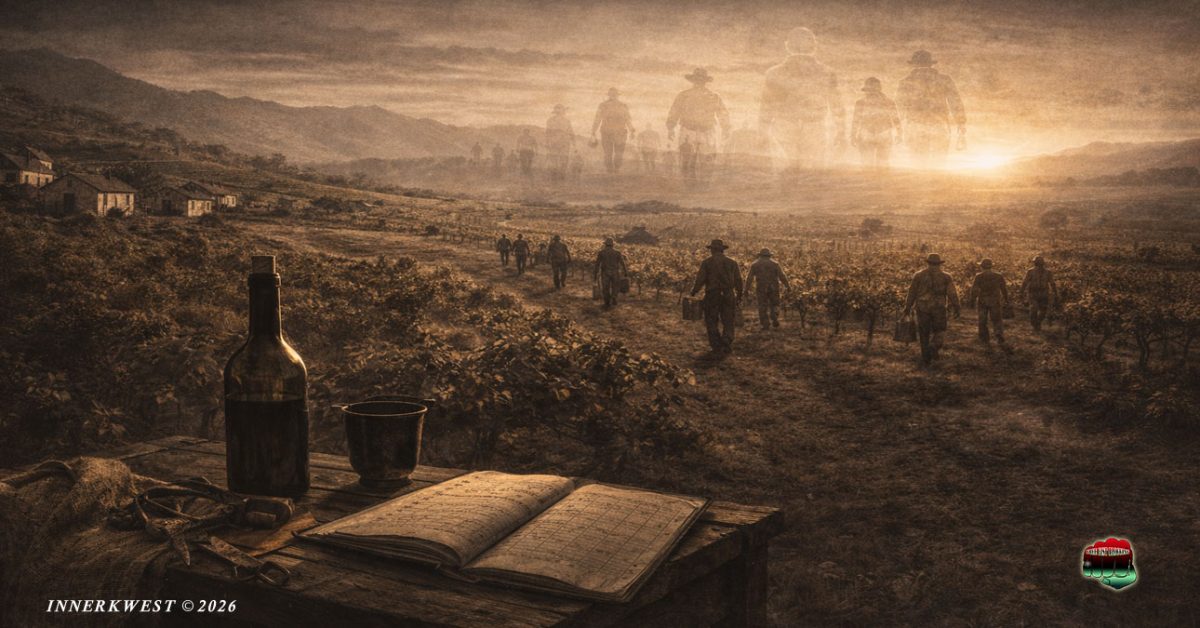
When Labor Control Entered the Human Body
By InnerKwest Intelligence Desk | March 2026
SERIES | Hidden Foundations of Global Power
Part III — Post-Apartheid Markets and Historical Responsibility
Long after formal slavery ended and decades before apartheid officially collapsed, a labor system took root in South Africa’s wine-producing regions that regulated workers not only through wages or law, but through dependency itself. Known as the Dop system, agricultural laborers were partially compensated with alcohol instead of money — embedding addiction into the structure of employment. What emerged was more than exploitation. It was an economic mechanism whose consequences extended across health, family stability, social mobility, and generations. The Dop system reveals how systems of extraction can survive political transition by reshaping human lives at the biological level.
Colonial Foundations: Labor After Slavery
The origins of the Dop system trace back to the Cape Colony under Dutch and later British rule.
Following the abolition of slavery in the 19th century, vineyard owners across the Western Cape confronted a familiar imperial problem: how to maintain agricultural output without freely controlled labor.
Rather than reconstruct wages around autonomy, estate systems evolved toward dependency.
Workers — largely descendants of enslaved Africans, Indigenous Khoisan populations, and mixed communities later classified under apartheid as “Coloured” — were tied to farms through housing, employment, and access to provisions.
Alcohol distribution became a management tool.
Payment blurred into control.
From Custom to System
By the early 20th century, the Dop system had moved beyond informal practice.
Farmworkers commonly received daily or weekly rations of wine as partial compensation for labor performed in vineyards and processing facilities.
The arrangement served multiple economic purposes:
- reduced cash wage obligations
- discouraged labor migration
- reinforced employer authority
- weakened collective organization
Alcohol functioned simultaneously as reward, currency, and restraint.
Dependency stabilized the workforce.
Apartheid and Institutional Reinforcement
Under apartheid (1948–1994), racial labor hierarchies formalized inequality across South African society.
Agricultural workers occupied one of the most legally vulnerable positions within this system.
Many farmworkers:
- lived in employer-owned housing
- lacked independent land rights
- faced mobility restrictions
- possessed minimal labor protections
Within this structure, the Dop system operated as a quiet extension of apartheid governance — rarely codified yet widely tolerated.
Control no longer required overt force.
Economic dependence achieved similar outcomes.
When Economic Systems Become Public Health Crises
The most enduring consequences of the Dop system emerged not only economically but biologically.
Long-term alcohol distribution normalized chronic consumption patterns across farming communities. Researchers and public health institutions later identified profound outcomes:
- widespread alcohol dependency
- elevated domestic violence rates
- reduced educational attainment
- chronic poverty cycles
- some of the world’s highest recorded rates of Fetal Alcohol Spectrum Disorders (FASD)
In parts of the Western Cape, entire generations were born into neurological disadvantage linked to maternal alcohol exposure.
The labor system altered human development itself.
Few economic systems leave such measurable physiological legacies.
Legal Abolition and Structural Survival
South Africa formally prohibited alcohol-based payment practices during late apartheid reforms, with stronger enforcement after democratic transition in 1994.
On paper, the Dop system ended.
In practice, its architecture persisted.
Post-apartheid investigations revealed:
- continued informal alcohol incentives
- entrenched housing dependency
- seasonal wage insecurity
- limited upward mobility for farm laborers
Legal reform dismantled policy.
It did not immediately dismantle outcomes.
Global Markets and Historical Amnesia
Today, South African wine competes successfully in international markets, marketed through narratives of heritage, landscape, and craftsmanship.
Less visible are the labor histories embedded within those landscapes.
Global supply chains often inherit historical inequalities while presenting finished products detached from origin conditions.
The Dop system raises uncomfortable questions about how global consumption intersects with localized historical harm.
Inter-generational Consequence
Unlike many labor systems that disappear with legislation, the Dop system transmitted effects across generations.
Communities shaped by dependency faced compounded barriers:
- health inequality
- educational disadvantage
- economic exclusion
- social fragmentation
The system’s most lasting impact was temporal.
Its consequences extended beyond the workers themselves to their children and grandchildren.
From Madeira to the Cape: Continuity of Extraction
Placed within historical context, the Dop system reflects continuity rather than anomaly.
Atlantic plantation economies pioneered methods of maximizing production through labor control.
Over centuries, mechanisms evolved:
- coercion
- wage suppression
- housing dependency
- chemical dependency
Different eras refined different tools.
The objective remained efficiency within unequal power structures.
Reform, Accountability, and the Present Moment
Modern South African producers increasingly confront this legacy through ethical certification programs, labor reforms, and worker advocacy initiatives.
Progress exists.
Yet reform operates alongside enduring inequality rooted in historical design.
The challenge facing post-apartheid society — and global markets — is not merely ending abusive systems, but addressing the long shadows they cast.

The Question That Remains
The Dop system demonstrates that economic systems can govern human behavior long after laws change and empires fall.
It forces a broader recognition:
Extraction does not always end when policy changes.
Sometimes it persists in bodies, communities, and futures shaped decades earlier.
History often measures systems by productivity.
InnerKwest examines them by consequence.
At InnerKwest.com, we are committed to delivering impactful journalism, deep insights, and fearless social commentary. Your cryptocurrency contributions help us execute with excellence, ensuring we remain independent and continue to amplify voices that matter.
To help sustain our work and editorial independence, we would appreciate your support of any amount of the tokens listed below. Support independent journalism:
BTC: 3NM7AAdxxaJ7jUhZ2nyfgcheWkrquvCzRm
SOL: HxeMhsyDvdv9dqEoBPpFtR46iVfbjrAicBDDjtEvJp7n
ETH: 0x3ab8bdce82439a73ca808a160ef94623275b5c0a
XRP: rLHzPsX6oXkzU2qL12kHCH8G8cnZv1rBJh TAG – 1068637374
SUI – 0xb21b61330caaa90dedc68b866c48abbf5c61b84644c45beea6a424b54f162d0c
and through our Support Page.
InnerKwest maintains a revelatory and redemptive discipline, relentless in advancing parity across every category of the human experience.
© 2026 InnerKwest®. All Rights Reserved | Haki zote zimehifadhiwa | 版权所有. InnerKwest® is a registered trademark of Inputit™ Platforms Inc. Global. No part of this publication may be reproduced, distributed, or transmitted in any form or by any means without prior written permission. Unauthorized use is strictly prohibited. Thank you for standing with us in pursuit of truth and progress!