
Editor’s Note: This article is Part I of InnerKwest’s ongoing examination of participation, power, and extraction in the digital age.
By InnerKwest Editorial Desk | January 12, 2026
Preface: The Trigger Is Not the Thesis
This essay was catalyzed by a recent moment, not defined by it.
In early January 2026, Elon Musk publicly expressed agreement with a post on X that presented white racial solidarity using explicitly exclusionary language. The reaction was immediate and polarized. For some, it confirmed long-held concerns. For others, it was dismissed as provocation, misinterpretation, or noise.
The InnerKwest editorial staff does not publish nor aggregate to litigate individual posts, emojis, or social-media intent.
But moments like this function as signal flares — not because they introduce new ideas, but because they expose underlying structures that have long gone unexamined. The significance lies less in the post itself than in what it reveals about power, ownership, and whose forms of unity are normalized versus scrutinized.
This essay is not about Elon Musk as a person.
It is about the systems that make such moments possible, survivable, and ultimately inconsequential for those who own the infrastructure.
The reaction fades.
The structure remains.
An InnerKwest Manifesto on Platforms, Power, and the Architecture of Modern Dependence
For more than a decade, the global digital economy has been framed as participatory—open, democratic, frictionless. Anyone can post. Anyone can build an audience. Anyone can “go viral.” And yet, beneath this mythology of access lies a quieter truth: the greatest fortunes of the 21st century have been built not by participation, but by ownership of the infrastructure that captures it.
This is not a cultural argument.
It is not an emotional one.
It is a balance-sheet reality.
The modern platform economy has reached a moment of recognition—not because its mechanics have changed, but because their outcomes have become too stark to ignore. Platforms now measure value in trillions. Communities that supply the labor, language, creativity, and attention that fuel those platforms remain largely excluded from appreciation, equity, and control.
When participation builds empires but never equity, the system is not broken.
It is functioning exactly as designed.
The InnerKwest Record: This Was Named Early
In 2022—four years before today’s renewed debates—InnerKwest published two pieces that were not written as commentary, but as warning:
The argument was neither subtle nor abstract. African Americans—and Black communities globally, particularly those aggregated under what became known as #BlackTwitter—were providing disproportionate cultural labor to platforms such as Facebook, Instagram, Twitter (now X), TikTok, and Amazon-adjacent ecosystems. That labor generated engagement, narrative gravity, data exhaust, and algorithmic fuel. It produced immense enterprise value.
What it did not produce was ownership.
Validation was substituted for equity.
Visibility was mistaken for power.
Participation was re-framed as progress.
InnerKwest called this what it was: a digital continuation of an older pattern—extraction without appreciation, labor without land, contribution without control.
Consciousness without ownership reproduces dependency.
The Digital Plantation Model (Defined)
To name a system is to make it discussable. To define it is to make it unavoidable.
The Digital Plantation Model operates in three stages:
Input
Human expression—language, humor, conflict, creativity, protest, intimacy, fear, aspiration.
Processing
Algorithmic amplification, data harvesting, behavioral modeling, advertising optimization, AI training.
Output
Enterprise valuation, infrastructure expansion, financial leverage, geopolitical influence.
The asymmetry is not accidental. Platforms scale on communal labor while wealth concentrates at the ownership layer. Participation is infinite. Equity is gated.
Participation ≠ Partnership
Influence ≠ Ownership
Engagement ≠ Appreciation
This is not metaphor. It is structure.
The Invisible Capital Engine: Every Keystroke Has a Balance Sheet
The so-called “cloud” is not ethereal. It is industrial.
Every keystroke—every post, scroll, image upload, reply, pause, argument, and reaction—feeds hyperscale data centers. These facilities are among the most capital-intensive assets on earth. Modern data-center campuses routinely require $8 billion to $17 billion in total build-out costs.
Those costs are rarely borne privately.
They are offset through:
- State and municipal tax abatements
- Energy subsidies
- Long-term amortized land and power leases
- Public infrastructure concessions
The risk is socialized.
The upside is privatized.
User activity drives data generation.
Data generation drives compute demand.
Compute demand justifies infrastructure expansion.
Infrastructure expansion becomes a balance-sheet asset.
Every keystroke is a capital contribution—just not one the contributor owns.
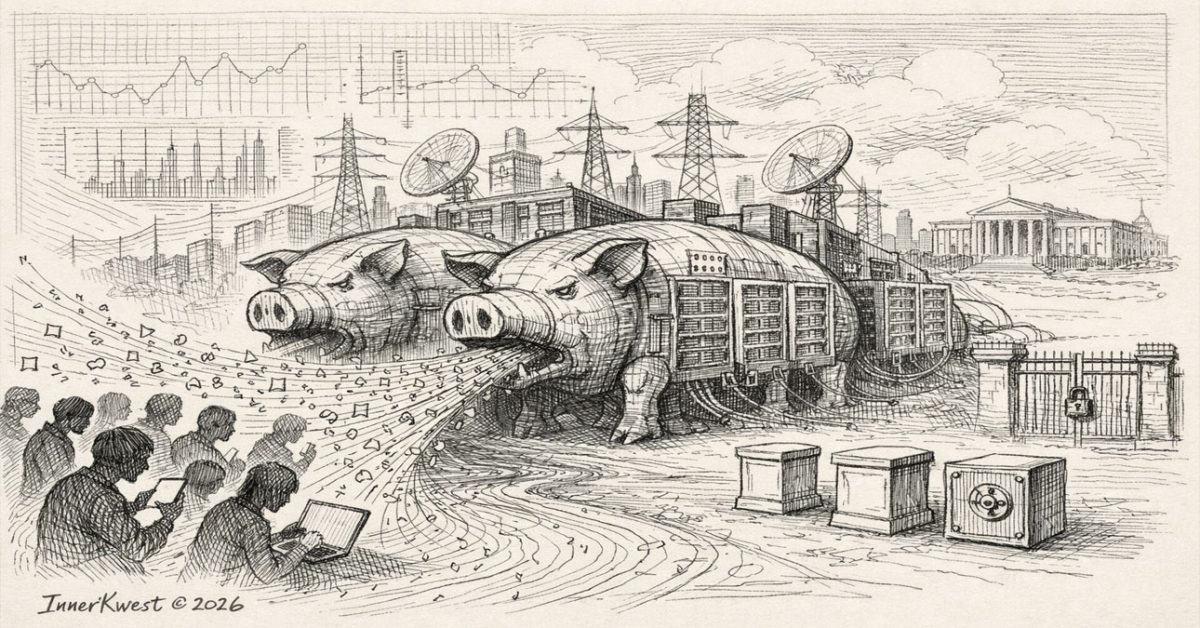
The HOGs (High Ongoing Get) and the Feed
At this scale, metaphor becomes useful—not for rhetoric, but for systems clarity.
Hyperscale data centers function as HOGs.
They are engineered to consume continuously.
They do not create their own nourishment.
They require FEED.
That feed is human expression.
Language. Culture. Conflict. Curiosity. Desire. Fear. Humor. Identity.
The platforms do not simply host speech.
They metabolize it.
Idle compute is value destruction. Underutilized infrastructure is failure. The HOGs cannot fast. The feed must never stop.
This is why platforms are structurally incentivized to maximize engagement—not understanding; to amplify emotion—not resolution; to reward dependency—not autonomy.
If your labor builds infrastructure you do not own, you are not participating in an economy.
You are fueling one.
Attempted Exit: Building Alternatives Under Constraint
This author did not stop at diagnosis.
During the same period these critiques were articulated, development efforts were launched for Wittyou, Khaunda, and Kyknotes—platforms designed to mirror dominant incumbents functionally while centering ownership, governance, and value retention differently.
These initiatives were built under severe capital constraint. The software worked. The demand existed. The community logic was sound.
They stalled for reasons familiar to under-capitalized challengers:
- No runway
- No tolerance for iteration
- No institutional patience
- No protection from early instability
The failure was not technical.
Code was never the barrier.
Permission was.
Control Case: Why Truth Social Survived
Contrast clarifies structure.
Truth Social launched during the same era using largely off-the-shelf software. It is operated by Trump Media & Technology Group, a publicly traded entity that emerged via a SPAC merger. While Donald Trump remains the largest shareholder and central figure, the platform is not privately owned in a narrow sense.
That nuance matters. But it does not change the lesson.
Truth Social benefited from capital insulation, narrative oxygen, political alignment, and time—the two resources most alternative platforms are never granted. It was allowed to fail forward. Others were not allowed to fail at all.
The market does not reward merit in isolation.
It rewards proximity to power.
Physical Enclaves, Digital Dependence
This asymmetry is not confined to the digital West.
In post-apartheid South Africa, two de facto Afrikaner enclaves—Orania and Kleinfontein—persist within a predominantly Black society. Their sustainability has long been linked to external financial support networks, diaspora capital, and private funding flows originating outside their immediate geography.
The existence of such enclaves is often framed as cultural preservation. Their financing structures are rarely interrogated. Solidarity, when exercised quietly through capital and infrastructure, is normalized.
By contrast, collective self-organization by marginalized communities—particularly in digital and economic domains—is frequently politicized, scrutinized, or de-legitimized.
The asymmetry is instructive.
Self-preservation is only controversial when it threatens extraction.
The Politics of Verifiability (Why Truth Feels Unprovable)
In the age of algorithmic mediation, absence of proof is often mistaken for absence of structure.
Modern power rarely leaves clean evidentiary trails. It operates through private capital flows, legal insulation, cultural framing, and informational dilution. Facts are not merely hidden; they are fragmented—distributed across jurisdictions, buried beneath counterclaims, re-framed as “disputed.”
Systems dependent on citation hierarchies—media institutions, regulatory bodies, and large language models—default to neutrality in the presence of ambiguity. Lived realities become “unverifiable.”
This is not conspiracy.
It is capital sophistication.
When power becomes uncitable, it becomes unchallengeable.
The Manifesto: From Participation to Ownership
This is neither a call to disengage nor a statement of grievance—it is a proposal for cohesive and structural realignment.
It is re-architecture.
We reject platforms where appreciation is structurally inaccessible.
We reject participation without equity.
We reject dependence disguised as inclusion.
Black-owned platforms are not separatist. They are corrective. Digital sovereignty is economic literacy applied at scale. Ownership is the only durable form of inclusion.
Cultural capital must produce capital participation.
Platforms without ownership pathways are extractive by design.
Alternatives fail not from inferiority—but from starvation.
The Doctrine (Standing)
The following principles govern this position:
- Cultural labor that builds infrastructure without ownership is extraction.
- Platform economies reward proximity to power, not neutrality of vision.
- Infrastructure—not engagement—is where wealth ultimately accrues.
- The future belongs to builders who control systems, not just influence narratives.
The question is no longer whether we participate.
The question is who appreciates.
InnerKwest does not publish to be agreed with.
It publishes to be referenced.
This piece is not a reaction.
It is a record.
Part II will examine how algorithmic systems and data infrastructures transform participation into governance.
Support InnerKwest: Powering Truth & Excellence with Bitcoin
At InnerKwest.com, we are committed to delivering impactful journalism, deep insights, and fearless social commentary. Your Bitcoin contributions help us execute with excellence, ensuring we remain independent and continue to amplify voices that matter.
Support our mission—send BTC today!
🔗 Bitcoin Address: 3NM7AAdxxaJ7jUhZ2nyfgcheWkrquvCzRm© 2026 InnerKwest®. All Rights Reserved | Haki zote zimehifadhiwa | 版权所有.
InnerKwest® is a registered trademark of Inputit™ Platforms Inc. Global
No part of this publication may be reproduced, distributed, or transmitted in any form or by any means without prior written permission. Unauthorized use is strictly prohibited.
Thank you for standing with us in pursuit of truth and progress!