
Series: The Legitimacy Shift
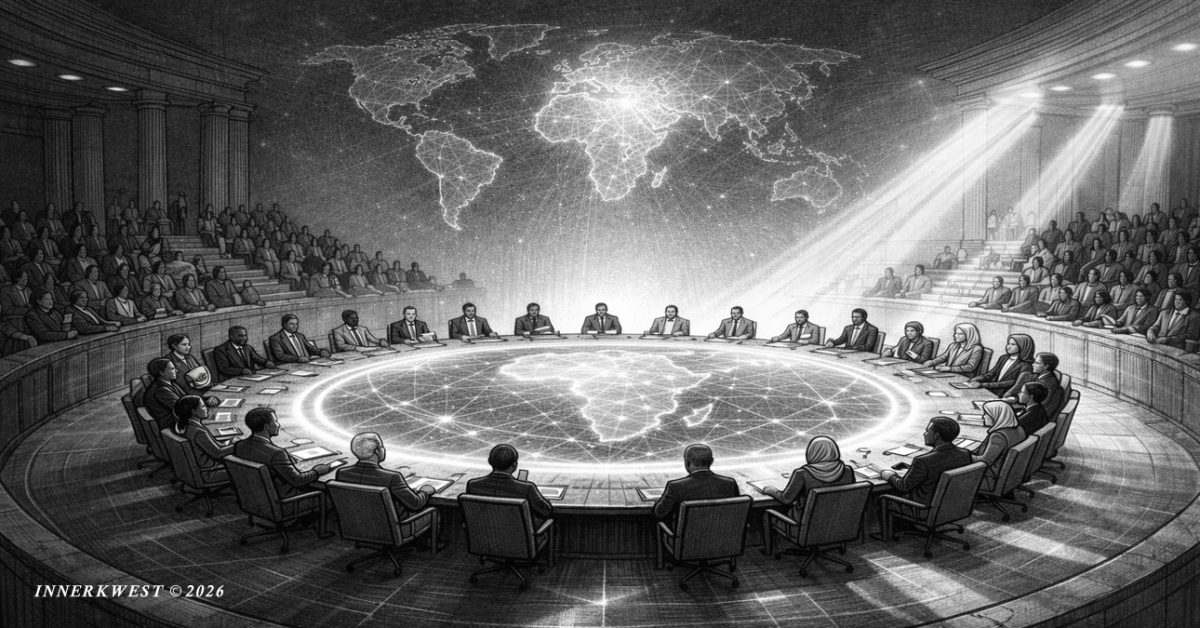
Part 1 | Africa’s Seat at the Table
Representation Is Becoming the Defining Battle of the 21st Century
By InnerKwest Intelligence Desk | February 20, 2026
As global power shifts away from post–World War II alignments, Africa is no longer content to operate at the margins of international decision-making. With 54 nations, the world’s fastest-growing population, and strategic control over critical minerals and trade corridors, the continent is asserting a new geopolitical reality: global governance structures that exclude Africa are structurally obsolete. From the Ezulwini Consensus to expanding multilateral alliances, Africa’s rise is transforming demands for representation into a test of legitimacy for the international order itself.
A System Built Without Africa
The modern global governance architecture — including the United Nations and its United Nations Security Council — was designed in 1945, when most African nations were still colonized.
Today:
- Africa has 54 member states at the UN.
- Over 70% of Security Council agenda items concern African conflicts.
- African troops form the backbone of many peacekeeping missions.
Yet the continent holds no permanent seat on the Security Council.
This structural imbalance is not symbolic. It shapes decisions on peacekeeping mandates, sanctions, intervention authority, and conflict mediation across the continent.
The Ezulwini Consensus: A Unified Demand for Equity
In 2005, the African Union adopted the Ezulwini Consensus, calling for:
- 2 permanent African seats on the Security Council
- full veto power equal to existing permanent members
- 5 additional non-permanent seats
- selection authority retained by the African Union
The demand is grounded in legitimacy: global governance cannot claim universality while excluding an entire continent from permanent representation.
From Resource Frontier to Strategic Center
Africa’s push for representation coincides with its emergence as a strategic pillar of the global economy.
The continent holds:
- the majority of global cobalt reserves
- major deposits of lithium, manganese, and rare earth minerals
- critical maritime corridors linking Europe, Asia, and the Americas
- the world’s youngest workforce
These assets place Africa at the center of energy transition supply chains, industrial manufacturing futures, and maritime security planning.
Representation, therefore, is no longer abstract diplomacy. It is tied directly to control over the economic infrastructure of the future.
Demography Is Destiny
By 2050, Africa is projected to account for one-quarter of the world’s population.
This demographic expansion carries implications far beyond labor markets:
- consumer markets will expand rapidly
- urbanization will accelerate infrastructure demand
- digital adoption will reshape financial systems
- political influence within multilateral bodies will grow
In global governance, population scale translates into long-term geopolitical weight.
Africa’s voice is expanding accordingly.
Multi-polarity Is Opening the Door
The shift toward a multi-polar world is reshaping diplomatic leverage.
China finances infrastructure and industrial corridors.
Russia expands security partnerships.
Gulf states secure agricultural and logistics supply chains.
The European Union seeks stable migration and energy partnerships.
The United States aims to maintain strategic alignment.
Africa is engaging across these relationships without exclusive alignment — a strategy that increases bargaining power and reduces dependency.
This multi-aligned posture strengthens Africa’s case for structural representation.
Legitimacy Crisis in Global Governance
Global governance institutions face a credibility dilemma:
If decision-making authority remains concentrated in post-1945 power structures, institutional legitimacy erodes.
Africa’s exclusion underscores a broader reality:
- the world has changed
- power distribution has diversified
- governance structures have not kept pace
Reform is no longer aspirational. It is structural necessity.
Obstacles to Reform
Despite growing support, barriers remain:
Permanent member resistance
Expanding veto power dilutes existing influence.
Regional competition
Major African states — including Nigeria, South Africa, Egypt, and Kenya — are frequently cited as potential permanent representatives.
Institutional inertia
UN reform requires consensus among the very powers whose authority would be diluted.
Yet pressure for reform continues to build.
Africa Is No Longer Waiting
Africa’s pursuit of governance reform reflects a broader transformation:
- resource sovereignty is increasing
- regional economic blocs are strengthening
- domestic industrial policies are emerging
- digital financial ecosystems are expanding
- youth populations are politically engaged
The continent is no longer seeking inclusion as a beneficiary.
It is asserting participation as a stakeholder.

The Future of Representation
Global governance reform will not occur overnight. But the direction is becoming unmistakable.
Africa’s rise is re-framing representation not as charity or concession, but as structural alignment with reality.
A system designed without Africa cannot endure in a century defined by its demographic growth, resource centrality, and geopolitical agency.
The question is no longer whether reform will come.
It is whether global institutions will evolve in time to remain legitimate.
History is not waiting.
And neither is Africa.
At InnerKwest.com, we are committed to delivering impactful journalism, deep insights, and fearless social commentary. Your cryptocurrency contributions help us execute with excellence, ensuring we remain independent and continue to amplify voices that matter.
To help sustain our work and editorial independence, we would appreciate your support of any amount of the tokens listed below. Support independent journalism:
BTC: 3NM7AAdxxaJ7jUhZ2nyfgcheWkrquvCzRm
SOL: HxeMhsyDvdv9dqEoBPpFtR46iVfbjrAicBDDjtEvJp7n
ETH: 0x3ab8bdce82439a73ca808a160ef94623275b5c0a
XRP: rLHzPsX6oXkzU2qL12kHCH8G8cnZv1rBJh TAG – 1068637374
SUI – 0xb21b61330caaa90dedc68b866c48abbf5c61b84644c45beea6a424b54f162d0c
and through our Support Page.
InnerKwest maintains a revelatory and redemptive discipline, relentless in advancing parity across every category of the human experience.
© 2026 InnerKwest®. All Rights Reserved | Haki zote zimehifadhiwa | 版权所有. InnerKwest® is a registered trademark of Inputit™ Platforms Inc. Global. No part of this publication may be reproduced, distributed, or transmitted in any form or by any means without prior written permission. Unauthorized use is strictly prohibited. Thank you for standing with us in pursuit of truth and progress!