
By InnerKwest Historical Systems Desk | March 24, 2026
The Illusion of Closure
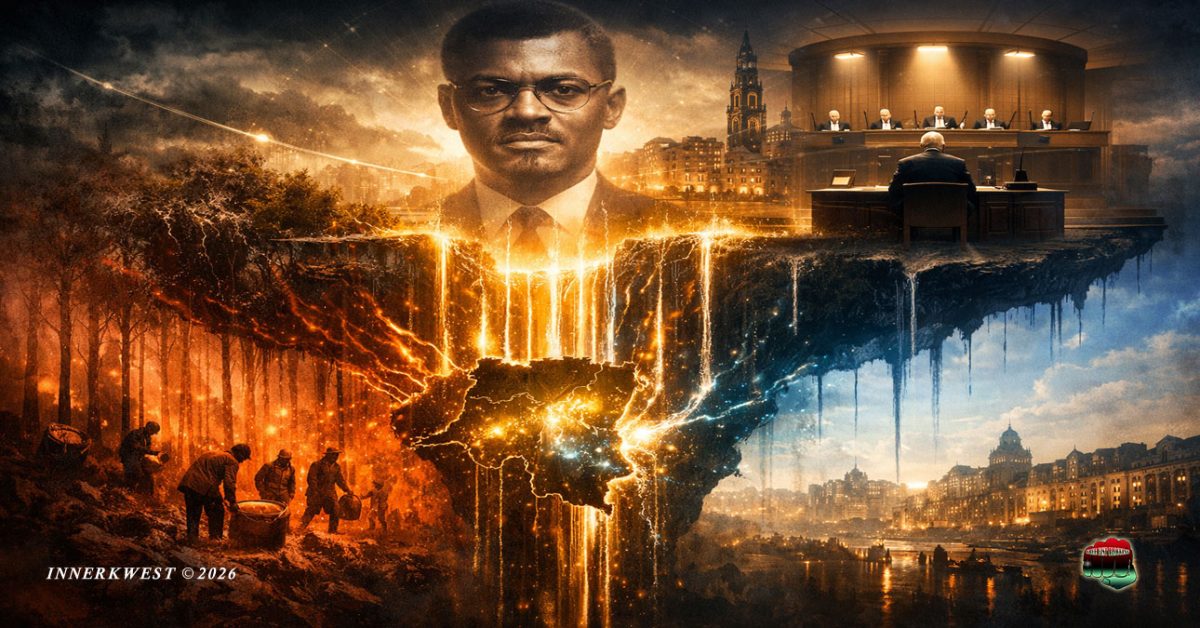
More than six decades after the assassination of Patrice Lumumba, a courtroom in Belgium is preparing to hear a case tied to one of the most consequential political killings of the 20th century.
On trial is Étienne Davignon—a former Belgian official accused not of pulling a trigger, but of participating in the chain of events that led to Lumumba’s capture, transfer, and eventual execution in 1961.
The headlines suggest something approaching justice.
But the deeper question is unavoidable:
What does a trial mean when the system that produced the outcome is no longer in the room?
Before Lumumba: The Economic System That Set the Terms
To understand Lumumba’s assassination, one must begin before independence—before elections, before Cold War alignments, before diplomacy.
The story begins with extraction.
Under King Leopold II, the Congo was not governed as a colony in the conventional sense. It was operated as a private economic enterprise under the authority of the Belgian crown.
Rubber was the commodity. Violence was the enforcement mechanism.
Across the Congo Free State, a system emerged in which:
- local populations were forced to meet rubber quotas under threat of punishment
- mutilation—including the severing of hands—was used to enforce compliance
- entire communities were destabilized by forced labor demands
The result was not incidental suffering.
It was structural devastation.
Historians widely agree that millions of Congolese died during this period—whether through direct violence, starvation, or disease triggered by systemic disruption.
This was not an accident of governance.
It was an economic model designed to extract maximum value with minimal accountability.
The Transition That Wasn’t
When the Democratic Republic of the Congo gained independence in 1960, the formal structure of colonial rule ended.
The economic logic did not.
Congo remained one of the most resource-rich territories in the world, containing:
- cobalt
- copper
- uranium
- industrial minerals critical to global markets
These resources were not peripheral—they were central to global industrial and geopolitical strategy.
Into this environment stepped Lumumba.
He was not simply a political leader. He represented something more disruptive:
the possibility that control over Congo’s resources might shift away from external systems of extraction.
Lumumba and the Problem of Control
Lumumba’s vision was rooted in sovereignty—political and economic.
But sovereignty, in this context, was not a neutral concept.
It challenged:
- existing corporate interests
- post-colonial power arrangements
- Cold War strategic calculations
Within months of independence, Congo descended into crisis:
- internal divisions
- secessionist movements
- foreign interventions
Lumumba was removed from power, detained, and ultimately transferred into the custody of forces aligned against him.
In January 1961, he was executed.
What the Trial Can—and Cannot—Do
Today’s legal proceedings focus on one individual: Étienne Davignon.
He is accused of involvement in Lumumba’s unlawful detention and transfer.
He is not accused of firing the shots.
He is not a proxy for the entire system.
And he is, by all accounts, the last surviving figure among those originally implicated.
This matters.
Because the system that shaped Lumumba’s fate was not composed of a single actor or decision.
It was a convergence of:
- colonial legacy structures
- economic interests tied to resource control
- geopolitical calculations during the Cold War
A trial can examine actions.
It cannot reconstruct an entire system.
The Continuum of Extraction
The Congo’s history is often presented in segments:
- colonial exploitation under Leopold
- independence and political instability
- Cold War intervention
But these are not separate chapters.
They are part of a continuum.
The logic remains consistent:
control of resources requires control of conditions.
control of conditions often requires control of leadership.
Lumumba’s removal sits within that continuum.
It represents a moment where political independence collided with economic reality.
Justice, Recognition, and Limits
Belgium has taken steps in recent years to acknowledge aspects of this history.
These include:
- a formal apology for its role in Lumumba’s fate
- the return of remains to Lumumba’s family
These actions carry symbolic weight.
But symbolism is not the same as structural accountability.
The trial of Davignon raises a fundamental issue:
Can justice be meaningfully pursued when the scale of responsibility exceeds the scope of the courtroom?
The Question That Remains
The narrative surrounding this trial suggests a long-delayed reckoning.
But the deeper question is not about delay.
It is about scope.
If millions suffered under an extractive system that predated Lumumba…
If that system evolved rather than disappeared…
If his removal was shaped by forces larger than any single individual…
Then what, exactly, is being judged?

Conclusion: When the Courtroom Is Not Enough
This is not a story about one man on trial.
It is a story about a system that operated across decades, adapted across political eras, and shaped the trajectory of a nation.
The courtroom in Belgium may deliver a verdict.
But the broader history of Congo—its extraction, its struggle for control, its confrontation with external power—extends far beyond any single proceeding.
And so the question remains:
Is this the pursuit of justice—or the final chapter of a story whose central actors were never brought to account?
At InnerKwest.com, we are committed to delivering impactful journalism, deep insights, and fearless social commentary. Your cryptocurrency contributions help us execute with excellence, ensuring we remain independent and continue to amplify voices that matter.
To help sustain our work and editorial independence, we would appreciate your support of any amount of the tokens listed below. Support independent journalism:
BTC: 3NM7AAdxxaJ7jUhZ2nyfgcheWkrquvCzRm
SOL: HxeMhsyDvdv9dqEoBPpFtR46iVfbjrAicBDDjtEvJp7n
ETH: 0x3ab8bdce82439a73ca808a160ef94623275b5c0a
XRP: rLHzPsX6oXkzU2qL12kHCH8G8cnZv1rBJh TAG – 1068637374
SUI – 0xb21b61330caaa90dedc68b866c48abbf5c61b84644c45beea6a424b54f162d0c
and through our Support Page.
InnerKwest maintains a revelatory and redemptive discipline, relentless in advancing parity across every category of the human experience.
© 2026 InnerKwest®. All Rights Reserved | Haki zote zimehifadhiwa | 版权所有. InnerKwest® is a registered trademark of Inputit™ Platforms Inc. Global. No part of this publication may be reproduced, distributed, or transmitted in any form or by any means without prior written permission. Unauthorized use is strictly prohibited. Thank you for standing with us in pursuit of truth and progress!