
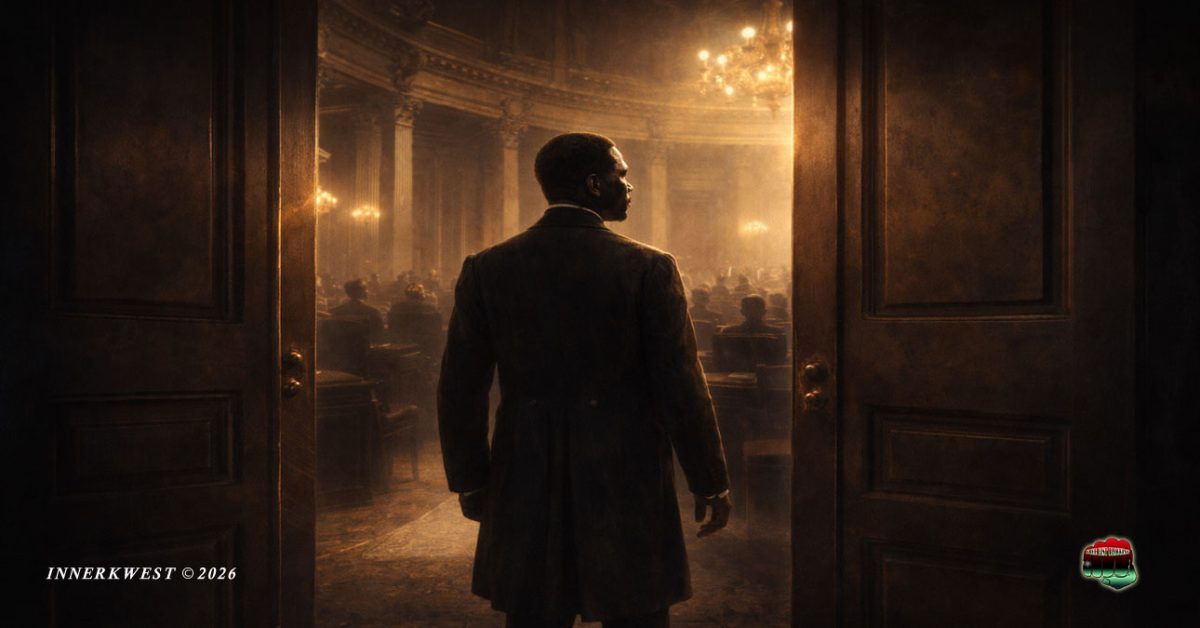
He rose to the highest office in a Southern state.
And still, it was not enough to secure what was already his.
By Intelligence Desk | April 7, 2026
Origin: Born Into a System That Had No Place for Him
P. B. S. Pinchback was born in 1837—not enslaved, but not free in the full sense either.
His mother had been enslaved.
His father had been her owner.
That contradiction defined his beginning.
Though his father acknowledged and raised him, even attempted to secure his future, the system around them remained unchanged. When his father died, the protection disappeared. The law did not follow blood—it followed structure.
So his mother made a decision.
She left.
She took her children north to Ohio, not for opportunity, but for certainty. Freedom, in that moment, was not philosophical. It was geographic.
Formation: Movement, Survival, and Self-Construction
There was no linear path waiting for him.
He worked young.
Supported family early.
Moved along the rivers that defined American commerce at the time—Mississippi, Missouri, Red.
Not as an observer.
As labor.
As function within a system that had not yet decided what he was allowed to become.
Then the war came.
And with it, a narrow opening.
Pinchback did not wait for permission. He entered Union-controlled New Orleans and helped organize Black military units—eventually becoming one of the few Black officers commissioned during the Civil War.
That matters.
Because authority, once exercised, is difficult to erase—even if the system tries.
Rise: Entering Power During Reconstruction
After the war, the structure shifted—but only partially.
Reconstruction opened doors, but not without resistance. It allowed entry, but not security.
Pinchback moved into politics.
Not cautiously.
Directly.
- Delegate to Louisiana’s constitutional convention
- Advocate for public education
- Contributor to laws guaranteeing civil rights in transportation and commerce
He wasn’t navigating the system.
He was helping write it.
Governor: Power, Briefly Held
In 1872, the system fractured internally.
Governor Henry Clay Warmoth was impeached.
The structure required continuity.
Pinchback stepped in.
For 35 days, he was governor of Louisiana—the first Black man to hold that office in the United States.
Not symbolic.
Operational.
Legislation moved.
Decisions were made.
Government continued.
But the duration tells the story.
Thirty-five days.
Long enough to prove capacity.
Not long enough to establish permanence.
Senator: The Office He Won—but Never Held
This is where the system reveals itself most clearly.
Pinchback was elected to the U.S. Senate.
Twice.
And yet—he was never seated.
Not because of lack of qualification.
Not because of absence of votes.
But because the structure—political, racial, institutional—refused to finalize what had already been decided.
Contested elections.
Procedural delays.
Political resistance.
All functioning as instruments.
Power had been granted.
But recognition was withheld.
Injustice: A Pattern, Not an Incident
This was not an isolated denial.
It was systemic.
Black political participation during Reconstruction existed within a narrow corridor:
- allowed when federally enforced
- challenged when locally resisted
- reversed when protection weakened
Pinchback operated at the highest level of that corridor.
And still, it narrowed around him.
Even his election victories could not overcome the broader structure aligned against them.
He was not removed from power.
Power was never fully allowed to settle around him.
Contribution: Building What Would Outlast Him
Yet he did not disappear.
He shifted.
- Served on Louisiana’s State Board of Education
- Helped establish what would become Southern University
- Continued shaping policy, education, and civil infrastructure
When direct power was blocked, he moved into institutional creation.
That work lasts longer.
System-Level Reading
Pinchback’s life is not simply a biography.
It is a case study.
A man born inside contradiction.
Rising within a system in transition.
Reaching the highest levels of authority.
And still encountering structural resistance at the point of permanence.
He governed.
But briefly.
He was elected.
But not seated.
He contributed.
But within limits set by others.

Final Reflection
What happened to Pinchback was not confusion.
It was design.
Reconstruction created the appearance of access.
But access is not the same as control.
And control is not the same as continuity.
He proved capability.
The system proved its boundaries.
And in that space—between what was achieved and what was denied—his story remains.
Not as anomaly.
But as pattern.
At InnerKwest.com, we are committed to delivering impactful journalism, deep insights, and fearless social commentary. Your cryptocurrency contributions help us execute with excellence, ensuring we remain independent and continue to amplify voices that matter.
To help sustain our work and editorial independence, we would appreciate your support of any amount of the tokens listed below. Support independent journalism:
BTC: 3NM7AAdxxaJ7jUhZ2nyfgcheWkrquvCzRm
SOL: HxeMhsyDvdv9dqEoBPpFtR46iVfbjrAicBDDjtEvJp7n
ETH: 0x3ab8bdce82439a73ca808a160ef94623275b5c0a
XRP: rLHzPsX6oXkzU2qL12kHCH8G8cnZv1rBJh TAG – 1068637374
SUI – 0xb21b61330caaa90dedc68b866c48abbf5c61b84644c45beea6a424b54f162d0c
and through our Support Page.
InnerKwest maintains a revelatory and redemptive discipline, relentless in advancing parity across every category of the human experience.
© 2026 InnerKwest®. All Rights Reserved | Haki zote zimehifadhiwa | 版权所有. InnerKwest® is a registered trademark of Inputit™ Platforms Inc. Global. No part of this publication may be reproduced, distributed, or transmitted in any form or by any means without prior written permission. Unauthorized use is strictly prohibited. Thank you for standing with us in pursuit of truth and progress!