
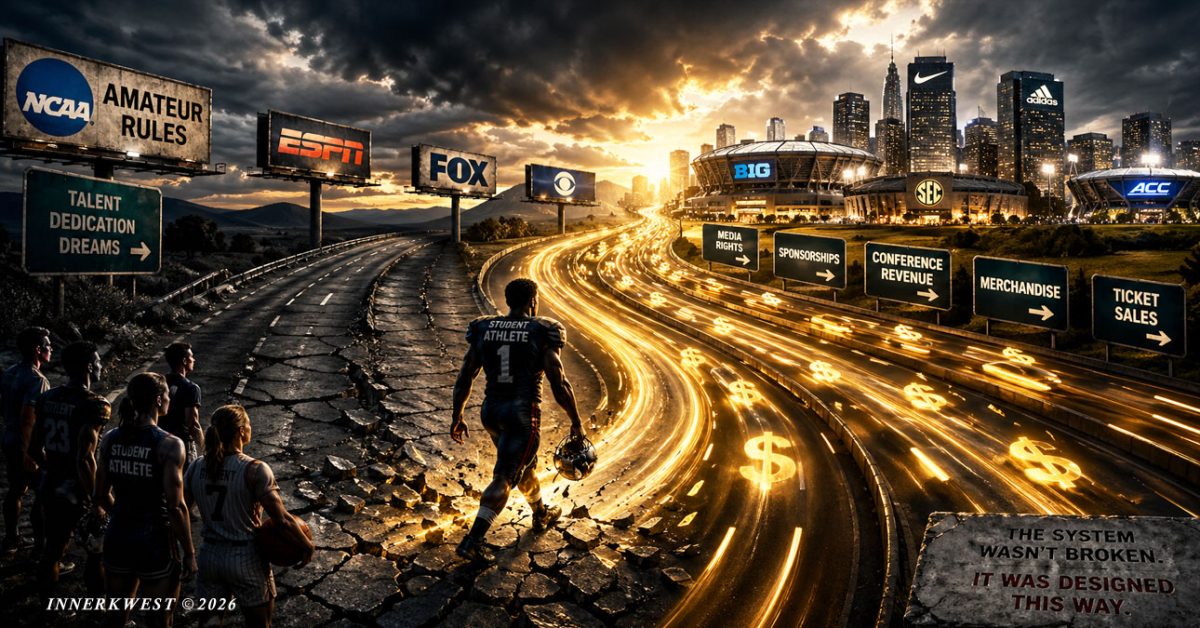
College athletes have generated billions in revenue for decades—but until recently, they weren’t allowed to share in the profits. With the rise of NIL (Name, Image, and Likeness) deals, that system is breaking down, exposing what many critics call a one-way money highway controlled by the NCAA.
By Intelligence Desk | InnerKwest
April 30, 2026
For decades, college sports operated on a simple economic contradiction:
The labor generated the revenue—but wasn’t allowed to share in it.
Now that system is cracking.
The case of Trinidad Chambliss—spotlighted in Vanity Fair—isn’t just about one quarterback fighting for another year of eligibility. It’s about the unraveling of a model that enriched institutions, elevated coaches into multimillionaires, and kept the primary value creators on a controlled allowance.
And for the first time, the players are winning ground.
A System Built on Asymmetry
College football is not amateur in any meaningful economic sense.
- Coaches routinely earn $5–10 million annually
- Conferences sign multi-billion-dollar media deals
- Universities expand stadiums, facilities, and branding empires
Meanwhile, for most of modern NCAA history, players were restricted to:
- Scholarships
- Limited stipends
- Strict rules against monetizing their own identity
The governing body, the National Collegiate Athletic Association, defended this model under the banner of “amateurism.”
But amateurism, in practice, became a one-way financial highway.
Related Article: Why High-School and College Athletes Deserve a Real Share of the Game
Chambliss and the New Economics of Power
Chambliss represents a new reality shaped by NIL (Name, Image, Likeness):
- Athletes can now legally monetize their brand
- Top players can earn millions while still in college
- In some cases, college earnings exceed early professional contracts
When the NCAA attempted to deny Chambliss an additional year of eligibility, it wasn’t framed as a financial decision.
It was procedural.
Eligibility rules. Medical waivers. Technicalities.
But the economic impact was unmistakable:
👉 Deny eligibility
👉 End his college career
👉 Cut off millions in potential earnings
That’s where the system’s logic begins to fracture.
The Coaching Contradiction
Here’s where the hypocrisy becomes impossible to ignore.
While athletes were historically barred from earning:
- Coaches signed massive contracts
- Athletic directors built personal brands
- Entire ecosystems formed around player performance
No one questioned whether a coach making $8 million violated the “spirit of amateurism.”
But a player earning from their own name?
That was once considered a threat to the system.
The contradiction isn’t subtle—it’s structural.
From Control to Containment
What the NCAA is attempting now isn’t a return to the old model—it’s containment.
- Maintain eligibility limits
- Preserve competitive balance
- Prevent indefinite college careers
These are defensible positions on paper.
But in practice, they collide with a new economic truth:
Players are no longer dependent on the system—they are participants in it.
And participants expect compensation.
The Larger Shift: Labor Recognizes Itself
What’s unfolding in college sports mirrors broader labor movements:
- Workers questioning value extraction
- Talent asserting ownership over output
- Institutions losing unilateral control
The difference here?
College athletes are doing it in real time, under national visibility, with billions at stake.
What Comes Next
Chambliss is not the endpoint. He’s a signal.
The next phase will likely include:
- Expanded legal challenges to NCAA authority
- Pressure for revenue-sharing models
- Potential federal intervention to standardize NIL and eligibility rules
And perhaps most significantly:
A redefinition of what “college athlete” actually means.

End Zone
The old model asked players to generate wealth they could not touch.
That era is ending.
Not because the system chose to evolve—but because the players forced it to.
The one-way money highway is no longer sustainable.
And for the institutions that profited from it, the bill is finally coming due.
At InnerKwest.com, we are committed to delivering impactful journalism, deep insights, and fearless social commentary. Your cryptocurrency contributions help us execute with excellence, ensuring we remain independent and continue to amplify voices that matter.
To help sustain our work and editorial independence, we would appreciate your support of any amount of the tokens listed below. Support independent journalism:
BTC: 3NM7AAdxxaJ7jUhZ2nyfgcheWkrquvCzRm
SOL: HxeMhsyDvdv9dqEoBPpFtR46iVfbjrAicBDDjtEvJp7n
ETH: 0x3ab8bdce82439a73ca808a160ef94623275b5c0a
XRP: rLHzPsX6oXkzU2qL12kHCH8G8cnZv1rBJh TAG – 1068637374
SUI – 0xb21b61330caaa90dedc68b866c48abbf5c61b84644c45beea6a424b54f162d0c
and through our Support Page.
InnerKwest maintains a revelatory and redemptive discipline, relentless in advancing parity across every category of the human experience.
© 2026 InnerKwest®. All Rights Reserved | Haki zote zimehifadhiwa | 版权所有. InnerKwest® is a registered trademark of Inputit™ Platforms Inc. Global. No part of this publication may be reproduced, distributed, or transmitted in any form or by any means without prior written permission. Unauthorized use is strictly prohibited. Thank you for standing with us in pursuit of truth and progress!