
May 22, 2026
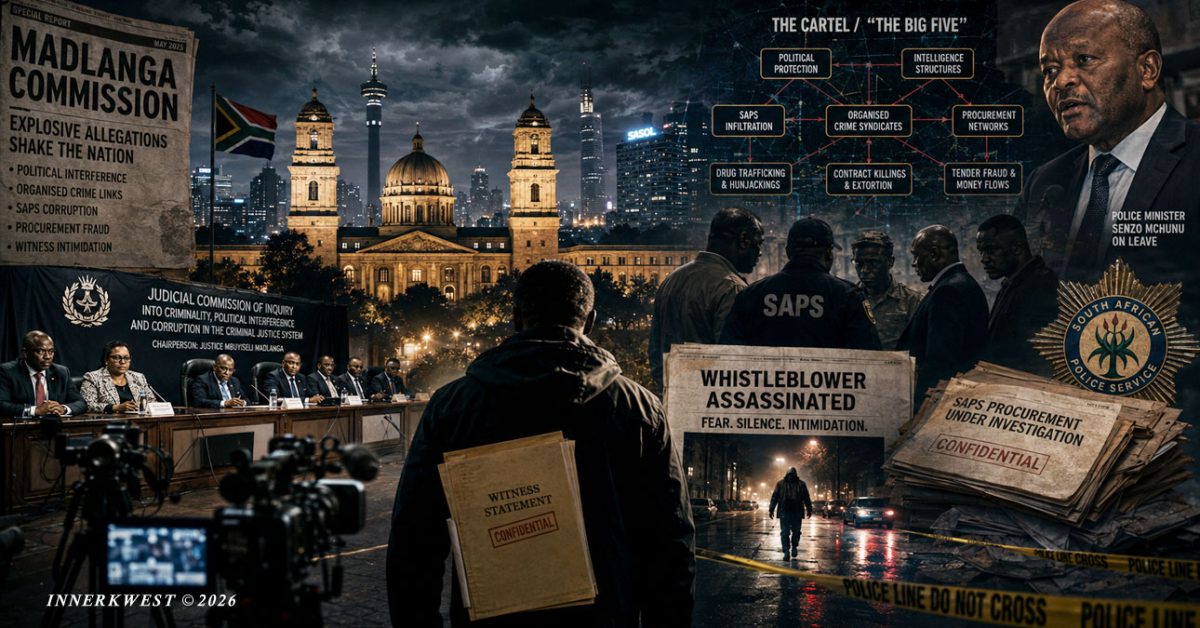
The Madlanga Commission is no longer exposing isolated corruption allegations. It is forcing South Africans to confront a far more destabilizing possibility: that organized criminal networks, political power, and elements of state security may have become deeply intertwined inside portions of the post-apartheid system.
Editor’s Note: This is a developing investigation. InnerKwest will continue updating this analysis as testimony, institutional responses, and additional revelations emerge from the Madlanga Commission proceedings.
By Sean Cohen
for InnerKwest Intelligence Desk
For years, South Africans have lived with the language of corruption.
The phrase became woven into the country’s political atmosphere during the era of “state capture,” a period dominated by allegations of political patronage, procurement manipulation, elite enrichment, and institutional compromise that culminated in the sprawling Zondo Commission investigations.
But what is now emerging from the Madlanga Commission feels psychologically different.
More dangerous.
More destabilizing.
The concern no longer centers solely on whether corrupt individuals manipulated portions of the state for financial gain.
The deeper fear now surfacing is whether parts of the state itself may have become operationally entangled with organized criminal ecosystems.
That distinction matters enormously.
Because corruption weakens institutions.
But the perception of criminal-state convergence threatens institutional legitimacy itself.
And legitimacy is the invisible foundation upon which democratic systems ultimately depend.
From State Capture to Criminal-State Convergence
Formally known as the Judicial Commission of Inquiry into Criminality, Political Interference, and Corruption in the Criminal Justice System, the commission is chaired by retired Constitutional Court Justice Mbuyiseli Madlanga.
The inquiry was launched after explosive allegations made in 2025 by KwaZulu-Natal Police Commissioner Lt. Gen. Nhlanhla Mkhwanazi, who accused political figures and institutional actors of interfering in organized-crime investigations, obstructing police operations, and undermining sensitive investigative structures tied to political killings and criminal syndicates.
The allegations were serious enough that President Cyril Ramaphosa responded by establishing the commission and placing Police Minister Senzo Mchunu on leave pending investigation.
But as testimony expanded, the inquiry rapidly evolved beyond ordinary political scandal.
What initially appeared to be another corruption probe increasingly began resembling something far more structurally alarming:
an investigation into whether organized criminal influence had penetrated portions of South Africa’s policing, intelligence, procurement, and political architecture simultaneously.
The “Big Five” Allegations
One of the most psychologically explosive dimensions of the inquiry involves testimony surrounding a network allegedly referred to as:
“The Big Five”
or
“The Cartel.”
According to testimony presented before the commission, the alleged network may have touched:
- drug trafficking,
- hijacking operations,
- procurement fraud,
- contract killings,
- intelligence manipulation,
- and political influence structures.
Whether all allegations are ultimately substantiated remains uncertain.
But public perception shifted dramatically the moment cartel language entered the national conversation.
Because once populations begin hearing testimony suggesting:
- organized syndicates may influence policing,
- intelligence systems may be compromised,
- and criminal networks may intersect with state structures,
the issue stops feeling like ordinary corruption.
It begins resembling a legitimacy crisis.
That transition is psychologically profound.
Modern democracies can survive scandal.
They struggle far more when citizens begin questioning whether formal institutions and informal criminal power structures remain clearly distinguishable from one another.
The Procurement State
As with previous South African corruption investigations, procurement systems again appear central to the emerging allegations.
Testimony tied to businessman Vusimuzi “Cat” Matlala and associated procurement relationships has intensified scrutiny surrounding:
- police-linked tenders,
- politically connected intermediaries,
- financial flows,
- and outsourcing ecosystems operating around state contracts.
This pattern matters because modern corruption increasingly operates less through direct theft and more through networked procurement architecture.
The state outsources.
Intermediaries emerge.
Political proximity develops.
Public funds circulate through layers of contractors, consultants, security structures, and affiliated entities difficult for ordinary populations to fully trace.
South Africa is hardly unique in this regard.
Across much of the world, procurement ecosystems increasingly function as one of the primary battlegrounds where politics, business, influence, and organized criminal interests intersect.
But in South Africa’s case, the allegations carry unusually high stakes because they emerge inside institutions directly tied to policing and national security legitimacy.
Fear Inside the Witness Ecosystem
The atmosphere surrounding the commission has become even more disturbing because of allegations involving intimidation, threats, and violence connected to testimony ecosystems.
Reports surrounding witness fears and the killing of commission-linked whistleblower figures have intensified public anxiety that portions of the networks under scrutiny may still retain operational capability.
That possibility changes everything psychologically.
Corruption investigations expose institutional weakness.
But investigations occurring under the shadow of intimidation suggest something more dangerous:
the persistence of power outside formal democratic oversight.
Historically, societies become unstable not merely when criminality exists, but when populations begin believing criminal networks possess sufficient reach to intimidate institutions meant to investigate them.
That perception alone can deeply erode civic confidence.
The SAPS Legitimacy Crisis
The Madlanga Commission is unfolding during a period where public trust in the South African Police Service was already under severe strain.
Years of:
- corruption allegations,
- misconduct investigations,
- violent crime,
- procurement scandals,
- and institutional failures
have weakened public confidence across large portions of society.
Now the commission is amplifying fears that the problem may not simply involve isolated bad actors.
The emerging concern is structural.
If senior police figures face arrest, suspension, investigation, or allegations of compromise, ordinary citizens inevitably begin asking a far more destabilizing question:
How deep does this go?
That question matters economically as well as politically.
Because security legitimacy underpins:
- investor confidence,
- economic stability,
- institutional trust,
- and long-term democratic resilience.
Nations do not merely compete through GDP figures or military strength.
They compete through perceived institutional reliability.
And once populations begin doubting whether security institutions themselves remain trustworthy, the effects ripple outward rapidly.
South Africa as a Continental Bellwether
The international implications of the Madlanga Commission extend far beyond Pretoria.
South Africa remains:
- Africa’s most industrialized economy,
- a BRICS member,
- a continental financial gateway,
- and one of the region’s most strategically important institutional states.
That reality makes the commission globally significant.
Because if the allegations ultimately reveal meaningful convergence between:
- organized criminal ecosystems,
- procurement networks,
- intelligence structures,
- political patronage,
- and law enforcement institutions,
then the implications extend into broader questions surrounding:
- democratic durability,
- post-colonial institutional resilience,
- state sovereignty,
- and modern governance itself.
The inquiry therefore represents more than a national scandal.
It has become a stress test.
Not only for South Africa’s institutions —
but for public faith in the post-apartheid democratic framework itself.

The State Within the State
One of the most unsettling aspects of the Madlanga Commission is that it increasingly forces South Africans to confront a possibility many societies instinctively resist acknowledging:
that parallel systems of influence can emerge inside formal democratic structures without immediately becoming visible to the public.
Not necessarily through dramatic coups or open authoritarianism.
But gradually:
through procurement,
through patronage,
through protection networks,
through institutional compromise,
and through the normalization of blurred boundaries between legality and criminality.
Modern states rarely collapse overnight.
More often, institutional legitimacy erodes incrementally until populations no longer fully trust:
- police,
- courts,
- intelligence systems,
- or political leadership
to operate independently from hidden influence structures.
That is the psychological danger now surrounding the commission.
Because modern democracies do not become unstable only when corruption exists.
They become unstable when populations begin suspecting that criminality and governance are no longer clearly separable from one another.
At InnerKwest.com, we are committed to delivering impactful journalism, deep insights, and fearless social commentary. Your cryptocurrency contributions help us execute with excellence, ensuring we remain independent and continue to amplify voices that matter.
To help sustain our work and editorial independence, we would appreciate your support of any amount of the tokens listed below. Support independent journalism:
BTC: 3NM7AAdxxaJ7jUhZ2nyfgcheWkrquvCzRm
SOL: HxeMhsyDvdv9dqEoBPpFtR46iVfbjrAicBDDjtEvJp7n
ETH: 0x3ab8bdce82439a73ca808a160ef94623275b5c0a
XRP: rLHzPsX6oXkzU2qL12kHCH8G8cnZv1rBJh TAG – 1068637374
SUI – 0xb21b61330caaa90dedc68b866c48abbf5c61b84644c45beea6a424b54f162d0c
and through our Support Page.
InnerKwest maintains a revelatory and redemptive discipline, relentless in advancing parity across every category of the human experience.
© 2026 InnerKwest®. All Rights Reserved | Haki zote zimehifadhiwa | 版权所有. InnerKwest® is a registered trademark of Inputit™ Platforms Inc. Global. No part of this publication may be reproduced, distributed, or transmitted in any form or by any means without prior written permission. Unauthorized use is strictly prohibited. Thank you for standing with us in pursuit of truth and progress!