
July 11, 2026
Has the Architecture of Political Influence Changed Since Gilens and Page?
By Solomon Reed
Senior Investigative Correspondent | InnerKwest
The Architecture of Influence Has Changed
Power rarely disappears.
It adapts.
Every generation believes it understands who influences public policy until history quietly introduces new participants.
For decades, Americans viewed political influence through familiar institutions.
Lobbyists walked the halls of Congress.
Corporate executives testified before committees.
Trade associations drafted position papers.
Political action committees financed campaigns.
Interest groups advocated for legislation.
The machinery of influence appeared relatively straightforward, even when the outcomes remained controversial.
More than a decade ago, political scientists Benjamin Page and Martin Gilens attempted to measure that machinery. Their landmark study, Testing Theories of American Politics: Elites, Interest Groups, and Average Citizens, concluded that organized economic interests and economic elites appeared to exercise substantially greater influence over public policy than average citizens.
The paper became one of the defining political science studies of the modern era.
It also captured America at a particular moment in time.
That America no longer exists.
The institutions remain.
The architecture surrounding them does not.
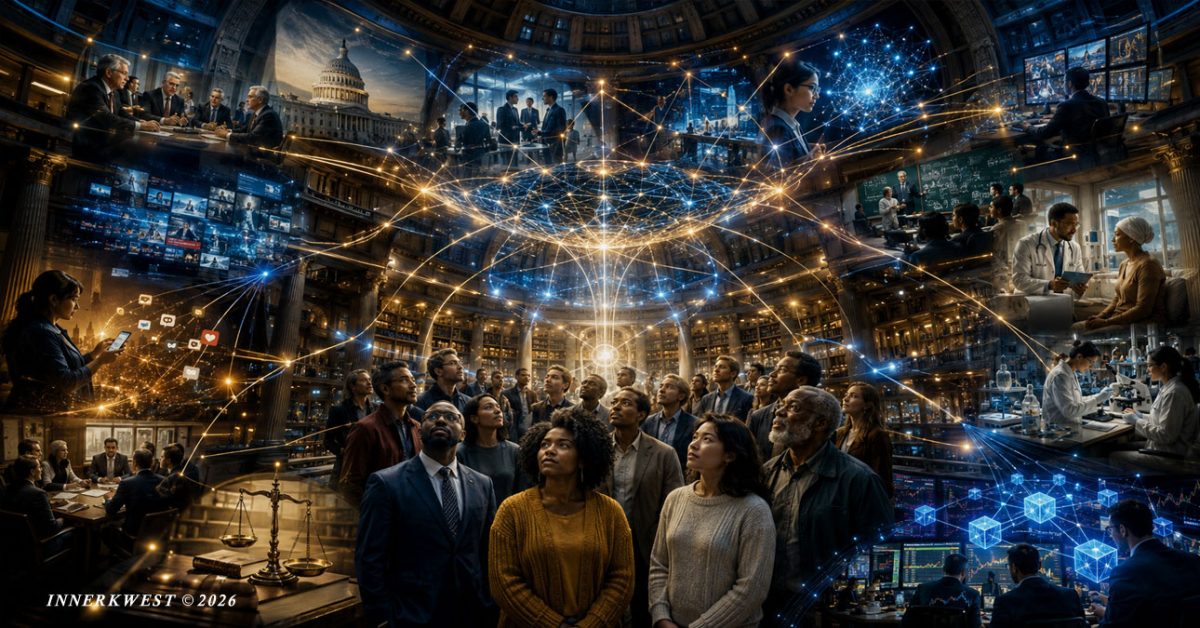
Today, influence moves through channels that scarcely existed when the study was published.
Artificial intelligence summarizes legislation before millions of citizens ever read the legislation themselves.
Recommendation algorithms determine which issues dominate public conversation and which quietly disappear beneath an endless stream of digital information.
Social media platforms amplify some voices while others struggle to be heard.
Large language models increasingly become research assistants, interpreters, and gateways to knowledge.
The original architecture has not disappeared.
It has expanded.
The question is no longer simply who influences government.
The more relevant question may be who now influences influence itself.
Influence No Longer Travels Alone
One of the most significant changes over the past decade is that institutions rarely operate in isolation.
They operate in ecosystems.
That distinction matters.
Banks no longer compete only with banks.
Technology companies increasingly shape financial policy.
Artificial intelligence companies now influence education, employment, healthcare, research, and public discourse simultaneously.
Media organizations no longer possess exclusive control over public attention.
The competition for influence has become multidimensional.
The debate surrounding the CLARITY Act illustrates the point.
At first glance, the legislation appeared to concern cryptocurrency regulation.
As debate intensified, the coalition surrounding the bill expanded.
Banking organizations entered the discussion.
Technology companies responded.
Law enforcement expressed concerns.
Advocacy organizations became involved.
Faith-based organizations publicly weighed in.
Suddenly, legislation governing digital financial infrastructure had become a conversation involving institutions whose missions traditionally existed far outside blockchain technology.
That evolution should not be dismissed.
It should be studied.
Because it reveals something larger than the legislation itself.
It demonstrates how influence increasingly operates through interconnected institutional networks rather than individual organizations acting alone.
The Price of Influence
Political influence often feels abstract until it arrives in someone’s hospital room.
Consider Keytruda, one of the world’s leading immunotherapy treatments for cancer.
For countless patients and their families, the discussion is not academic.
It is deeply personal.
A physician recommends what may be one of the most effective treatment options available.
Hope suddenly has a name.
Then another question follows.
Can the patient actually obtain it?
That answer rarely depends upon a single institution.
It emerges from an entire ecosystem.
Researchers develop the science.
Manufacturers invest years and billions of dollars bringing therapies to market.
The Food and Drug Administration evaluates safety and effectiveness.
Patent law determines periods of market exclusivity.
Congress establishes statutory frameworks governing healthcare programs.
The Centers for Medicare & Medicaid Services influence reimbursement.
Private insurers establish coverage policies.
Pharmacy benefit managers negotiate formularies.
Hospitals determine procurement practices.
Patient advocacy organizations lobby for expanded access.
Institutional investors evaluate future earnings.
Each institution performs a legitimate function.
Yet together they influence one profoundly human question.
Can a patient receive the treatment their physician believes offers the best chance?
That is institutional influence in twenty-first century America.
Rarely does one organization determine the outcome.
The outcome emerges from the interaction of many.
From Economic Elites to Digital Gatekeepers
Gilens and Page examined economic elites, organized interest groups, and average citizens.
If that same framework were constructed today, additional participants would almost certainly demand consideration.
Artificial intelligence.
Recommendation algorithms.
Digital platforms.
Search engines.
Social media ecosystems.
Large language models.
Online creators.
Prediction markets.
Blockchain governance.
These entities do not vote.
Most do not contribute campaign donations.
Yet they increasingly shape what citizens know before they ever form political opinions.
Attention itself has become a form of influence.
Who controls visibility?
Who determines discoverability?
Who prioritizes information?
Who summarizes complexity?
Who frames public understanding?
Those questions scarcely existed when Gilens and Page conducted their research.
Today they are impossible to ignore.
A New Generation of Influence
Perhaps the greatest transformation is not technological.
It is structural.
Influence once appeared easier to identify because institutions largely remained within their traditional domains.
Banks focused on banking.
Technology companies built software.
Universities conducted research.
Religious organizations emphasized moral questions.
Media organizations reported the news.
Those boundaries have become increasingly porous.
Technology companies now influence finance.
Financial institutions influence technology policy.
Religious organizations enter debates involving blockchain regulation.
Artificial intelligence increasingly shapes research itself.
The architecture has become interconnected.
That may prove to be the defining political transformation of the twenty-first century.
Not the disappearance of influence.
The convergence of influence.
The New Architecture of Power
Perhaps the most significant lesson emerging from the past decade is that influence has become increasingly difficult to isolate.
Power once appeared easier to recognize because institutions generally operated within clearly defined boundaries. Banks focused on finance. Pharmaceutical companies developed medicines. Technology companies built software. Universities conducted research. Religious organizations largely confined themselves to questions of faith and morality.
Those boundaries have become increasingly fluid.
Today, financial institutions shape technology policy. Technology companies influence financial markets. Artificial intelligence increasingly mediates access to information. Advocacy organizations engage debates involving digital infrastructure. Faith-based organizations participate in discussions surrounding financial legislation. Healthcare policy is shaped not only by medical research, but by lawmakers, regulators, insurers, manufacturers, investors, and patient advocates operating within the same ecosystem.
No single institution controls the outcome.
Yet each contributes to it.
That evolution represents more than a technological shift.
It represents a structural shift.
Influence is no longer exercised primarily through individual institutions acting independently. It increasingly emerges through interconnected networks of institutions whose interests occasionally converge, occasionally compete, and often reinforce one another in ways that are not immediately visible to the public.
Perhaps that is why modern policy debates often appear more complex than those of previous generations.
The conversation no longer belongs exclusively to legislators and lobbyists.
It now includes algorithms that determine visibility, artificial intelligence that summarizes information, digital platforms that shape public attention, advocacy organizations that broaden policy debates, and financial markets that respond instantly to legislative signals.
The architecture itself has expanded.
Benjamin Page and Martin Gilens asked one of the defining political questions of the early twenty-first century.
A decade later, America may be confronting another.
Not whether influence exists.
But whether the public still recognizes all the institutions—and increasingly, all the systems—that now participate in producing it.
Power did not disappear.
It evolved.
And understanding that evolution may become one of the defining civic responsibilities of the digital age.

Conclusion
Every generation believes it understands where power resides.
Sometimes it resides in legislatures.
Sometimes it resides in boardrooms.
Sometimes it resides in financial institutions, advocacy organizations, universities, or the media.
The reality is often more complex.
Power rarely belongs to a single institution for very long.
It adapts.
Benjamin Page and Martin Gilens offered one of the most important examinations of political influence in modern America. Their research challenged conventional assumptions about who shapes public policy and forced both scholars and citizens to reconsider the relationship between government, economic interests, and the public.
More than a decade later, their work remains remarkably relevant.
Yet the environment surrounding it has evolved.
Lobbyists still walk the halls of Congress.
Corporations still advocate for their interests.
Organized groups continue to influence legislation.
Those realities have not disappeared.
What has changed is the architecture surrounding them.
Algorithms now shape attention.
Artificial intelligence increasingly organizes information.
Digital platforms influence public discourse.
Institutional ecosystems have become more interconnected than at any point in modern history.
The pathways through which influence travels have multiplied.
Understanding those pathways may become one of the defining civic responsibilities of the digital age.
Because citizens cannot meaningfully participate in a system they no longer understand.
Nor can democratic institutions remain healthy if the public recognizes only yesterday’s sources of influence while overlooking today’s.
The challenge before America is not simply identifying who possesses influence.
It is understanding how influence itself continues to evolve.
That conversation extends well beyond politics.
It reaches healthcare.
Finance.
Technology.
Education.
Artificial intelligence.
And every institution whose decisions increasingly shape daily life.
Power has never been static.
Neither has democracy.
Perhaps the defining question of the next generation is not whether influence exists.
History has already answered that.
The more enduring question is whether society will continue recognizing new architectures of influence as quickly as they emerge.
Because while institutions may change…
Influence never stops evolving.
At InnerKwest.com, we are committed to delivering impactful journalism, deep insights, and fearless social commentary. Your cryptocurrency contributions help us execute with excellence, ensuring we remain independent and continue to amplify voices that matter.
To help sustain our work and editorial independence, we would appreciate your support of any amount of the tokens listed below. Support independent journalism:
BTC: 3NM7AAdxxaJ7jUhZ2nyfgcheWkrquvCzRm
SOL: HxeMhsyDvdv9dqEoBPpFtR46iVfbjrAicBDDjtEvJp7n
ETH: 0x3ab8bdce82439a73ca808a160ef94623275b5c0a
XRP: rLHzPsX6oXkzU2qL12kHCH8G8cnZv1rBJh TAG – 1068637374
SUI – 0xb21b61330caaa90dedc68b866c48abbf5c61b84644c45beea6a424b54f162d0c
and through our Support Page.
InnerKwest maintains a revelatory and redemptive discipline, relentless in advancing parity across every category of the human experience.
© 2026 InnerKwest®. All Rights Reserved | Haki zote zimehifadhiwa | 版权所有. InnerKwest® is a registered trademark of Inputit™ Platforms Inc. Global. No part of this publication may be reproduced, distributed, or transmitted in any form or by any means without prior written permission. Unauthorized use is strictly prohibited. Thank you for standing with us in pursuit of truth and progress!