
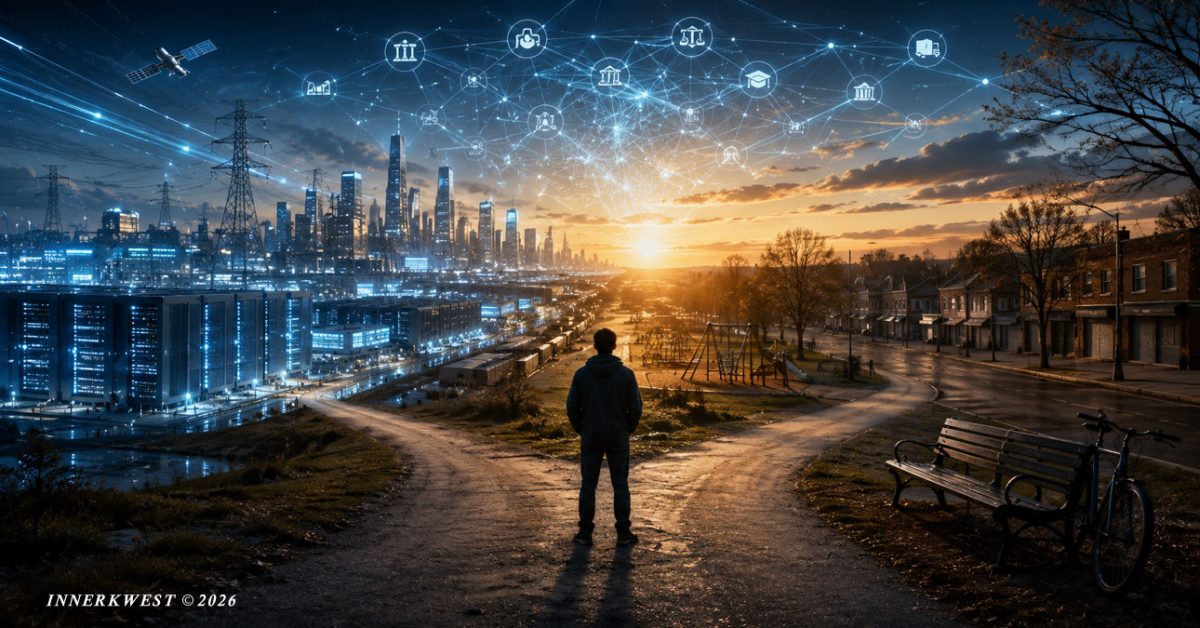
As governments race to build artificial intelligence infrastructure, a deeper question emerges: What happens when technological success outpaces society’s ability to adapt?
By the InnerKwest Editorial Desk
Artificial intelligence has moved well beyond the realm of emerging technology. Increasingly, governments are treating it as a form of national infrastructure—no different in strategic importance than the electric grid, interstate highways, telecommunications networks, or defense systems. The race to dominate AI is no longer confined to software development. It now encompasses semiconductor manufacturing, hyperscale data centers, electrical generation, cloud infrastructure, and the immense computational resources required to train the next generation of intelligent systems.
Viewed through that lens, today’s AI competition resembles previous industrial races that reshaped global power. Nations are investing not simply to develop better software, but to secure economic resilience, technological leadership, and national security advantages that could define the balance of power for decades.
Nowhere is that competition more evident than between the United States and China. Both governments increasingly regard artificial intelligence as a strategic priority, arguing that leadership in AI will influence everything from military readiness and scientific discovery to economic growth and geopolitical influence.
On its face, the argument appears difficult to dispute. Build the infrastructure. Expand computing capacity. Accelerate research. Stay ahead of your competitors.
But beneath the urgency of the global AI race lies a question that receives remarkably little attention.
What happens if society succeeds technologically faster than it adapts socially?
History has repeatedly shown that technological revolutions reshape economies. Artificial intelligence may become the first to fundamentally challenge humanity’s relationship with work, purpose, and participation at the same time.
The New Infrastructure Race
Artificial intelligence no longer resides primarily in university laboratories or Silicon Valley campuses. It is rapidly becoming a physical enterprise requiring an unprecedented buildout of infrastructure. The public often interacts with AI through a chatbot or digital assistant, but behind every response lies a vast industrial network of hyperscale data centers, semiconductor fabrication plants, fiber-optic networks, cloud platforms, and power systems capable of supporting enormous computational demands.
That reality is reshaping public policy. Governments are no longer debating AI solely through the lens of innovation; they are confronting practical questions about energy generation, permitting, water resources, domestic manufacturing, and the resilience of supply chains needed to support a technology expected to underpin future economic growth.
The scale of investment reflects that shift. Companies are committing hundreds of billions of dollars to expand computing capacity, while governments increasingly view AI infrastructure as a strategic national asset rather than a private-sector initiative alone. Just as the twentieth century depended on highways, railroads, electrical grids, and telecommunications networks, the twenty-first century may well be defined by the infrastructure that powers artificial intelligence.
Every AI query, every generated image, every large-language model, and every autonomous system ultimately depends on a physical ecosystem that consumes extraordinary amounts of electricity, capital, engineering expertise, and advanced manufacturing. The intelligence may appear intangible, but the foundation supporting it is anything but.
Artificial intelligence is no longer simply software. It is becoming part of the critical infrastructure upon which future economies may depend.
The Productivity Revolution
Every major technological breakthrough has fundamentally changed how people work. The steam engine transformed transportation and manufacturing, electricity extended the productive day and accelerated industrialization, and the computer revolution reshaped how information is created, stored, and shared. Each innovation dramatically increased productivity, but each also depended on human beings to direct, operate, or interpret the technology.
Artificial intelligence represents a different kind of transformation.
Rather than primarily extending human physical capabilities, AI increasingly augments—or in some cases performs—tasks traditionally associated with human cognition. It can analyze vast datasets in seconds, generate software code, summarize complex legal documents, assist in medical diagnosis, produce financial models, and create written or visual content that, until recently, required years of education or professional experience.
The implications extend far beyond factory automation. Occupations once considered insulated from technological disruption—including researchers, software engineers, accountants, attorneys, educators, journalists, designers, and other knowledge-based professionals—are now confronting tools capable of performing portions of their work with remarkable speed.
This does not necessarily mean these professions disappear. History suggests that technology often changes jobs rather than simply eliminating them. But artificial intelligence introduces a variable unlike previous industrial revolutions: it reaches into the realm of intellectual labor itself.
That distinction shifts the conversation. The central question is no longer whether AI can assist with increasingly sophisticated cognitive tasks. Evidence suggests that it already can in many domains.
The more important question is whether our economic institutions, educational systems, and social structures can adapt quickly enough to a world in which the nature of human work is being fundamentally redefined.
The Great AI Paradox
Many developed nations face similar demographic challenges.
Declining birth rates.
Aging populations.
Rising healthcare costs.
Growing rates of obesity and chronic illness.
Persistent labor shortages across selected industries.
Governments openly acknowledge these trends as long-term economic concerns.
At precisely the same time, those governments are investing heavily in technologies explicitly designed to increase productivity while reducing human labor requirements in many sectors.
This creates an extraordinary paradox.
Societies simultaneously seek:
- More workers.
- Greater productivity.
- Improved public health.
- Less dependence on human labor for many cognitive tasks.
These objectives do not always move in the same direction.
The contradiction deserves far more public discussion than it currently receives.
The Physical Presence Question
Much of the public debate surrounding artificial intelligence focuses on employment—who may lose a job, which industries will be transformed, and how economies will adapt. Those are legitimate concerns, but they may not be the most profound ones.
AI has the potential to reshape something even more fundamental: the degree to which people actively participate in daily life.
Long before the arrival of generative AI, modern society was already moving toward greater convenience and less physical engagement. Remote work reduced commuting. Online shopping replaced trips to local stores. Streaming services diminished public entertainment venues, while smartphones and social media transformed much of our interaction into digital experiences. Each innovation delivered undeniable benefits, but together they also encouraged lives that required less movement and fewer face-to-face encounters.
Artificial intelligence could accelerate that trend. As AI systems assume a growing share of administrative work, planning, scheduling, customer service, transportation logistics, and routine decision-making, the efficiency gains will be significant. Yet greater efficiency may also mean fewer reasons for people to leave their homes, interact with neighbors, or participate in the informal social exchanges that have historically helped bind communities together.
The concern, therefore, extends beyond employment statistics or economic productivity. It is about human engagement itself.
A society can become wealthier, more productive, and technologically sophisticated while simultaneously becoming more sedentary, more isolated, and less connected to the communities around it. Those changes rarely appear in economic reports, yet they can profoundly influence public health, civic participation, and overall quality of life.
Gross domestic product can measure economic output. It cannot measure whether a community has become stronger, whether neighbors know one another, or whether people still find purpose through meaningful participation in society.
As artificial intelligence continues to evolve, those human dimensions may prove just as important as the technological achievements themselves.
Beyond Employment
For generations, work has represented far more than a paycheck. It has provided structure to daily life, fostered relationships, created opportunities for mentorship, and given countless people a sense of identity and purpose. Professions often become part of how individuals understand themselves and how they contribute to their families, communities, and society as a whole.
That is why the discussion surrounding artificial intelligence cannot be confined to employment statistics alone.
If AI increasingly performs intellectual tasks once considered uniquely human, the challenge extends beyond economic displacement. It raises questions about the role work has historically played in shaping our lives and whether society is prepared for a future in which productivity and human participation are no longer as closely linked as they have been for centuries.
History offers examples of technological disruption, but previous industrial revolutions generally created new forms of employment even as they displaced older ones. Artificial intelligence introduces a different possibility. It is not simply automating repetitive physical labor; it is beginning to assist with—or in some cases perform—analytical, creative, and knowledge-based work that has long been viewed as distinctly human.
Whether that ultimately results in widespread job displacement remains an open question. What is already clear, however, is that the conversation can no longer be measured solely in terms of wages, employment rates, or economic output.
It has become a question of purpose.
If machines assume a growing share of society’s productive work, how should individuals continue to find meaning, contribution, and fulfillment? How should educational systems prepare future generations for a world in which the value of human labor may be defined differently? And how should governments, businesses, and communities respond if technological progress outpaces our ability to redefine the role of work itself?
These are not questions that economics alone can answer. They belong equally to philosophy, sociology, education, public policy, and perhaps most importantly, to the broader conversation about what it means to live a meaningful human life in an increasingly intelligent age.
Power, Influence and the Rooms Where Ideas Converge
Artificial intelligence is doing more than transforming technology—it is concentrating influence. The race to develop increasingly capable AI systems demands extraordinary amounts of capital, computational power, semiconductor manufacturing, energy generation, cloud infrastructure, engineering talent, and data. Few industries in modern history have required the convergence of so many strategic resources under the stewardship of so few organizations.
As a result, attention naturally extends beyond the companies building AI to the individuals and institutions helping shape its direction. Increasingly, some of the world’s most influential discussions are taking place in forums where technology executives, investors, policymakers, military leaders, academics, and business executives exchange ideas about the future of artificial intelligence and its implications for society.
Among the best-known of these gatherings are the World Economic Forum in Davos, the Bilderberg Meeting, Allen & Company’s annual Sun Valley Conference, and the invitation-only Dialog network. Each serves a different purpose, operates under different levels of transparency, and attracts a distinct mix of participants. Their existence alone should not be interpreted as evidence of coordinated policymaking or secret agreements. Private meetings among influential leaders have long been part of diplomacy, business, and international affairs.
Their growing prominence does, however, raise questions worthy of public discussion.
As artificial intelligence becomes increasingly intertwined with national security, healthcare, finance, communications, education, and economic development, where are the conversations shaping its future taking place? Who is invited to participate? Which perspectives are represented—and which may be absent? How much transparency should the public reasonably expect when discussions involve technologies with the potential to influence billions of lives?
These are not questions rooted in suspicion. They are questions rooted in democratic governance.
Healthy societies have long recognized that influence and accountability should evolve together. As the concentration of technological and economic power increases, public interest in transparency will likely grow alongside it. The issue is not whether influential people should meet. They always have. The question is whether institutions developing technologies of global consequence can maintain public confidence while many of their most consequential conversations occur beyond public view.
That may become one of the defining governance challenges of the AI era.
Questions Worth Asking
Artificial intelligence has generated remarkable optimism.
It has also generated understandable uncertainty.
Perhaps the public conversation should move beyond asking whether AI can replace human labor.
Perhaps the more important questions are:
- Should every replaceable task actually be replaced?
- How should productivity gains be distributed?
- Can ownership expand alongside automation?
- Will AI strengthen communities or further isolate them?
- How should societies preserve purpose in an increasingly automated economy?
- Are we measuring prosperity too narrowly?
These questions deserve careful consideration before technological momentum outruns social preparation.

Conclusion
History often celebrates civilizations for the technologies they create.
Perhaps history will judge this generation by something different.
Not by how intelligent our machines became—
—but by whether we remembered why human beings mattered in the first place.
Artificial intelligence may prove to be one of humanity’s greatest achievements.
Its greatest challenge, however, may not be engineering increasingly capable machines.
It may be ensuring that technological progress continues to strengthen the people and societies it was intended to serve.
As nations race toward an AI-powered future, perhaps the ultimate measure of success will not be who built the most intelligent systems.
It will be whether civilization remained wise enough to ensure that human purpose evolved alongside them.
At InnerKwest.com, we are committed to delivering impactful journalism, deep insights, and fearless social commentary. Your cryptocurrency contributions help us execute with excellence, ensuring we remain independent and continue to amplify voices that matter.
To help sustain our work and editorial independence, we would appreciate your support of any amount of the tokens listed below. Support independent journalism:
BTC: 3NM7AAdxxaJ7jUhZ2nyfgcheWkrquvCzRm
SOL: HxeMhsyDvdv9dqEoBPpFtR46iVfbjrAicBDDjtEvJp7n
ETH: 0x3ab8bdce82439a73ca808a160ef94623275b5c0a
XRP: rLHzPsX6oXkzU2qL12kHCH8G8cnZv1rBJh TAG – 1068637374
SUI – 0xb21b61330caaa90dedc68b866c48abbf5c61b84644c45beea6a424b54f162d0c
and through our Support Page.
InnerKwest maintains a revelatory and redemptive discipline, relentless in advancing parity across every category of the human experience.
© 2026 InnerKwest®. All Rights Reserved | Haki zote zimehifadhiwa | 版权所有. InnerKwest® is a registered trademark of Inputit™ Platforms Inc. Global. No part of this publication may be reproduced, distributed, or transmitted in any form or by any means without prior written permission. Unauthorized use is strictly prohibited. Thank you for standing with us in pursuit of truth and progress!