
August 7, 2026
Markets once rewarded proven performance. Increasingly, they reward compelling visions of the future.
By InnerKwest Markets Desk
For generations, Wall Street operated under an unwritten covenant. Capital followed proof.
The world’s largest investment firms, hedge funds, and institutional managers accumulated trust through years—often decades—of audited performance. Reputation was earned across bull markets, bear markets, liquidity crises, and economic cycles. Billions of dollars generally represented the culmination of experience rather than anticipation.
Artificial intelligence appears to be rewriting that covenant.
Today, extraordinary sums of capital are increasingly flowing toward individuals and organizations whose greatest asset is not necessarily a lengthy investment record, but an exceptionally credible vision of the future. In this emerging environment, markets are no longer valuing only what exists. They are assigning enormous value to what influential participants believe will exist.
The implications extend far beyond Silicon Valley.
They may represent the birth of a new form of capital altogether.
From Fundamental Capital to Narrative Capital
Financial markets have always priced expectations. Stocks trade on future earnings. Venture capital invests years before profitability. Innovation has never been incompatible with speculation.
What has changed is the speed with which conviction itself is becoming monetized.
Capital once flowed primarily toward tangible assets, productive businesses, and demonstrated execution. Later, digital platforms introduced the power of network effects, where users themselves became economic assets. Today, artificial intelligence appears to be introducing another layer.
Narrative.
Not narrative in the dismissive sense of marketing or public relations, but narrative as an investable economic force.
A persuasive thesis about the future—when supported by technical credibility, elite networks, scarce expertise, and strategic positioning—can now attract billions before traditional financial metrics have sufficient time to mature.
Markets are increasingly pricing probability itself.
The Aschenbrenner Case Study
Leopold Aschenbrenner has become one of the more visible examples of this transformation.
His prominence stems from more than technical expertise. His widely discussed views regarding artificial general intelligence, combined with his proximity to the industry’s most influential circles, have elevated him into something larger than an individual researcher.
For many investors, the attraction is not simply his credentials.
It is the possibility that he possesses a clearer map of where artificial intelligence is heading than the market currently appreciates.
If that assumption proves correct, early alignment with such insight could become extraordinarily valuable.
This represents a subtle but meaningful shift in institutional thinking.
Historically, investors often sought managers with decades of verified performance.
Increasingly, some are also seeking managers with decades of perceived informational advantage.
The distinction is profound.
The Age of Narrative Arbitrage
Perhaps the defining investment strategy of the AI era is not valuation arbitrage.
It is narrative arbitrage.
Traditional arbitrage exploits pricing inefficiencies.
Narrative arbitrage seeks belief inefficiencies.
The investor’s objective becomes identifying transformative ideas before they become institutional consensus.
History offers familiar examples.
Electric vehicles were once viewed as speculative curiosities before becoming central to global industrial policy.
Bitcoin evolved from an obscure cryptographic experiment into an institutional asset held on corporate balance sheets.
Graphics processors were long considered gaming hardware before becoming the foundation of modern AI infrastructure.
In each instance, investors who recognized the emerging narrative before broader acceptance were rewarded not merely because markets were irrational, but because markets had not yet fully repriced the future.
Artificial intelligence may be accelerating this phenomenon to an unprecedented degree.
The Institutional Meme
The comparison may sound provocative, yet it deserves consideration.
Retail markets have experienced meme stocks and meme coins—assets whose valuations were amplified by collective belief, viral distribution, and digital communities.
Institutional finance may be developing its own equivalent.
Not in the form of internet jokes or social-media campaigns, but through elite intellectual ecosystems where ideas spread among influential founders, venture capitalists, sovereign wealth funds, family offices, and technology executives.

In these circles, credibility itself becomes a multiplier.
A compelling thesis presented by the right individual, within the right network, at precisely the right historical moment, can mobilize extraordinary capital with remarkable speed.
This is not necessarily irrational.
Nor is it necessarily evidence of a speculative bubble.
Rather, it reflects the increasing economic value of informed anticipation.
One recent illustration of this changing psychology appeared far from the institutional conference circuit.
When Robinhood expanded access to speculative digital assets such as CashCat and other emerging tokens, critics saw another chapter in meme finance. Supporters viewed it as democratized access to rapidly evolving markets. Regardless of one’s perspective, the episode underscored a broader reality: markets have become increasingly willing to assign value based not only on present utility, but also on the collective expectation of future significance.
Institutional investors and retail traders may operate in different arenas, but they are not necessarily responding to different incentives. Both are attempting to identify tomorrow’s winners before consensus forms.
The difference lies less in psychology than in scale.
A retail investor may speculate on a newly listed digital asset because they believe others will eventually recognize its value. A sovereign wealth fund or venture partnership may commit billions to an AI thesis because it believes technological transformation will unfold faster than conventional valuation models anticipate.
Both decisions are expressions of the same underlying question:
What is the future worth today?
The New Centers of Influence
This transformation also shifts attention toward the environments where influential narratives are formed.
Public discussion naturally extends beyond technology companies themselves to the invitation-only forums where many of the world’s most influential figures exchange ideas.
Gatherings such as the World Economic Forum in Davos, the Bilderberg Meeting, Allen & Company’s Sun Valley Conference, and the invitation-only DIALOG network have each become part of broader conversations surrounding technology, capital allocation, geopolitical strategy, and artificial intelligence.
Each serves different purposes, and their structures vary considerably.
Yet collectively they illustrate an important reality.
Markets increasingly recognize that influence does not originate solely inside corporate boardrooms.
It also emerges from networks where policymakers, investors, technologists, and industry leaders exchange perspectives before those ideas reach the broader public.
Whether one views these forums as beneficial, controversial, or simply consequential, they demonstrate that information itself has become an increasingly strategic asset.
AI’s Self-Reinforcing Flywheel
Artificial intelligence has introduced an economic flywheel unlike any previous technological revolution. Credibility attracts capital. Capital finances compute. Greater computing power accelerates research, producing new breakthroughs that further reinforce credibility and attract still more investment. The cycle feeds upon itself, compounding with remarkable speed.
What makes this dynamic especially consequential is that AI development increasingly depends upon resources that are themselves becoming more concentrated. Advanced semiconductor manufacturing, hyperscale cloud infrastructure, energy generation, proprietary data, and elite engineering talent are no longer independent competitive advantages. They have become interconnected strategic assets. Control over one often expands access to the others, creating reinforcing barriers that grow stronger with each successive investment cycle.
In this environment, narrative becomes more than persuasion. A compelling vision is not simply capable of attracting attention—it can unlock the capital required to acquire the infrastructure that transforms vision into reality.
Should Investors Be Concerned?
Not necessarily.
Markets have always rewarded those who correctly anticipated transformative change.
The concern arises when the velocity of capital formation begins to outpace the mechanisms traditionally used to validate investment assumptions.
If narratives become sufficiently powerful, they may temporarily substitute for evidence.
History offers numerous reminders that extraordinary optimism can both accelerate genuine innovation and inflate unsustainable expectations.
The challenge for investors is distinguishing between visionary insight and narrative momentum.
Those are not always the same phenomenon.

A Structural Shift
It would be easy to dismiss these developments as another speculative cycle.
That interpretation may prove incomplete.
Artificial intelligence appears to be restructuring not only industries, but also the mechanisms through which markets assign value.
For more than a century, industrial economies rewarded ownership of physical assets.
The internet rewarded ownership of digital platforms.
Artificial intelligence may increasingly reward ownership of conviction itself—provided that conviction is supported by exceptional expertise and access to the information networks shaping tomorrow’s economy.
If so, Wall Street is witnessing something larger than another technology boom.
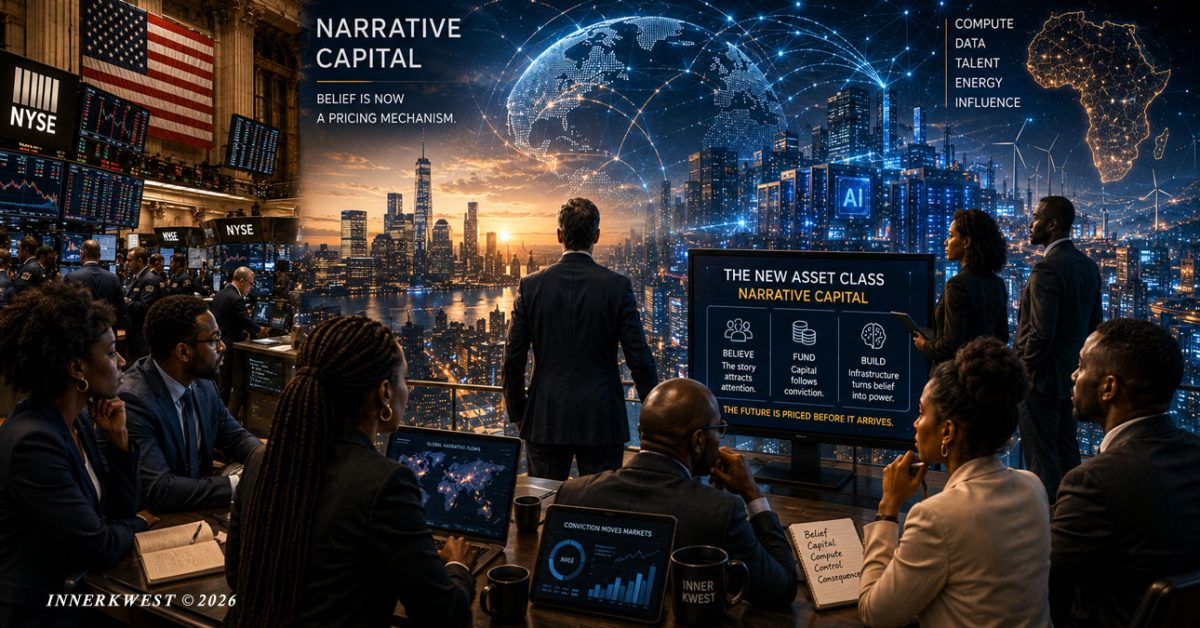
It is witnessing the emergence of narrative capital as a strategic asset class.
Whether that evolution ultimately strengthens markets or introduces new systemic risks remains an open question.
What is becoming increasingly difficult to dispute is that the future is being priced faster than ever before.
The investors who thrive over the next decade may not simply be those with the best financial models.
They may be those who most accurately recognize which narratives become reality.
At InnerKwest.com, we are committed to delivering impactful journalism, deep insights, and fearless social commentary. Your cryptocurrency contributions help us execute with excellence, ensuring we remain independent and continue to amplify voices that matter.
To help sustain our work and editorial independence, we would appreciate your support of any amount of the tokens listed below. Support independent journalism:
BTC: 3NM7AAdxxaJ7jUhZ2nyfgcheWkrquvCzRm
SOL: HxeMhsyDvdv9dqEoBPpFtR46iVfbjrAicBDDjtEvJp7n
ETH: 0x3ab8bdce82439a73ca808a160ef94623275b5c0a
XRP: rLHzPsX6oXkzU2qL12kHCH8G8cnZv1rBJh TAG – 1068637374
SUI – 0xb21b61330caaa90dedc68b866c48abbf5c61b84644c45beea6a424b54f162d0c
and through our Support Page.
InnerKwest maintains a revelatory and redemptive discipline, relentless in advancing parity across every category of the human experience.
© 2026 InnerKwest®. All Rights Reserved | Haki zote zimehifadhiwa | 版权所有. InnerKwest® is a registered trademark of Inputit™ Platforms Inc. Global. No part of this publication may be reproduced, distributed, or transmitted in any form or by any means without prior written permission. Unauthorized use is strictly prohibited. Thank you for standing with us in pursuit of truth and progress!