
November 2, 2026
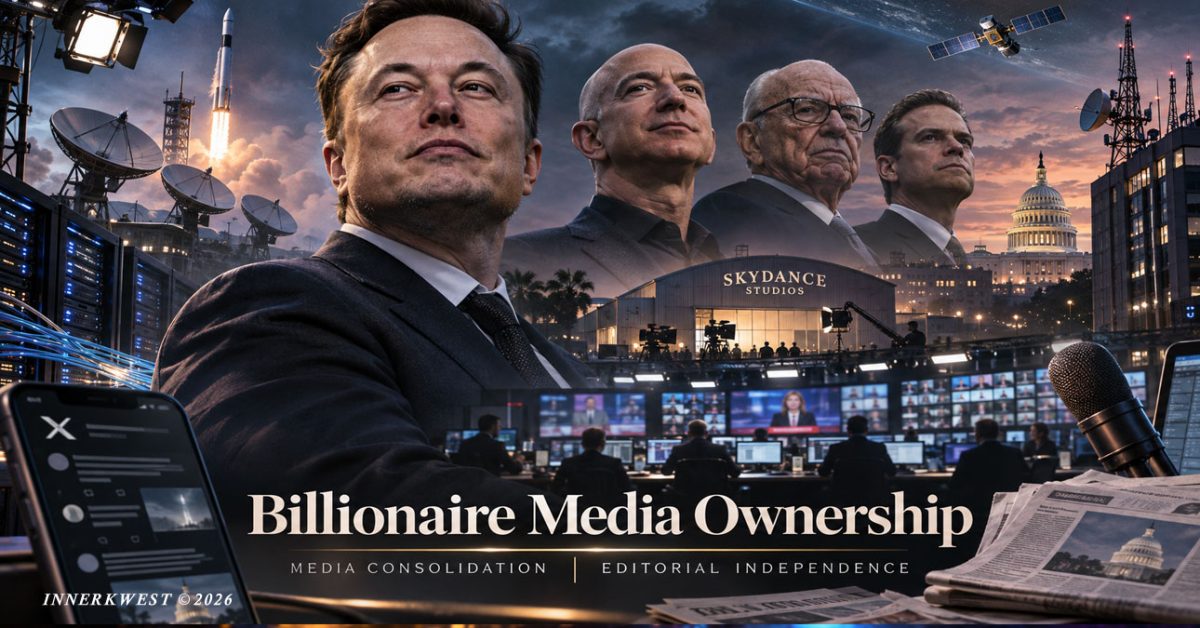
Elon Musk’s reported $1 billion investment in Skydance arrives as ownership of America’s information system is becoming increasingly concentrated among extraordinary private fortunes. The question is larger than whether any billionaire has ordered a journalist to change a story. It is what happens when media ownership begins to overlap with social platforms, communications infrastructure, government contracting and access to political power.
By the InnerKwest Editorial Desk
On October 22, Elon Musk was reported to have invested approximately $1 billion in Skydance, little more than two weeks after the company completed its $110 billion takeover of Warner Bros. Discovery. The combination brought CNN, CBS News, HBO, Paramount and Warner Bros. under one corporate roof.
The investment did not mean Musk bought CNN. It did not establish that he acquired editorial authority over CBS News, and there is no public evidence that he now determines what CNN investigates, what appears on 60 Minutes or what HBO may produce. The precise rights accompanying his reported investment have not been publicly disclosed.
Those distinctions matter. But they do not end the inquiry.
Musk already controls X, one of the world’s most consequential platforms for political communication and breaking news. His businesses extend into artificial intelligence, automobiles, rockets and satellite communications. SpaceX and Starlink occupy increasingly important positions in civilian, commercial and governmental communications. For part of 2025, Musk also served as a special government employee and senior adviser to President Donald Trump while becoming the public face of the government-efficiency initiative known as DOGE.
Now he has reportedly placed roughly $1 billion into a corporation containing two major American television news organizations.
Seen separately, each relationship has its own business or political explanation. Seen together, they raise a question that is becoming harder to avoid.
At what point does extraordinary economic power become information power?
The answer should not depend on whether the billionaire involved is admired or despised.
Reverse the politics. Imagine a billionaire closely associated with the American left controlling an enormously influential social platform, a global satellite communications network and companies with major government relationships; imagine that same person enjoying unusual access to a presidential administration and then investing $1 billion in a corporation containing CNN, CBS News and HBO.
Would scrutiny be unreasonable?
The standard should not change because the billionaire does.
Ownership Is Not Interference
The United States has never possessed a media system free of wealthy owners. Newspapers were historically controlled by powerful families and proprietors. Broadcast empires followed. Today’s information institutions include public companies, private owners, family trusts, founders with controlling voting shares and multinational corporations.
These structures are not interchangeable.
The Ochs-Sulzberger family has maintained control of The New York Times across generations through a dual-class stock structure. As of March 2026, the Ochs-Sulzberger Trust and another entity controlled by family descendants represented approximately 94.6 percent of the company’s Class B stock.
That is different from Jeff Bezos personally purchasing The Washington Post.
It is different again from Michael Bloomberg founding and retaining majority ownership of Bloomberg LP.
And each differs from Musk acquiring an investment position in a publicly traded media conglomerate.
Any serious examination of concentrated media power has to preserve those distinctions. The issue cannot simply be reduced to wealthy people owning media. Wealthy proprietors have financed journalism for centuries. Their capital has sometimes strengthened news organizations and protected them from commercial pressures that might otherwise have destroyed them.
Bezos provides a useful example precisely because the record is not one-dimensional.
When he acquired the Post in 2013, there was immediate concern that the founder of Amazon might use one of America’s most influential newspapers to advance his commercial interests. Martin Baron, the Post’s executive editor from 2013 through 2021, says he saw no such interference during his tenure.
Baron entered the relationship suspicious of what an owner with Bezos’s wealth and outside business interests might eventually want from the newspaper. Years later, he said he never discovered the agenda he feared. Bezos, he said, did not interfere with news coverage and gave the newsroom journalistic independence.
That evidence belongs in a fair account.
Then the relationship between ownership and editorial direction became more complicated.
In 2024, the Post declined to publish a presidential endorsement that its editorial staff had prepared. Bezos later defended the decision to discontinue presidential endorsements as an effort to address public perceptions of media bias.
In February 2025, he announced that the Post’s opinion section would concentrate on two principles: personal liberties and free markets. Viewpoints opposing those principles, he said, could be published elsewhere. Opinion editor David Shipley resigned rather than lead the section under the new mandate.
These were decisions involving the opinion side of the newspaper. They are not evidence that Bezos ordered news reporters to alter their journalism.
They demonstrate something else.
An owner does not need to telephone a reporter and kill a story to influence the character of a media institution. Ownership determines leadership. It influences budgets, institutional philosophy, expansion, contraction and the amount of risk an organization is prepared to absorb. Ultimately, ownership possesses considerable power over what kind of institution the property will become.
That is not evidence of corruption. It is part of what ownership means.
The Murdoch Model
Long before Musk’s Skydance investment or Bezos’s purchase of the Post, the Murdoch family demonstrated another form of concentrated media power.
Its interests span two major publicly traded corporations.
Fox Corporation includes Fox News Media, the Fox broadcast network, television stations, sports operations and entertainment properties. News Corp owns Dow Jones, publisher of The Wall Street Journal, Barron’s and MarketWatch, alongside the New York Post, major British and Australian newspapers, HarperCollins and other businesses.
The important issue is not simply the number of properties. It is the voting structure behind them.
Fox’s 2026 annual report says LGC Holdco, owned by Murdoch family trusts, beneficially owns approximately 38.8 percent of Fox’s Class B voting stock. Voting and disposition decisions involving those shares are, with limited exceptions, made by a managing director whose appointment and replacement are controlled by Lachlan Murdoch. Fox itself warns investors that this concentration of ownership can affect shareholder votes and the prospects for changes in corporate control.
At News Corp, LGC Holdco held approximately 34.52 percent of Class B stock as of June 30, 2026.
The family’s 2025 succession settlement makes the arrangement more revealing.
New trusts were established for Lachlan, Grace and Chloe Murdoch. Prudence MacLeod, Elisabeth Murdoch and James Murdoch ceased being beneficiaries of trusts holding shares in Fox and News Corp. Under the announced structure, voting control over the shares held through LGC Holdco rests solely with Lachlan Murdoch through his appointed managing director.
The trusts have a term extending to 2050.
The question of who controls part of the public square, in other words, does not necessarily end when the person who assembled the empire leaves it.
Corporate structures, trusts and voting arrangements can transmit control across generations.
The Murdoch case differs substantially from Musk’s investment in Skydance. That difference is precisely why it belongs here. One illustrates established family voting control across major traditional news institutions. Bezos illustrates personal ownership of a major newspaper by a billionaire whose principal fortune was created elsewhere. The Times demonstrates family control of a publicly traded newspaper company through voting architecture.
Musk presents something different again.
His interests already cross several layers of the modern information environment.
A Firewall Waiting to Be Tested
Questions surrounding Skydance did not begin with Musk’s investment.
When the Warner Bros. Discovery transaction closed in October, CNN and CBS News came under the same corporate roof. Mark Thompson remained chairman and editor-in-chief of CNN Worldwide. Bari Weiss remained editor-in-chief of CBS News. Both report separately to Skydance CEO David Ellison and co-CEO Ynon Kreiz.
Thompson told CNN employees that he expected to continue with the same responsibilities and prerogatives and expressed confidence that the new leadership would support CNN’s tradition of independent journalism.
Those assurances belong in the record.
So does the unusual mechanism created to protect them.
As part of a settlement involving the Warner Bros. Discovery acquisition, Skydance agreed to establish a five-member News Editorial Independence Board overseeing CNN and CBS News. Its members are to be journalists, but they will be appointed and paid by Skydance. Reuters reported that the settlement does not explicitly grant the board investigative powers and leaves unclear whether its decisions will be binding. Journalists and media experts have consequently questioned how much authority it will possess when a serious dispute arrives.
That dispute has not yet arrived.
Nor should corporate assurances of independence simply be dismissed because critics distrust them.
The meaningful test comes later, when journalism becomes inconvenient to ownership.
Suppose CNN undertakes an aggressive investigation of SpaceX’s government relationships. Suppose CBS News investigates DOGE and reaches conclusions deeply unfavorable to Musk. Suppose HBO produces a documentary sharply critical of one of his companies.
There is presently no evidence that Musk would attempt to prevent any of those projects.
The point of asking is not to predict that he will.
It is to ask whether the institution is built to withstand the conflict if it ever comes.
That question is especially pertinent because Skydance is not entering this new era without financial pressure. On October 26, days after the Musk investment was reported, the company offered voluntary buyouts to some employees as it began reducing costs following the Warner Bros. Discovery acquisition and the debt that accompanied it.
Cost cutting is not censorship. Nor does a buyout program establish editorial interference.
It does, however, describe the environment in which editorial independence will have to function. Newsrooms do not operate outside corporate economics.
A firewall matters most when something on one side becomes expensive to someone on the other.
When Nobody Gives the Order
There is another mechanism of influence that is much harder to document because it may operate without an explicit command.
Journalists work inside institutions. They understand which subjects produce uncomfortable meetings. They observe who gets promoted. They know when executives become nervous. They watch budgets expand and disappear. They see colleagues summoned into meetings and programs removed from schedules.
Over time, boundaries can become understood without anyone writing them down.
The experience described by former MSNBC host Joy Reid is worth considering in that context, while distinguishing her account from a proven finding about why her program was canceled.
After leaving MSNBC in 2025, Reid described internal tension surrounding her coverage of Gaza. She later said she believed that coverage contributed to her dismissal and described receiving warnings that continuing to discuss Gaza could endanger her position. MSNBC did not publicly identify Gaza coverage as the reason The ReidOut was canceled.
That leaves an unresolved question.
It does not require accepting the corporation’s explanation as definitive. Neither does it require treating Reid’s interpretation as conclusively established.
The contradiction itself is worthy of journalism.
What changed between continued institutional support for Reid and cancellation of the program? What discussions occurred internally? What role, if any, did editorial disagreements play? Were ratings, programming strategy, corporate restructuring or other considerations decisive?
The institution under examination cannot settle those questions merely by issuing its explanation. Neither can the person contesting the decision settle them by offering hers.
But imagine being another journalist watching such a dispute.
You do not necessarily need to know why a colleague disappeared from the schedule. You need only observe that a controversial subject generated internal tension, that warnings circulated about professional consequences and that eventually the program was gone.
No censorship memorandum is necessary.
People can begin adjusting before anyone tells them to adjust.
That possibility—anticipatory compliance—is one of the reasons concentrated ownership is difficult to measure solely by searching for explicit orders.
When Private Influence Meets Public Power
DOGE presents another version of the problem.
The initiative was formally established by presidential executive order. Musk did not privately create a federal agency. The White House told a federal court in 2025 that Musk was a White House employee and senior adviser, not an employee or administrator of the U.S. DOGE Service, and that he possessed no formal authority to make government decisions.
That legal distinction matters.
So does what happened around it.
Musk became the unmistakable public face of DOGE while its personnel operated across the federal government. The Government Accountability Office later identified 206 people who, under its definition of DOGE personnel, held positions within the Executive Office of the President between January 20, 2025 and January 31, 2026. Twenty-seven were described as special government employees.
GAO also reported that the Executive Office of the President did not provide requested records allowing the watchdog to confirm ethics training and financial disclosures for all of the personnel covered by its review.
The episode exposed a problem for institutions organized around formal lines of authority: how should accountability operate when practical influence may appear much larger than the office a person formally occupies?
Subsequent findings made that question less abstract.
In August 2026, GAO examined savings posted on DOGE’s Wall of Receipts. As of July 7, the page reported approximately $110 billion in savings from contracts, grants and leases.
GAO found that some estimates were incorrect or lacked supporting evidence. It said DOGE had not used its stated methodology for the majority of savings associated with contracts reported as terminated. For 96 percent of reported grant savings, GAO lacked sufficient information to verify the method used to calculate them.
One example was difficult to reconcile.
DOGE reported more than $1.7 billion in savings from a Defense Health Agency information-technology contract supporting more than 700 military treatment facilities worldwide. According to GAO, the contract was not terminated. Its scope and value were not reduced. Funds were not deobligated.
“No savings were achieved,” GAO concluded.
The figure nevertheless remained on the Wall of Receipts.
That finding does not establish that Musk calculated the number, ordered it published or even knew about it.
It establishes something more useful here.
Institutions exercising substantial power require other institutions capable of independently checking their claims.
The press is one of them.
And that returns the inquiry to ownership.
What happens when individuals whose companies, investments, government relationships or political activities deserve aggressive journalistic scrutiny also acquire economic interests in institutions responsible for conducting that scrutiny?
The Public Square Has Changed
The phrase media ownership may now be too narrow.
For most of the twentieth century, concern about concentrated media power centered on newspapers, radio stations and television networks. Whoever controlled the printing press or broadcast license possessed extraordinary influence over what information could reach large populations.
The contemporary information system has more layers.
There is the newsroom producing information and the platform distributing it. There is the algorithm deciding whether millions of people encounter it. There is communications infrastructure carrying it. Artificial-intelligence systems increasingly summarize, interpret and mediate what people discover.
And behind all of them is capital.
These systems do not ordinarily share the same owners. Yet some of the same fortunes increasingly appear across several of them.
Musk’s relevance to this discussion therefore did not begin with Skydance.
X is an information institution even though it is not a newsroom. Presidents, government agencies, corporations and journalists communicate there. Breaking events unfold there. Markets react to statements made there. Propaganda circulates there. News organizations distribute reporting there.
SpaceX and Starlink occupy another layer.
Artificial intelligence another.
Government relationships introduce another.
The Skydance investment adds an economic interest in traditional news and entertainment.
None of this proves that these assets are being coordinated into a unified system of influence. They do not have to be for the concentration itself to deserve examination.
That distinction matters.
Democratic accountability has long depended upon different centers of power checking one another. Government scrutinizes corporations. Journalists scrutinize government. News organizations scrutinize corporations. Competing media organizations scrutinize one another. Citizens use communications systems to scrutinize all of them.
What happens when ownership, infrastructure, distribution, political access and media interests begin accumulating around a smaller number of economic centers?
The most prominent American information institutions already demonstrate how many forms concentrated control can take.
The Ochs-Sulzberger family maintains control of The New York Times through family holdings and super-voting stock.
Jeff Bezos owns The Washington Post.
The Murdoch family maintains substantial voting power across Fox Corporation and News Corp through family trusts whose voting authority has been structured around Lachlan Murdoch.
Michael Bloomberg remains founder and majority owner of Bloomberg LP.
David Ellison leads Skydance. His father, Oracle co-founder Larry Ellison, provided extraordinary financial backing for the Warner Bros. Discovery transaction. Reuters reported that Larry Ellison personally guaranteed more than $40 billion in equity financing during the takeover. Four years earlier, he had committed $1 billion toward Musk’s acquisition of Twitter, now X. Musk has now reportedly invested roughly the same amount in Skydance.
Those relationships are not evidence of conspiracy.
They are relationships.
Their concentration is a matter of record.
The more useful question is therefore no longer simply who owns the media. It is what kind of control each ownership structure permits, what other interests overlap with that control, and what safeguards exist when those interests collide with journalism.
The Independence Test
There is a temptation whenever questions of media influence arise to search for the dramatic moment: the secret telephone call, the suppressed investigation, the reporter ordered to stand down, the billionaire telling an editor what cannot be published.
Sometimes such evidence exists.
Often it does not.
Yet other institutions do not ordinarily wait for proven misconduct before constructing safeguards around conflicts of interest. Banks establish internal controls before an executive steals money. Courts establish recusal standards before a judge sells a verdict. Universities require disclosure of research funding before a sponsor is caught rewriting a scientific conclusion.
Journalism deserves comparable institutional seriousness.
The answer to concentrated media ownership is not to presume corruption. It is to construct institutions in which interference becomes difficult and visible when attempted.
That requires genuine editorial firewalls, transparent governance and disclosure of significant ownership and voting interests. It requires news executives capable of saying no to ownership and journalists able to investigate companies connected to investors without wondering whether doing so threatens their careers.
It also requires something less easily written into corporate bylaws: an information ecosystem sufficiently diverse that no proprietor, family, corporation, political faction or technology platform can determine the boundaries of permissible public knowledge.
The Skydance News Editorial Independence Board may prove to be a meaningful safeguard.
Its name cannot tell us that.
The answer will come when independence becomes expensive—when an investigation threatens an important corporate relationship, when a significant investor becomes the subject, when political pressure arrives, when revenue is endangered, or when a journalist refuses to soften a conclusion.
That is when an editorial firewall becomes something more than architecture on paper.

Who Owns the Ability to Ask?
Musk’s reported Skydance investment may ultimately prove to be exactly what an investment ordinarily is: capital seeking a return.
There is presently insufficient public evidence to conclude that he invested in Skydance to control CNN, CBS News or another newsroom.
That absence of evidence is not a reason to stop asking questions about concentrated information power. It is a reason to ask more precise ones.
The consequential transformation in American media may not be that billionaires own newspapers and television networks. Wealthy proprietors have existed throughout the history of the press.
What has changed is the information environment around them.
Capital. Technology. Artificial intelligence. Social communication. Satellite infrastructure. Government contracting. Political access. Entertainment. News.
Each possesses power independently.
Their intersection deserves scrutiny even when every transaction is legal and every corporate assurance sincere.
The Murdoch succession arrangement demonstrates that concentrated information power can be structured to endure beyond the generation that assembled it.
The Bezos experience demonstrates that an owner can respect the independence of a newsroom for years while still possessing the authority to reshape other parts of the institution.
The Ochs-Sulzberger structure demonstrates how family control can persist inside a publicly traded media company through voting architecture.
Skydance presents another experiment: two major television news organizations inside a vastly enlarged entertainment corporation, accompanied by an editorial-independence mechanism whose most important tests have not yet occurred.
Musk introduces a newer question.
What happens when wealth no longer merely owns a media property but occupies several layers of the environment through which information itself travels?
Freedom of the press has never depended solely upon whether someone actually orders a journalist to remain silent.
It also depends upon whether the journalist expects such an order before it is given.
That is considerably harder to measure.
A reporter who receives an explicit command can expose it. A newsroom that gradually learns which questions are expensive may never receive one.
And a public that waits for proof of direct censorship before examining concentrated information power may eventually discover that it was looking for the easiest evidence rather than the most consequential.
The essential question is no longer merely who owns CNN, The Washington Post, Fox News, The Wall Street Journal, X or any other institution through which people understand their world.
It is who possesses the ability to shape the environment in which information is produced, financed, distributed, discovered—and trusted.
The public square has grown larger than the printing press.
So has the power to own it.
At InnerKwest.com, we are committed to delivering impactful journalism, deep insights, and fearless social commentary. Your cryptocurrency contributions help us execute with excellence, ensuring we remain independent and continue to amplify voices that matter.
To help sustain our work and editorial independence, we would appreciate your support of any amount of the tokens listed below. Support independent journalism:
BTC: 3NM7AAdxxaJ7jUhZ2nyfgcheWkrquvCzRm
SOL: HxeMhsyDvdv9dqEoBPpFtR46iVfbjrAicBDDjtEvJp7n
ETH: 0x3ab8bdce82439a73ca808a160ef94623275b5c0a
XRP: rLHzPsX6oXkzU2qL12kHCH8G8cnZv1rBJh TAG – 1068637374
SUI – 0xb21b61330caaa90dedc68b866c48abbf5c61b84644c45beea6a424b54f162d0c
and through our Support Page.
InnerKwest maintains a revelatory and redemptive discipline, relentless in advancing parity across every category of the human experience.
© 2026 InnerKwest®. All Rights Reserved | Haki zote zimehifadhiwa | 版权所有. InnerKwest® is a registered trademark of Inputit™ Platforms Inc. Global. No part of this publication may be reproduced, distributed, or transmitted in any form or by any means without prior written permission. Unauthorized use is strictly prohibited. Thank you for standing with us in pursuit of truth and progress!