
Updated November 20, 2026:
An Independent Historical and Civic Inquiry
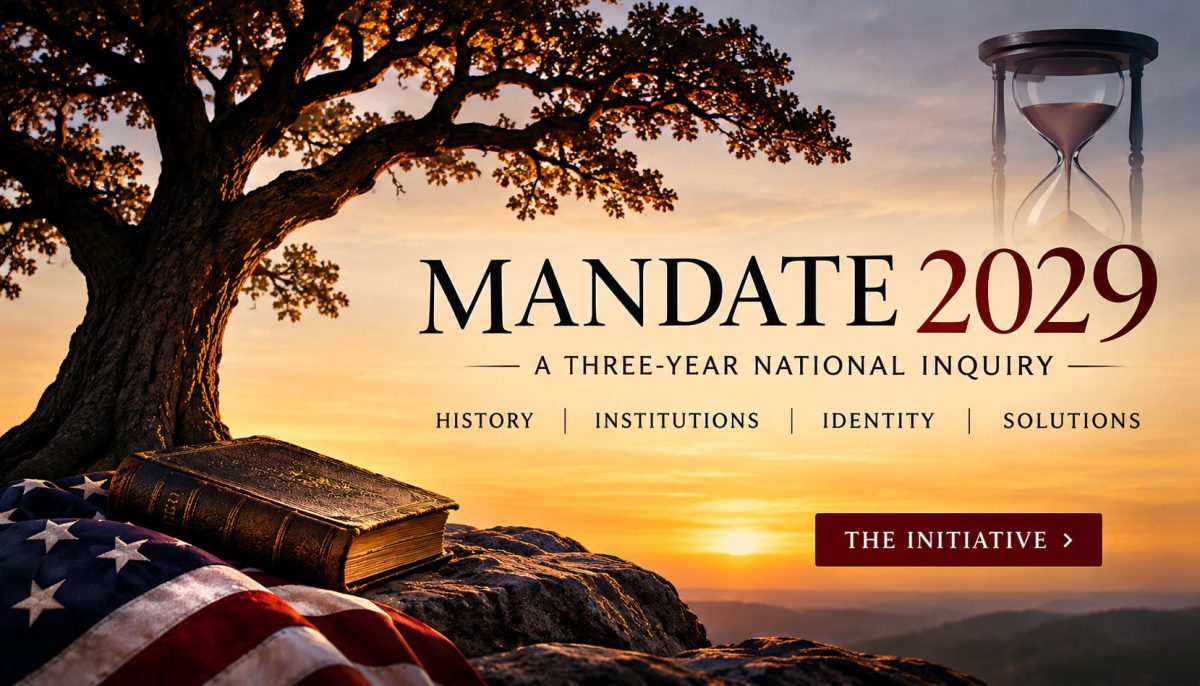
Mandate 2029: From Historical Understanding to Institutional Resolve
An independent undertaking to examine America’s institutional foundations, develop original mandates, cultivate human and organizational capabilities, and establish consequential change that can endure.
Mandate 2029 is a three-year undertaking beginning with a fundamental examination of the historical foundations of American institutions, the contradictions that have shaped their development, and the arrangements through which authority, opportunity, and participation have been established, exercised, and contested.
Our examination begins before 1619 and extends through the institutional developments and controversies of the present. It encompasses citizenship, historical identity, governance, religion, economics, education, political authority, and the responsibilities of individuals and communities within the American experience.
History provides the foundation for our inquiry, but historical interpretation is not its final purpose.
We intend to understand how institutions acquired their authority, how particular arrangements became entrenched, why certain divisions have endured, and why advances once considered secure can be diminished or reversed.
More importantly, we intend to determine what must be established so that future generations are not perpetually required to revisit the same unresolved institutional conditions.
Our Mission
Mandate 2029 exists to transform historical understanding into institutional resolve, and that resolve into the development and execution of original mandates capable of producing consequential and enduring results.
We do not regard the examination of history as an exercise in assigning perpetual blame. Nor do we consider criticism of existing institutions, however justified, a sufficient response to their deficiencies.
Understanding must lead somewhere.
Our undertaking therefore extends beyond research, commentary, and civic discourse. It encompasses the deliberate development of human, intellectual, technological, economic, and organizational capabilities necessary to construct and execute mandates.
A mandate, as we understand it, is not a recommendation, a declaration of preferred outcomes, or a promise of future action. It is a defined construction of requirements, responsibilities, mechanisms, resources, and actions organized toward a specific institutional result.
The inquiry that informs a mandate must remain open to evidence, contradiction, and revision. The mandate that emerges from that inquiry must possess the clarity and structural discipline necessary for execution.
And execution alone is not the final measure.
The consequence of what is established, its effectiveness, and its capacity to endure must ultimately determine its value.
The Historical Responsibility
American history contains extraordinary intellectual, civic, legal, religious, and economic achievements. It also contains profound contradictions between the principles institutions have declared and the conditions they have maintained.
Those contradictions deserve examination without the obligation to preserve inherited interpretations or accept established authorities as the final arbiters of historical meaning.
We recognize the contributions of scholars, jurists, ministers, civic leaders, organizers, entrepreneurs, and ordinary citizens whose efforts have shaped the nation. Their accomplishments provide essential evidence of what determined individuals and organized communities can achieve.
Yet history also reveals the limitations of achievement when it is not accompanied by durable institutional capacity.
Access can be restricted. Recognition can be withdrawn. Policies can be reversed. Institutions can be redirected by those who control their authority and resources.
These realities require us to examine the distinction between participation in existing arrangements and the capacity to establish arrangements of our own.
Our examination will give particular attention to the historical experiences of African Americans, the institutions developed within their communities, and the continuing relationships among nationality, identity, citizenship, economic opportunity, and institutional independence.
These subjects are inseparable from the broader American experience, but they cannot be understood adequately through generalized accounts that overlook their particular historical circumstances.
We intend to examine them with intellectual independence, historical evidence, and a willingness to challenge assumptions, including our own.
The Circumstances Before Us
Mandate 2029 emerges during a period of significant institutional reconsideration.
Project 2025 and the policy agenda associated with it represent an important contemporary subject of examination. Its proposals concerning executive authority, federal administration, regulatory structures, and the relationship between government and society warrant sustained scrutiny.
We intend to examine relevant proposals, their historical foundations, their implementation where applicable, and their consequences for institutions and the people affected by them.
Our examination will be substantive rather than reflexive. Agreement or disagreement will not substitute for evidence, and political affiliation will not determine the validity of an argument.
Nevertheless, Mandate 2029 is not constituted merely as an opposition to Project 2025.
A response defined exclusively by what it opposes remains dependent upon the agenda of others.
Our purpose is broader and more enduring: to investigate the arrangements that have produced recurring institutional vulnerabilities and to establish capabilities through which different outcomes can be constructed and sustained.
The years ahead demand more than the ability to recognize a problem. They require the capacity to address its underlying structure.
The Resolve
We distinguish between understanding a condition, enduring it, and possessing the means to change it.
Tolerance may describe the extent to which individuals or communities withstand circumstances they did not create and do not control. It does not, by itself, establish a remedy.
Tolerance measures endurance. It does not establish a solution.
The Resolve represents our commitment to move beyond the recurring cycle of recognition, objection, accommodation, and reversal.
It is not a declaration that every answer is already known. It is the conviction that inquiry must ultimately produce something more substantial than another interpretation of familiar problems.
We intend to develop original mandates grounded in historical understanding, informed judgment, defined requirements, and the resources necessary for execution.
We also recognize that no mandate can be more effective than the capabilities available to carry it forward.
This understanding informs the institutional development of Mandate 2029 itself.
Developing and Growing Capabilities
Mandate 2029 must become capable of developing capabilities.
That responsibility applies both to the institution and to the individuals who become associated with its work.
Our developing collaborative environment, Nexus, is envisioned as a means of identifying knowledge, experience, talent, and potential across disciplines. These may include historical research, law, economics, decentralized finance, technology, media, marketing, organizational development, and other fields relevant to our evolving requirements.
But identification is only the beginning.
We intend to cultivate an environment in which individuals can expand their knowledge, encounter unfamiliar disciplines, collaborate with others, assume meaningful responsibilities, and develop capabilities beyond those they initially bring.
The relationship must be reciprocal.
Mandate 2029 should grow stronger through the contributions and development of its inductees. Its inductees should likewise gain opportunities for intellectual, professional, organizational, and potentially economic advancement through their association with the institution.
Such opportunities must be developed responsibly, with appropriate distinctions among participation, employment, collaboration, ownership, and independent enterprise.
We do not assume that every individual will follow the same path or seek the same outcome.
We do recognize that the continuing development of people is among the most important capabilities an institution can establish.
An institution that can cultivate successive generations of capable individuals possesses a foundation for continuity beyond its original leadership.
From Mandate to Institutional Consequence
Mandate 2029 will examine opportunities to construct the organizational arrangements, collaborative environments, economic mechanisms, technological systems, and independent institutions necessary to support its work.
Some mandates may require new organizational structures. Others may involve the development of existing capabilities, coordinated action, specialized partnerships, or entirely new institutional approaches.
Their forms must be determined by their requirements rather than by a predetermined organizational formula.
We do not presume that every mandate will succeed or that every institutional deficiency can be resolved within the undertaking’s initial three-year horizon.
The purpose of that horizon is to concentrate our examination, establish direction, and develop the foundations from which consequential work can proceed.
The year 2029 is therefore a milestone, not an expiration date for the responsibilities we undertake.
Our standard is not the number of declarations issued, the volume of commentary produced, or the appearance of activity.
It is what we establish, what becomes operational, what produces meaningful consequences, and what retains the capacity to advance after its initial architects are gone.
The Responsibility Ahead
We begin without predetermined conclusions about every question our examination will encounter.
We do not, however, begin without conviction.
We believe historical understanding must inform institutional construction. We believe human capability can be developed and expanded. We believe independent judgment, disciplined collaboration, and organized resources can create possibilities that isolated individuals cannot achieve alone.
And we believe the responsibility to shape the future cannot remain exclusively in the hands of those who presently control its institutions.
Mandate 2029 invites serious inquiry, independent thought, demonstrated capability, and a willingness to undertake the difficult work of construction.
We seek neither the comfort of perpetual opposition nor the temporary satisfaction of being heard.
We intend to understand what has been established, determine what must change, develop the capabilities necessary to act, and construct what can endure.
That is the responsibility of our Resolve.
Visit Mandate 2029 for the complete resolve.
—Chastened Whip