
November 4, 2026
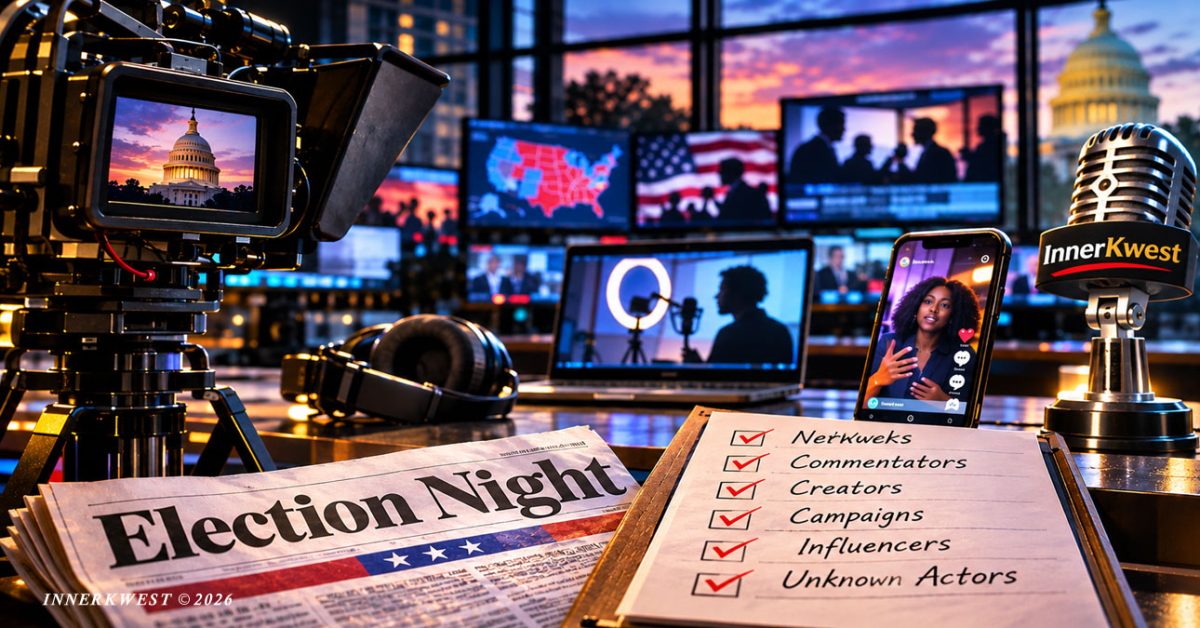
Election night produced moments that revealed something larger than the results. Political commentators openly experienced victories and defeats alongside the movements they cover. A supposedly damaging hot-mic recording became something different when its context was restored. Beyond television, campaigns increasingly reach voters through creators whose roles may be even harder to identify. The old argument about political media bias may no longer adequately describe the information system Americans are using.
By the InnerKwest Editorial Desk
Before the polls had closed Tuesday night, Jesse Watters already sounded defeated.
“I don’t feel great,” the Fox News host said during The Five. “I feel like I’m about to play a game that I know I’m going to lose; I’m just trying not to get hurt.”
This was not a reporter describing Republican anxiety. Watters was describing his own.
He talked about the possibility of Republicans losing the Senate making him angry. He also described asking two contractors working at his home whether they had voted and encouraging them to leave and do so.
There was little ambiguity about his political preference.
There was also little pretense that there should be.
Watters is a political commentator, and The Five is built around personalities offering opinion rather than functioning as a traditional evening newscast. His audience is unlikely to mistake him for a disinterested election correspondent.
That distinction matters.
But it may matter less than it once did.
For generations, arguments about American journalism have revolved around bias. Conservatives accused major news organizations of favoring Democrats. Liberals pointed to conservative talk radio, Fox News and later an expanding ecosystem of right-leaning digital media. News organizations responded with standards, labels and distinctions between reporting and opinion.
The argument assumed something important: that audiences could generally tell which was which.
Election night offered reasons to reconsider that assumption.
A Clip That Appeared to Prove Too Much
Later, another Fox personality became the subject of a very different controversy.
Bret Baier was caught on a live microphone beginning a question that quickly circulated online:
“Can we do a spin on the races that—?”
The sentence was never completed.
Separated from its surroundings, the interpretation almost wrote itself. Fox had suffered a difficult election night for Republicans, and one of its best-known anchors appeared to have been caught privately asking how the network should “spin” what had happened.
The clip traveled.
There was only one problem.
The fuller evidence did not support the easiest interpretation.
Baier said he was asking Bill Hemmer to take a “spin on the board”—the large interactive election display used to move among races and examine outstanding results. Footage from elsewhere in the broadcast showed Baier using similar language while directing attention to that board.
The clarification does not require anyone to trust Fox News.
It requires something more basic: examining the available evidence.
The hot-mic recording remains real. So does the sentence. But the surrounding context materially changes what can responsibly be concluded from it.
That distinction is becoming increasingly difficult to preserve in an information environment where the fragment often arrives before the explanation.
A few seconds of video can leave a television studio, appear on X, TikTok or another platform, acquire a caption, be reposted by people who already possess strong assumptions about the speaker and reach millions before anyone encounters the surrounding minute.
By then, the fragment may have acquired a meaning of its own.
The Baier episode is useful precisely because it does not neatly support a case against Fox. It demonstrates something less convenient.
Sometimes the viral evidence is weaker than the story built around it.
The Other Side Wasn’t Watching Quietly Either
The emotional investment visible on Fox was not confined to the political right.
During CNN’s election coverage, commentator Van Jones reacted openly to Democratic victories.
“I’m so happy,” he said, before comparing the evening to Christmas and a birthday and describing the results as a rejection of Trumpism.
Again, the distinction matters. Jones was appearing as a commentator, not presenting himself as a neutral news anchor. CNN’s election coverage included anchors and correspondents alongside explicitly identified political analysts and commentators representing different perspectives.
Nothing about Jones expressing a political opinion therefore establishes deception by CNN.
But place the Jones and Watters moments beside one another and a different question appears.
What exactly is the audience watching?
A reporter may deliver verified results. Minutes later a commentator interprets them from an openly political perspective. A strategist may explain what the result means for a party. Another panelist challenges that interpretation. The anchor moves to a correspondent at campaign headquarters. A clip from the exchange is extracted and distributed on social media without the labels or context that accompanied the original broadcast.
All of it becomes “the news.”
The institutional distinctions remain.
The experience of consuming them is becoming less distinct.
That matters because television may now be the easier environment to understand.
At least the names and roles are usually displayed on the screen.
Beyond the Studio
Much of America’s political information no longer begins with a television network or newspaper.
It arrives through a phone.
Pew Research Center reported in 2026 that 59 percent of American adults get news from social media at least sometimes. Twenty-six percent said they do so often.
The person delivering that information may be a journalist.
Or a podcaster.
Or an activist.
Or a comedian.
Or a political consultant.
Or an influencer whose audience originally followed for something having little to do with politics.
Those categories increasingly overlap.
Reuters documented the growth of a new left-leaning media ecosystem during the 2026 election cycle in which podcasters, livestreamers and digital publishers were becoming important conduits between progressive candidates and potential voters. The development followed an earlier expansion of conservative alternative media that had already demonstrated how political personalities could build enormous audiences outside traditional news organizations.
Candidates noticed.
So did campaigns.
They no longer have to persuade an editor that a candidate deserves an interview or convince a television producer that an appearance warrants airtime. A politician can sit across from a podcaster whose audience numbers in the millions and speak for an hour without encountering the conventions of a Sunday political program.
That can be valuable.
Long-form conversations can reveal things that eight-minute television interviews cannot. Independent media can challenge assumptions established institutions overlook. Audiences can hear directly from candidates rather than through edited excerpts.
But removing the old gatekeepers does not remove influence.
It changes who exercises it.
When the Person on the Screen Is Being Paid
The boundary becomes more difficult when political campaigns enter the creator economy directly.
Investigations during the 2026 campaign found candidates and political organizations paying online creators to produce supportive content. In some cases, the financial relationship was not apparent to the people encountering the posts.
That is different from Jesse Watters telling viewers what he thinks.
Whatever one thinks of his politics, the audience knows where he works. They know the program they are watching. His opinions are part of the product.
A creator appearing between cooking videos, comedy clips, financial advice or lifestyle posts presents a different information problem.
The viewer may know the creator.
The viewer may not know the campaign.
Commercial advertising has spent years developing disclosure practices intended to tell audiences when an influencer has a financial relationship with a company whose product appears in a post. Political communication has entered many of the same platforms without producing an equally intuitive system for audiences trying to understand what they are seeing.
The Federal Trade Commission’s endorsement rules illustrate the oddity. The agency tells commercial influencers to disclose material relationships with brands, but its endorsement guidelines do not govern political advertisements. Election law imposes other disclaimer requirements, yet those rules developed around political communications that did not necessarily resemble today’s creator economy.
A political message can therefore arrive looking less like an advertisement than a recommendation from someone the viewer already follows.
That relationship may be more valuable than the advertisement.
Trust has moved from the institution to the personality.
The Labels Are Still There
It would be easy to conclude that journalism, commentary and political advocacy have simply become indistinguishable.
They have not.
Reporters still report. Newsrooms still maintain standards. Commentators are frequently identified as commentators. Campaign advertisements remain advertisements. Many creators clearly tell their audiences what they believe and who supports their work.
The distinctions exist.
The problem is that information increasingly travels farther than the labels attached to it.
A television segment becomes a 20-second clip.
A podcast becomes a quotation.
A campaign appearance becomes a viral moment.
A creator’s endorsement enters an algorithmic feed beside reporting from a newspaper, commentary from a television personality, a politician’s own post and a video uploaded by someone whose identity the viewer may never investigate.
The platform does not necessarily arrange these items according to their journalistic function.
It arranges them according to the systems governing attention.
Once information reaches that environment, the traditional question—Is this outlet biased?—begins to feel incomplete.
The audience first has to determine what kind of information it is looking at.

What Election Night Revealed
The 2026 midterms will be analyzed through vote totals, demographic movement, turnout, economic dissatisfaction and the decisions made by candidates and parties.
Those are political questions.
Election night exposed another one that has less to do with who won.
Watters could speak from inside the emotional experience of the political movement he favored because his role permitted it.
Jones could celebrate Democratic victories because his role permitted that too.
Baier’s unfinished sentence could be detached from the broadcast, interpreted as evidence of something considerably more serious and distributed before much of the audience encountered the context that complicated the allegation.
None of those events, standing alone, defines American journalism.
Together with the expanding creator economy, personality-driven political media and campaigns learning to operate inside those systems, they reveal how much the environment surrounding journalism has changed.
There was a time when much of the argument centered on whether the person behind the anchor desk was telling the audience the truth.
That question has not disappeared.
It has been joined by others.
Who is speaking?
What role are they performing?
Who is paying them?
What disappeared when the clip was shortened?
And who benefits from the version that traveled?
The answers cannot always be found in the information itself.
Sometimes they require knowing where it came from.
The public square now contains more voices than at any previous moment in American history. That expansion has weakened old gatekeepers and allowed people previously excluded from mass communication to reach enormous audiences.
It has also transferred more responsibility to the person holding the screen.
The difficult task is no longer simply deciding whom to believe.
It is determining what, exactly, you are watching.
At InnerKwest.com, we are committed to delivering impactful journalism, deep insights, and fearless social commentary. Your cryptocurrency contributions help us execute with excellence, ensuring we remain independent and continue to amplify voices that matter.
To help sustain our work and editorial independence, we would appreciate your support of any amount of the tokens listed below. Support independent journalism:
BTC: 3NM7AAdxxaJ7jUhZ2nyfgcheWkrquvCzRm
SOL: HxeMhsyDvdv9dqEoBPpFtR46iVfbjrAicBDDjtEvJp7n
ETH: 0x3ab8bdce82439a73ca808a160ef94623275b5c0a
XRP: rLHzPsX6oXkzU2qL12kHCH8G8cnZv1rBJh TAG – 1068637374
SUI – 0xb21b61330caaa90dedc68b866c48abbf5c61b84644c45beea6a424b54f162d0c
and through our Support Page.
InnerKwest maintains a revelatory and redemptive discipline, relentless in advancing parity across every category of the human experience.
© 2026 InnerKwest®. All Rights Reserved | Haki zote zimehifadhiwa | 版权所有. InnerKwest® is a registered trademark of Inputit™ Platforms Inc. Global. No part of this publication may be reproduced, distributed, or transmitted in any form or by any means without prior written permission. Unauthorized use is strictly prohibited. Thank you for standing with us in pursuit of truth and progress!