
November 12, 2026
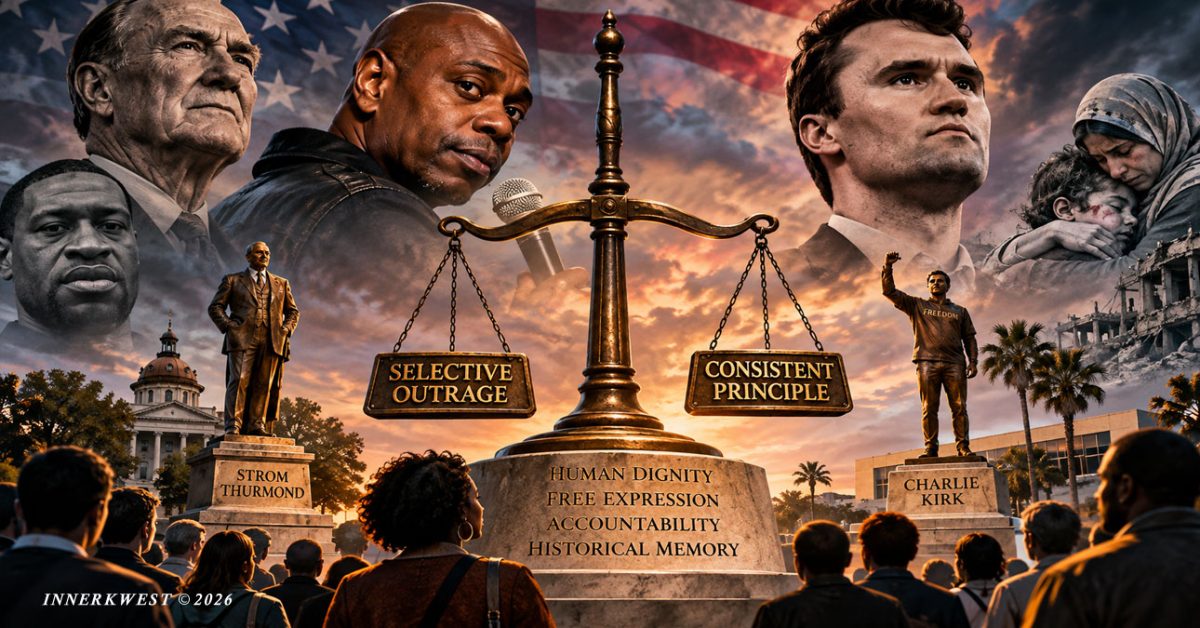
Political violence, public grief, selective indignation, and the institutions that decide whose lives deserve monuments.
By the InnerKwest Editorial Desk
There is a peculiar habit in American public life of discovering moral boundaries only after someone familiar crosses them in the wrong direction. What passes for satire in one gathering becomes an intolerable offense in another. The difference is not always the language, the circumstances, or even the severity of the joke. Sometimes it is simply the person whose name has been placed at the center of it.
Dave Chappelle’s recent remarks about the assassination of Charlie Kirk have produced another round of public indignation, much of it centered on whether the comedian had ventured beyond the permissible boundaries of humor. Kirk’s widow has every reason to regard jokes about her husband’s murder as cruel. Her grief is real, and there is no serious argument that his political positions somehow diminished his right to live. Yet the controversy has unfolded in a country where jokes about death, violence, racial suffering, and entire populations have frequently been defended as exercises of free expression.
That history complicates the present outrage.
During his November 7 performance at Madison Square Garden, Chappelle joked about feeling better following Kirk’s death. He also delivered a line imagining Kirk looking up from the afterlife, laughing so hard that he could not breathe. The remarks circulated widely, attracting criticism from political commentators and public figures who regarded them as an unacceptable treatment of political assassination.
The wording of the second joke was particularly notable. Months earlier, comedian Tony Hinchcliffe had used a strikingly similar construction about George Floyd during a roast of Kevin Hart. Floyd’s death under the knee of a Minneapolis police officer had become one of the defining images of American police brutality. Hinchcliffe turned that death into a punchline. Chappelle later used comparable language, substituting Kirk.
Whether Chappelle intended a deliberate reversal has not been established. The resemblance is nevertheless substantial enough to invite comparison, particularly among those who have defended provocative comedy when its subject was someone they opposed.
The difficulty begins when public figures attempt to reconcile their positions. A person may reasonably dislike both jokes, defend the right to tell both, or distinguish between them based on context. What requires examination is the individual who celebrates one as fearless comedy and condemns the other as evidence of moral collapse without explaining why the standard has changed.
That is where the matter becomes more interesting than the comedians themselves.
The Laughter That Came Before
Charlie Kirk was no stranger to the use of provocative language. His political identity was built in part around public confrontation, particularly on college campuses, where he challenged opponents and encouraged young conservatives to defend positions that were frequently unpopular in those environments.
A recording circulating in the aftermath of the Chappelle controversy shows Kirk discussing gay people and Gaza. In the clip, he invokes the prospect of gay people being thrown from buildings and turns the destruction of Gaza’s buildings into part of the joke. Laughter follows from the audience.
The original recording should be examined in its complete context before assigning a definitive date or treating it as a comprehensive statement of Kirk’s position on Gaza. What is relevant here is the use of destruction and threatened violence as material for humor.
The devastation in Gaza has involved civilian deaths, displacement, and the destruction of homes and infrastructure. The people who endured those conditions were not abstractions created for an American political argument. They were families whose circumstances had been transformed by war, and whose suffering existed independently of the opinions held about the conflict thousands of miles away.
An audience laughing at a joke does not necessarily mean that it approves of the violence being described. Comedy frequently depends on exaggeration, discomfort, and the unexpected. But those considerations do not become irrelevant when another speaker uses a similar device about a person whom that audience admires.
Kirk’s murder remains a grave act of political violence. His earlier remarks remain part of his public record. Neither fact cancels the other.
What is difficult to defend intellectually is the suggestion that examining both somehow constitutes an attack upon the deceased. Death does not erase a public record, and grief cannot reasonably require that history cease asking questions.
The Politics of Offense
Much of the American debate surrounding free expression has become entangled with the identities of those exercising it. Political commentators routinely defend the importance of allowing offensive opinions, especially when the speaker belongs to their own ideological community. Yet similar expressions from opposing voices can produce demands for professional consequences, public apologies, or institutional intervention.
There are circumstances in which different reactions are justified. Timing matters, as does context. A remark made immediately after a murder may carry implications that a similar remark made years later does not. The relationship between the speaker and the subject may also matter, along with the audience’s understanding of what is being said.
Those distinctions deserve consideration rather than dismissal.
But a principle of free expression that changes according to political allegiance is difficult to distinguish from a preference for protecting one’s own side. The public is entitled to ask whether commentators who defended earlier jokes about human suffering have applied comparable reasoning to Chappelle. That question should be answered through their actual statements, not through assumptions about what their silence might mean.
There is an additional complication. Political movements sometimes treat criticism of a deceased leader as an offense against the movement itself. The understandable desire to protect a grieving family can gradually become an expectation that the public refrain from examining the person’s political life.
That expectation is particularly troublesome when the deceased occupied a prominent role in shaping public opinion.
Kirk was not merely a private citizen whose family has been drawn unwillingly into public controversy. He was the founder of Turning Point USA, an influential political organization, and a nationally recognized commentator whose work was intended to affect American political culture. His assassination deserves unequivocal condemnation. His public career remains a legitimate subject of historical examination.
Those positions are not in conflict.
When Political Influence Becomes a Monument
The effort to memorialize Kirk introduces another dimension to the controversy. On the first anniversary of his assassination, Turning Point USA unveiled an eight-foot bronze statue at its Phoenix headquarters, commemorating the organization’s founder.
There is nothing inherently unusual about an organization honoring the person responsible for its creation. Kirk helped build Turning Point USA into a recognizable force in conservative youth politics, developed a substantial media presence, and became an important figure in efforts to engage young voters. His supporters regard those accomplishments as significant contributions to American political life.
The question becomes more complicated when remembrance begins to resemble an assertion of historical greatness.

Political influence is not synonymous with heroism, nor is the tragedy of an assassination a substitute for examining a person’s achievements and public conduct. A monument commissioned by a private organization reflects that organization’s values and interpretation of its founder. It does not, by itself, establish a broader civic consensus about his historical importance.
Government-sponsored monuments carry different implications. When public institutions authorize permanent recognition, they are doing more than permitting private remembrance. They are participating in the construction of civic memory, often with the expectation that future generations will encounter the subject as someone worthy of public honor.
Americans have struggled with that distinction for generations. Monuments erected to political leaders, military commanders, and public officials have repeatedly become the subject of controversy as previously neglected aspects of their lives received greater historical attention.
South Carolina offers an example in which the problem was not merely a disputed interpretation. The monument itself required a factual correction.
Strom Thurmond and the History Missing From the Stone
Strom Thurmond’s political career was remarkable for its longevity. He served as governor of South Carolina and later spent nearly half a century in the United States Senate, accumulating influence through seniority and becoming one of the most recognizable political figures of his generation.
His career also included an unmistakable commitment to racial segregation. In 1948, he ran for president as the candidate of the States’ Rights Democratic Party, opposing federal civil rights initiatives. Nine years later, he conducted a record-setting filibuster against civil rights legislation. Those positions were not peripheral to his public life. They formed part of the political identity through which he gained national prominence.
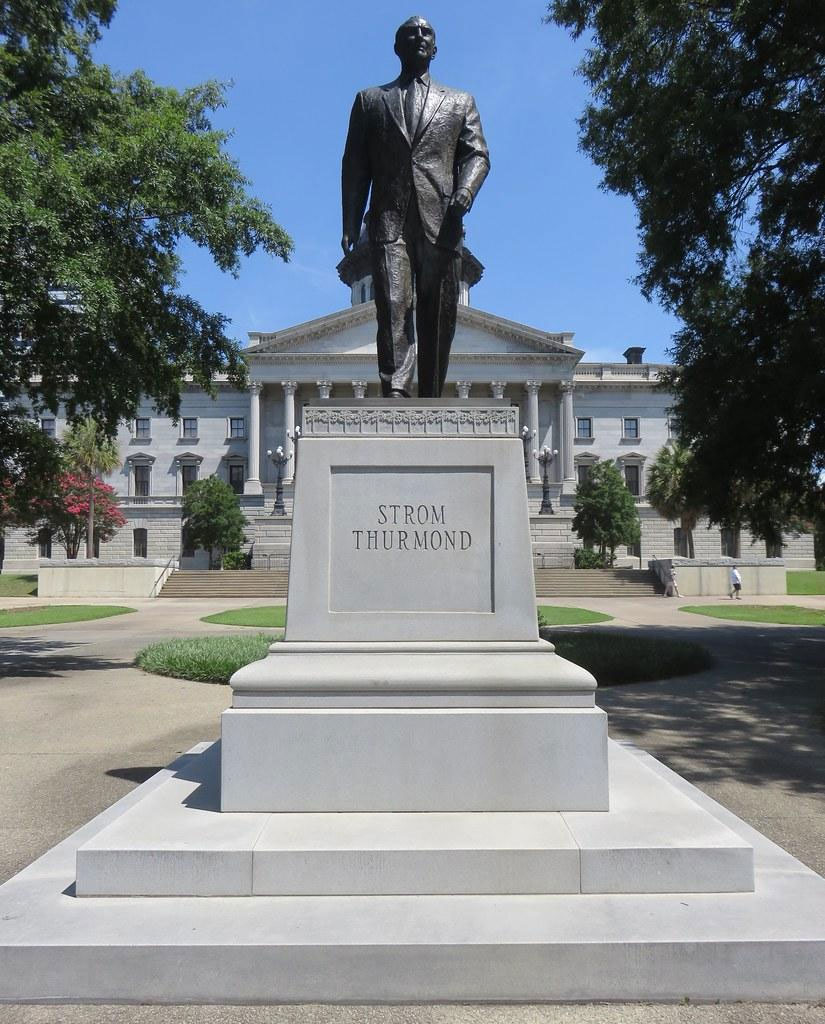
In December 1999, while Thurmond was still alive, a monument honoring him was unveiled on the grounds of the South Carolina State House.
The inscription presented the senator’s family history as it was then publicly acknowledged. It identified four children.
There was another child.
In 1925, Thurmond had fathered a daughter, Essie Mae Washington-Williams, with Carrie Butler, a 16-year-old African American domestic worker employed by his family. Thurmond was 22 at the time. Their daughter grew up knowing the identity of her father, and the two maintained a relationship that included his assistance with her education.
The relationship remained outside Thurmond’s acknowledged public family history throughout his long political career.
After his death in 2003, Essie Mae publicly confirmed that she was his daughter. Her account introduced a deeply personal dimension to a biography already marked by the politics of racial separation. Here was a man who had publicly defended segregation while privately maintaining a relationship with an African American daughter.
The historical significance lies in the contradiction, but Essie Mae’s own experience should not be reduced to an instrument for condemning her father. She spoke about their relationship with a complexity that reflected her personal history, including affection and disappointment. Her testimony deserves to be understood on its own terms.
South Carolina, meanwhile, faced a practical problem with the monument it had erected.
The inscription was incomplete.
In 2004, the state’s General Assembly directed that the monument be altered to acknowledge Essie Mae and correct the number of Thurmond’s children from four to five. The change was subsequently made.
There is an enduring lesson in that episode. A state had constructed a permanent tribute to one of its most influential political figures, yet the biography presented in stone omitted a fact that substantially complicated the public understanding of his life. The monument had not necessarily been intended to deceive. It nevertheless reflected an incomplete account, and history eventually required the institution responsible for it to acknowledge what had been missing.
The correction did not erase Thurmond’s years in public office, nor did it resolve the contradictions of his political career. It made the monument more accurate.
That is an important distinction. Historical accountability does not always require removing a memorial. Sometimes it requires confronting the distance between the person being celebrated and the person who actually lived.
The Problem With Permanent Reverence
Comparing the monuments of Strom Thurmond and Charlie Kirk does not mean equating their political careers. Thurmond exercised governmental authority for decades, participated directly in legislative decisions, and held positions whose consequences became part of American institutional history. Kirk operated through political organizing, commentary, and public persuasion. Their circumstances, accomplishments, and responsibilities were different.
The comparison concerns the institutions responsible for preserving their legacies.
A monument is rarely a neutral presentation of a complete life. It represents a selection of achievements, characteristics, and symbols that the sponsoring institution considers worthy of preservation. The selection may be defensible, but it remains a selection.
Thurmond’s monument demonstrates how an incomplete public biography can become embedded in official commemoration. Kirk’s monument raises a different question: how a political organization interprets the significance of its founder and whether that interpretation should be understood as an organizational tribute or a broader historical judgment.
These are legitimate questions regardless of one’s opinion of either man.
The difficulty arises when reverence is allowed to substitute for examination. Once a public figure has been elevated into a symbol, criticism of the person’s record can be interpreted as an attack upon everyone who identifies with that symbol. Historical inquiry then becomes entangled with political loyalty, and facts that complicate the preferred narrative are treated as intrusions.
The result is not necessarily a false history. It may be something more difficult to detect: a carefully limited history in which the favorable elements receive permanent recognition while the less convenient portions remain available only to those willing to look for them.
That is how public memory can become selective without appearing to be deliberately fabricated.

The Compass and the Institution
The controversy surrounding Chappelle has exposed questions that cannot be settled by deciding whether his remarks were funny. Comedy is subjective, and audiences will continue to disagree about its limits. Political violence, however, is not a matter of comedic preference. Kirk’s assassination was an attack upon a human life, and the fact that he was a controversial public figure offers no justification for it.
The same recognition of human dignity should extend beyond the boundaries of political affiliation.
George Floyd’s death does not become suitable for ridicule because an audience disagrees with the political movement associated with his name. Palestinian civilians do not become less deserving of compassion because their suffering occurs within a conflict that divides American opinion. Nor does Kirk’s death become less tragic because his public statements offended people.
These circumstances differ in their causes and historical significance, but none requires the abandonment of a consistent regard for human life.
The more demanding inquiry concerns the institutions and commentators who claim to uphold that regard. Their positions should be examined across circumstances, especially when the subject of condemnation changes from an opponent to an ally.
The same principle applies to historical commemoration. A political movement may honor its founder, a state may recognize a longtime official, and a family may preserve the memory of someone it loved. None of those acts should require the public to suspend its examination of the historical record.
South Carolina’s amendment to the Thurmond monument remains an instructive reminder that official remembrance is not necessarily complete remembrance. The state eventually acknowledged a fact that the original inscription had omitted. Whether the public’s understanding of Thurmond changed as substantially as the monument did is a larger question, one that cannot be answered by the addition of a name alone.
The Kirk monument presents its own questions for the generations that will encounter it. What will they be told about his political influence, his public rhetoric, his accomplishments, and the controversies that accompanied his career? Will the memorial encourage historical understanding, or will it primarily communicate the admiration of those who commissioned it?
Neither question diminishes the right of his supporters to remember him.
Both concern the public’s right to understand him.
There is a tendency in American political discourse to demand that every controversy produce an immediate verdict. Someone must be vindicated, someone condemned, and the matter declared settled before the next controversy arrives. That habit is poorly suited to questions involving human dignity, historical memory, and the conduct of institutions.
The Chappelle episode deserves more than another contest over who has been offended. It invites an examination of whether the principles invoked in public debate have any durability beyond the immediate interests of those invoking them.
A society committed to human dignity should have little difficulty condemning political assassination while permitting scrutiny of the deceased. It should be capable of recognizing the grief of a widow without transforming that grief into a prohibition against historical inquiry. It should also be capable of examining jokes about death without assuming that every person who laughs has endorsed the circumstances of the death itself.
The same intellectual discipline ought to govern the construction of monuments. Admiration may explain why a statue was commissioned, but it cannot settle the historical judgment of the person depicted. That judgment remains subject to evidence, revision, and the discovery of facts that earlier generations may have neglected or preferred not to acknowledge.
Strom Thurmond’s monument required a correction because the official account of his family was incomplete. Charlie Kirk’s monument, erected by the organization he founded, represents the admiration of a political community whose interpretation of his legacy will continue to be examined.
And the jokes that brought these questions into view will eventually fade from the headlines.
What should remain is the more difficult question of whether Americans are prepared to apply their professed moral standards when doing so requires examining people they admire.
A moral compass has little value if its direction depends upon whose hand is holding it.
At InnerKwest.com, we are committed to delivering impactful journalism, deep insights, and fearless social commentary. Your cryptocurrency contributions help us execute with excellence, ensuring we remain independent and continue to amplify voices that matter.
To help sustain our work and editorial independence, we would appreciate your support of any amount of the tokens listed below. Support independent journalism:
BTC: 3NM7AAdxxaJ7jUhZ2nyfgcheWkrquvCzRm
SOL: HxeMhsyDvdv9dqEoBPpFtR46iVfbjrAicBDDjtEvJp7n
ETH: 0x3ab8bdce82439a73ca808a160ef94623275b5c0a
XRP: rLHzPsX6oXkzU2qL12kHCH8G8cnZv1rBJh TAG – 1068637374
SUI – 0xb21b61330caaa90dedc68b866c48abbf5c61b84644c45beea6a424b54f162d0c
and through our Support Page.
InnerKwest maintains a revelatory and redemptive discipline, relentless in advancing parity across every category of the human experience.
© 2026 InnerKwest®. All Rights Reserved | Haki zote zimehifadhiwa | 版权所有. InnerKwest® is a registered trademark of Inputit™ Platforms Inc. Global. No part of this publication may be reproduced, distributed, or transmitted in any form or by any means without prior written permission. Unauthorized use is strictly prohibited. Thank you for standing with us in pursuit of truth and progress!