
November 14, 2026
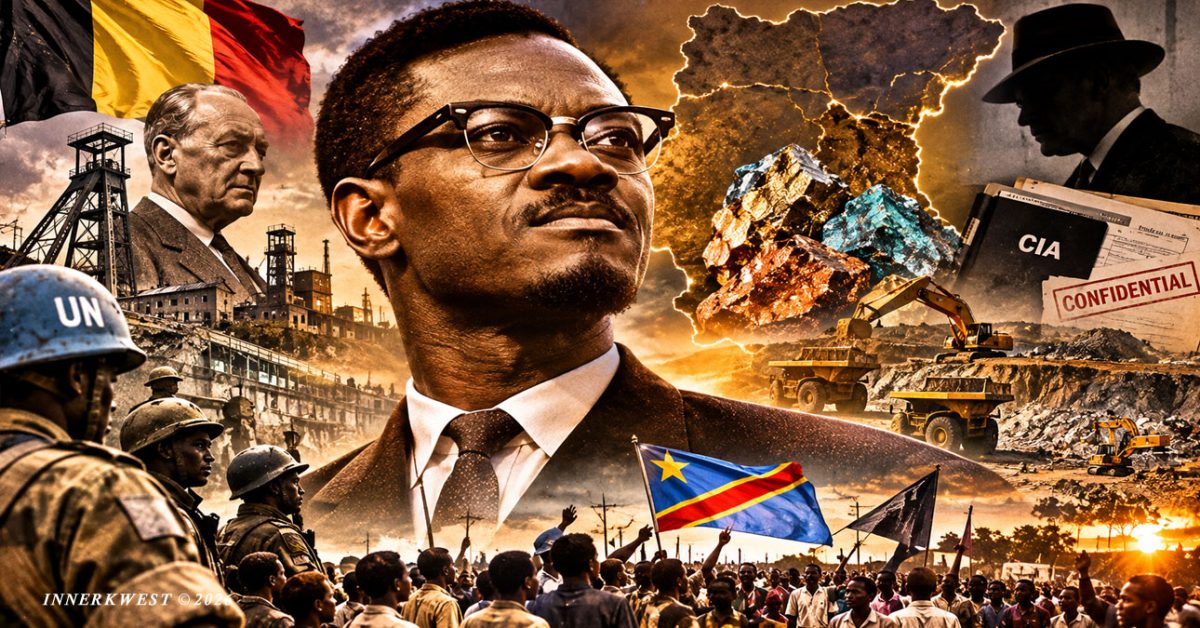
The assassination of Patrice Lumumba was not an isolated act of political violence. Behind Congo’s troubled independence stood Belgian mining interests, foreign intelligence operations, and a struggle over who would control one of the world’s richest territories. The consequences would extend far beyond 1961.
By the InnerKwest Editorial Desk
On June 30, 1960, Congo gained its independence from Belgium.
Eleven days later, its wealthiest province declared itself a separate state.
By September, the country’s first prime minister, Patrice Lumumba, had been driven from power. On January 17, 1961, he was murdered alongside two political colleagues.
He was 35 years old.
For decades, the circumstances surrounding his death were obscured by official denials, conflicting accounts, and documents withheld from public scrutiny. Subsequent investigations would expose the involvement of Belgian officials, the financial interests of a powerful mining corporation, and an American intelligence operation that had separately contemplated his assassination.
The history is disturbing enough without embellishment.
What happened to Lumumba was part of a larger confrontation over whether Congo’s newly acquired political independence would extend to control of its territory, institutions, and extraordinary natural wealth.
The Mining Company Behind the Curtain
Long before independence, Congo had been organized to serve the economic interests of its colonial rulers.
Under King Leopold II, whose personal control of the Congo Free State began in 1885, forced labor, violence, disease, and starvation contributed to catastrophic population losses. Some historical estimates suggest a demographic decline approaching 10 million people, although the precise figure remains disputed.
Belgium assumed direct colonial control in 1908. The system became more formally administered, but the extraction of Congolese wealth remained central to its economy.
Among the most powerful enterprises was Union Minière du Haut-Katanga, or UMHK.
Established in 1906, the Belgian-controlled corporation operated vast copper and cobalt interests in Katanga. Its holdings extended into industrial facilities, transportation, hospitals, schools, and entire mining communities.
It also controlled the Shinkolobwe uranium mine, which supplied strategically important material for the American atomic weapons program during World War II.
Congo’s minerals had helped fuel industrial development abroad and the emergence of the nuclear age.
The Congolese themselves had little authority over the decisions governing those resources.
Independence threatened to change that relationship.
Or so it appeared.
Eleven Days After Freedom
On July 11, 1960, Moïse Tshombe declared Katanga independent from the newly established Congolese state.
The province contained some of the country’s most valuable mineral deposits and represented an essential source of public revenue.
Its separation threatened the economic survival of Lumumba’s government.
Belgian military personnel and advisers assisted the secessionist authorities. UMHK helped sustain the breakaway administration by directing substantial tax payments to Katanga rather than the central government.
A Belgian parliamentary investigation completed in 2001 documented the company’s financial support for the secession.
This was not merely a disagreement among Congolese politicians over the proper structure of government.
Foreign commercial interests had a direct stake in the outcome.
Lumumba wanted a unified Congo. Tshombe favored arrangements that would preserve Katanga’s autonomy and control over its wealth.
The difference was fundamental.
Without effective authority over Katanga, the central government would struggle to exercise the sovereignty it had just acquired.
Belgium’s Unfinished Departure
Belgium formally surrendered colonial authority in June 1960, but Belgian influence did not disappear with the lowering of its flag.
The parliamentary inquiry into Lumumba’s death documented efforts by Belgian officials to undermine his government and support political opponents.
Belgian personnel remained deeply involved in Katanga’s administration and security apparatus.
Some officials regarded Lumumba as an obstacle to Belgian interests. Others feared the consequences of his political direction and the rapid dismantling of colonial arrangements.
Their actions went beyond expressing concern.
Belgian authorities supported efforts to remove him from power, while elements of the former colonial establishment helped sustain the province that had rejected his government’s authority.
The distinction between formal independence and effective control was becoming painfully apparent.
Congo had acquired the legal right to govern itself.
Whether it would be allowed to exercise that right was another matter.
Washington Had Its Own Plans
The United States viewed the crisis through the Cold War.
When Lumumba sought Soviet assistance after failing to secure the support he wanted from Western governments and the United Nations, American officials increasingly treated him as a potential threat.
Lumumba maintained that Congo should be free to seek assistance without becoming subordinate to either Washington or Moscow.
That position did not satisfy American intelligence officials.
In 1975, the United States Senate’s Church Committee investigated covert operations directed against foreign leaders.
Its findings established that the CIA had developed an assassination plot against Lumumba.
Poison intended for use against him was delivered to the CIA station in Congo.
The plot was not carried out, and the committee did not establish that the CIA directly participated in his eventual murder.
Nevertheless, the revelation was extraordinary.
While Congo struggled to establish its independence, intelligence officials of the United States were considering the assassination of its prime minister.
The documentary evidence leaves little room to dispute that fact.
The Removal and Murder of Lumumba
In September 1960, a constitutional confrontation erupted between Lumumba and President Joseph Kasa-Vubu.
Kasa-Vubu announced the prime minister’s dismissal. Lumumba challenged the decision, and Parliament continued to support him.
Colonel Joseph-Désiré Mobutu then intervened.
Mobutu, whom Lumumba had appointed army chief of staff, announced the military’s neutralization of the competing political authorities. American intelligence maintained contacts with him, and American assistance subsequently helped strengthen his position.
Lumumba was isolated, eventually captured, and imprisoned.
On January 17, 1961, he was transferred to Katanga with Maurice Mpolo and Joseph Okito.
All three were beaten and executed.
Katangan authorities ordered the killings. Belgian officers and police personnel were present and involved in the circumstances of the executions.
Their bodies were subsequently exhumed and destroyed using acid.
The destruction was deliberate. It helped conceal the crime and denied the families the remains of their loved ones.
For years, the truth was buried beneath official explanations that did not withstand investigation.
In 2001, a Belgian parliamentary commission concluded that certain Belgian ministers and other Belgian actors bore moral responsibility for the circumstances leading to Lumumba’s death.
It did not establish that the Belgian government collectively ordered his assassination.
That distinction matters. So does the documented conduct that the inquiry uncovered.
In 2002, Belgium apologized.
It had taken more than four decades.
What Followed Was Not Freedom
In November 1965, Mobutu seized power again.
This time, he remained in control for 32 years.
His government, which renamed the country Zaire, became synonymous with authoritarian rule, political patronage, and the diversion of public wealth.
For much of the Cold War, Washington considered Mobutu a valuable strategic ally.
The leader who had helped remove Congo’s first prime minister became the beneficiary of sustained Western political support.
Mobutu’s dictatorship ended in 1997, but the country did not emerge into lasting peace.
Regional wars followed, drawing in neighboring governments and armed movements. The aftermath of the Rwandan genocide, disputes over security and territory, domestic political struggles, and competition over resources contributed to devastating violence.
The human cost reached into the millions.
The International Rescue Committee estimated approximately 5.4 million excess deaths in Congo between 1998 and 2007, many resulting not from direct combat but from disease, hunger, displacement, and the collapse of essential services.
The precise estimate has been challenged by subsequent demographic research.
The scale of the humanitarian catastrophe has not.
It would be misleading to suggest that Lumumba’s assassination alone caused every conflict and death that followed. Congo’s later wars involved distinct political actors, regional rivalries, and historical circumstances.
But the destruction of its first independent government, followed by decades of dictatorship and weakened institutions, cannot be excluded from the account of how the country arrived there.
A Country Rich in Minerals, Poor in Security
More than six decades after Lumumba’s murder, Congo remains indispensable to global industry.
Its copper and cobalt are essential to electrical systems, batteries, and modern manufacturing. In 2025, the country accounted for roughly three-quarters of the world’s mined cobalt production.
The commodities have changed in strategic importance. So have the governments, corporations, and investors involved.
Congolese leaders have exercised authority over mining agreements and resource policy, and they must be held accountable for their own decisions.
But the underlying question remains difficult to escape.
How does a country possessing such extraordinary natural wealth continue to experience such profound insecurity and deprivation?
The answer cannot be reduced to colonialism alone, nor can the consequences of colonial economic structures simply be dismissed because decades have passed.
Congo’s history requires examination of both external interference and domestic responsibility.
To ignore either is to leave the account incomplete.
The Tooth That Returned
In June 2022, Belgian authorities returned a tooth attributed to Patrice Lumumba to his family.
More than 61 years had passed since his assassination.
The rest of his remains had been deliberately destroyed.
The return was accompanied by renewed acknowledgment of Belgium’s responsibility in the events surrounding his death.
It was a moment of historical recognition, but not a restoration of what had been taken.
A man had been murdered. A government had been destroyed. A country had been pushed into a struggle over sovereignty that would outlive the individuals responsible.
And a family had waited more than six decades to receive even that small remnant.

The Record Is No Longer Hidden
Patrice Lumumba was not beyond criticism. His brief government faced serious internal divisions, and military operations conducted during his tenure included grave abuses against civilians in South Kasai.
Those facts belong in the historical record.
So do the actions of Union Minière du Haut-Katanga, Belgian officials, the CIA, Mobutu, and the Katangan authorities who ordered Lumumba’s execution.
The evidence does not establish that all these actors shared a single coordinated plan. Their interests sometimes differed, and their responsibilities were not identical.
But their actions converged in the destruction of Lumumba’s political authority and, ultimately, his life.
The larger consequence was a country whose first experiment in independence was overwhelmed by internal conflict and foreign intervention before its institutions could take root.
Congo’s subsequent history cannot be explained by that episode alone. Neither can the episode be separated from the institutional weaknesses and struggles over wealth that followed.
The names are known. Much of the documentary record is available. The official investigations have been published.
What remains is not a shortage of history, but a willingness to confront what that history establishes.
Congo did not lack the wealth to build a nation. Its first government was denied the opportunity to determine, free from foreign intervention, how that wealth might serve its people.
That is not the whole story of Congo.
But it is a part of the story the world has too often been willing to leave behind.
At InnerKwest.com, we are committed to delivering impactful journalism, deep insights, and fearless social commentary. Your cryptocurrency contributions help us execute with excellence, ensuring we remain independent and continue to amplify voices that matter.
To help sustain our work and editorial independence, we would appreciate your support of any amount of the tokens listed below. Support independent journalism:
BTC: 3NM7AAdxxaJ7jUhZ2nyfgcheWkrquvCzRm
SOL: HxeMhsyDvdv9dqEoBPpFtR46iVfbjrAicBDDjtEvJp7n
ETH: 0x3ab8bdce82439a73ca808a160ef94623275b5c0a
XRP: rLHzPsX6oXkzU2qL12kHCH8G8cnZv1rBJh TAG – 1068637374
SUI – 0xb21b61330caaa90dedc68b866c48abbf5c61b84644c45beea6a424b54f162d0c
and through our Support Page.
InnerKwest maintains a revelatory and redemptive discipline, relentless in advancing parity across every category of the human experience.
© 2026 InnerKwest®. All Rights Reserved | Haki zote zimehifadhiwa | 版权所有. InnerKwest® is a registered trademark of Inputit™ Platforms Inc. Global. No part of this publication may be reproduced, distributed, or transmitted in any form or by any means without prior written permission. Unauthorized use is strictly prohibited. Thank you for standing with us in pursuit of truth and progress!