
November 14, 2026
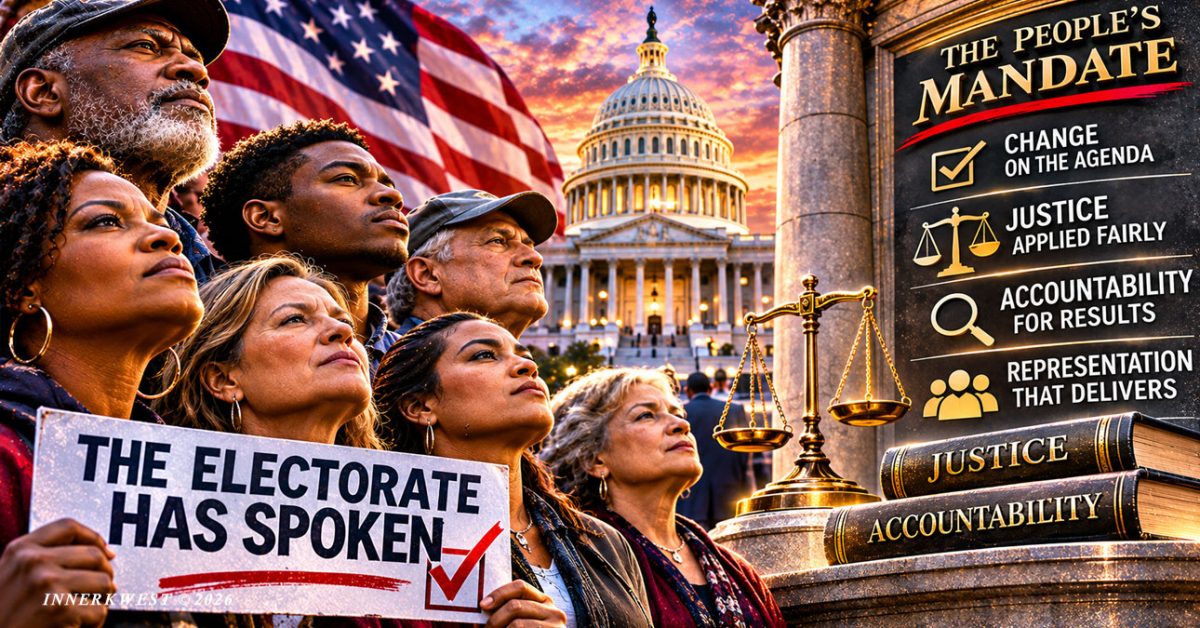
Voters changed the balance of power, overcoming political expectations and, in several states, districts redrawn to resist that change. Now the mandate moves from the ballot box into congressional rooms the electorate does not control. What happens when the people demand change, but their representatives must decide what that change means?
By the InnerKwest Editorial Desk
Something unusual happened on the way to Washington. The question is not whether Chuck Schumer and Hakeem Jeffries understood the voter sentiment behind the blue tsunami. The message was difficult to miss. The question now is whether they are willing to act on it—and whether they are prepared to do the will of the people who gave them the mandate.
Before voters ever reached the polls in November, political institutions had already spent months preparing for what they thought those voters would do.
Congressional districts were redrawn in the middle of the decade. Lines moved across Texas, Florida, Alabama, North Carolina, Ohio and other states as Republicans sought additional protection for a narrow House majority. California Democrats answered with a redistricting offensive of their own. What normally follows the census became a national political contest conducted before the next census had arrived.
The calculations were sophisticated. Previous elections could be measured. Demographic changes could be modeled. Districts could be constructed around assumptions about how particular communities were likely to vote.
Then people voted.
The Republican redistricting strategy largely failed to produce its intended result. In Texas, Republicans captured only one of five Democratic seats they had targeted while Democrats defeated Republicans in two districts. Democratic incumbents survived newly configured terrain in Florida and Alabama. California Democrats flipped all five Republican seats targeted by their retaliatory map. Missouri’s attempted Republican redraw was stopped by the courts and rejected by voters.
Redistricting did not cause the Democratic wave by itself. The evidence points to something broader. Voters were dissatisfied with the administration, the economy and the war with Iran. Roughly six in ten participants in the AP Voter Poll disapproved of President Donald Trump’s handling of the presidency. Latino voting patterns shifted from assumptions drawn from 2024. Some districts designed around the expectation that previous political trends would continue discovered that voters had changed before the maps did.
The lines mattered.
The voters mattered more.
Now another set of predictions is being made.
This time they concern what the people elected by those voters will do once they enter the rooms where congressional power is organized.
Two Measurements of the Same Moment
Public-opinion polling and prediction markets are telling apparently different stories about the Democratic leadership that will inherit the new congressional majority.
A national YouGov survey commissioned by the progressive advocacy organization Indivisible asked registered voters whether Senate Democrats should choose Chuck Schumer as majority leader or someone else. Fifty-seven percent selected someone else. Ten percent selected Schumer. Among Democratic voters, 62 percent preferred someone else.
The survey consisted of 1,000 online interviews with registered voters and was weighted for demographic, geographic, partisan and previous-vote characteristics. Its approximate 95 percent confidence interval was 3.8 percentage points. Indivisible is not a neutral observer in the leadership dispute; it is actively campaigning for a change in Senate Democratic leadership. That sponsorship matters and should accompany the numbers. It does not make the survey disappear.
Other polling conducted before the election suggested dissatisfaction with congressional leadership as well, although some of those samples were drawn from competitive races rather than the country as a whole.
Prediction markets have been telling another story: substantial expectations of leadership continuity.
There is no contradiction in this.
A voter can believe that Schumer should be replaced and simultaneously wager money that Democratic senators will retain him. One measurement asks what people want. The other attempts to price what participants believe an institution will actually do.
The distance between those two answers is where the more interesting story begins.
Schumer’s position is no longer uncontested. Maryland Sen. Chris Van Hollen announced on November 12 that he would challenge him for Senate Democratic leader, saying that Americans had called for change and that the moment required new leadership. Schumer says he has the votes to remain. The closed-door election is expected in early December and will be the first contested election for Senate Democratic leader in decades.
There are elected Democrats on both sides.
Bernie Sanders and Sen.-elect Abdul El-Sayed are supporting Van Hollen. Other senators, including Sherrod Brown and Catherine Cortez Masto, are supporting Schumer. Maine Sen. Angus King, an independent who caucuses with Democrats, has argued that changing leadership after such a successful election would make little sense.
Those disagreements are not evidence that representative democracy has failed.
They are representative democracy at work.
The harder question is what representation requires after the ballots have been counted.
A Mandate, According to the Leaders Themselves
There is no need to assign an electoral mandate to Schumer and House Democratic Leader Hakeem Jeffries. They have already said one exists.
Six days after the election, the two leaders issued a joint statement saying Americans had demanded “dramatic change” and had given congressional Democrats a “clear mandate.” They identified affordability, healthcare, the Iran war and accountability for corruption among the responsibilities flowing from the election.
That statement changes the terms of the discussion.
The question is no longer whether congressional leadership recognizes that voters demanded something consequential.
Leadership says that they did.
The question is what follows from recognizing it.
An electoral mandate is not a blank check handed to a political party. Nor is it an instruction sheet containing a position on every bill, investigation, appointment and leadership election that will follow.
Millions of voters can arrive at the same ballot choice for different reasons. Some vote primarily because of prices. Others because of war. Healthcare, immigration, corruption, executive power, abortion, civil liberties or simple dissatisfaction may move others. Elections aggregate those motives into results; they do not erase their differences.
But neither can the magnitude of political change simply be reduced to another ordinary transfer of offices.
Voters changed the balance of power.
They did so in an election in which some districts had been deliberately reconfigured in anticipation of how those voters would behave. In several places, those assumptions failed.
The result deserves to be understood before it is interpreted on the electorate’s behalf.
Where the Voter Disappears From the Ballot
The election settles who goes to Washington. It does not settle what happens when they get there.
Voters do not elect the Senate majority leader. Democratic senators do. Under Democratic Conference rules, the leader is selected by members of the conference, without a vote of the full Senate. A contested election is conducted by secret ballot and continues until someone receives a majority of those present and voting.
That procedure is not an exception to representative democracy. It is part of it. Voters choose senators and send them to Washington with the authority to make decisions the electorate will never encounter on a ballot. Choosing their leadership is one of them.
The House arrives at leadership somewhat differently. Democrats choose their party leadership internally, while the Speaker is ultimately elected by the full House. Here again, however, the public’s influence is indirect. A voter in Kansas cannot cast a ballot for or against Hakeem Jeffries as Speaker unless Jeffries happens to be that voter’s representative—and even then, the ballot is for his congressional seat, not the speakership.
This is where the 2026 election becomes more interesting than a conventional argument about who should lead Democrats.
The people who produced the new majority now hand their electoral power to representatives who must interpret what they were sent there to do. Some will conclude that retaining experienced leadership gives them the best chance of carrying out that assignment. Others may read an election of this magnitude as a demand for changes that should reach the leadership table itself.
There is no national ballot that settles the argument.
There are instead hundreds of elected representatives, carrying hundreds of constituencies into rooms where decisions are made in the electorate’s name.
The distance between those rooms and the ballot box has always existed. After an election built so heavily around change, it becomes considerably harder to ignore.
What Does Accountability Mean After Election Day?
Representative democracy was never designed to convert every opinion poll into a legislative command.
There are reasons for that.
Public opinion can move rapidly. Majorities can contradict one another. Representatives possess information their constituents may not have. Negotiation requires compromise. Long-term policy sometimes demands decisions that are immediately unpopular. A legislator who merely checks the latest survey before every vote would not really be exercising judgment at all.
But discretion creates its own problem.
How does an electorate hold institutions accountable when the most consequential decisions inside those institutions are several steps removed from the ballot?
That question becomes more difficult when political leaders themselves invoke the electorate as the source of their authority.
If an election is described as a clear mandate, then the word mandate must carry some meaning beyond victory.
And if leadership claims the authority of that mandate, leadership can reasonably be examined against the objectives it says the mandate contains.
That is not the same thing as requiring Schumer or Jeffries to step aside.
It is not evidence that either man is a Democrat “in name only.” Political labels of that kind may express dissatisfaction, but they resolve very little. They substitute a judgment about ideological authenticity for the more difficult examination of performance.
The useful questions are harder.
Can congressional leadership translate the electoral demand it has identified into legislation?
Can it conduct meaningful oversight while governing?
Can it pursue affordability while investigating corruption?
Can it negotiate where negotiation is necessary without allowing negotiation to become surrender?
Can it distinguish accountability from revenge without using that distinction to avoid accountability altogether?
Justice and accountability are not inherently competing obligations.
Neither are governing and oversight.
Congress was constructed to do more than one thing at a time.
The Redistricting Lesson
There is an irony in what happened in November.
Redistricting is partly an exercise in prediction.
Political mapmakers examine what voters have done and construct districts around assumptions about what those voters will do again. The 2026 mid-decade redistricting campaign depended heavily on the durability of political patterns visible in 2024.
Some of those patterns did not hold.
In the Texas districts targeted by Republicans, for example, the strategy depended partly upon continued Republican strength among Latino voters. Instead, the electorate moved. A map designed around yesterday’s behavior encountered tomorrow’s voter.
Prediction markets now confront a different version of the same uncertainty.
Their participants examine congressional relationships, incumbent advantages, caucus loyalties, political experience and the absence or presence of credible challengers. From those ingredients they estimate what an institution will do.
Those markets may prove correct.
But the election just demonstrated something worth remembering.
Institutions can calculate around voters.
They cannot always calculate voters themselves.
The People Between the People and Power
It would be easy to make this a story about two men. The structure of Congress makes it considerably larger than that.
If Democratic senators retain Schumer as their leader, they will have made that decision. The same is true of House Democrats and Jeffries. Leadership does not perpetuate itself by declaration. Members of Congress make choices about who will represent them inside the institution, and those choices become part of their own records.
That matters after an election in which voters changed the balance of power.
Newly elected members arrive in Washington with constituencies of their own. So do incumbents who survived the election. They may disagree about what voters intended, how much change was demanded, or whether experienced leadership is an asset in carrying it out. Those disagreements are unavoidable. An election can establish political direction without producing unanimous instructions about how Congress should organize itself.
The responsibility for interpreting that direction nevertheless has to land somewhere.
It lands first with the representatives the voters elected.
They will decide who leads them. They will decide which legislation advances, which investigations receive attention, where compromise is warranted and where resistance is required. Eventually, those decisions accumulate into something voters can judge.
That is the accountability chain.
It is slower and less direct than the ballot box, and much of it takes place beyond public view. But the distance does not eliminate responsibility. It merely changes where responsibility resides.
The Unanswered Mandate
The 2026 electorate has already done the part that belongs exclusively to it.
It voted.
It changed congressional control. It altered political expectations in states that had seemed resistant to such movement. It overcame, in several places, district configurations constructed around assumptions that previous voting behavior would continue.
Now the mandate moves somewhere voters cannot directly follow it.
Into caucus rooms.
Into leadership elections.
Into committee assignments.
Into negotiations.
Into private conversations among people who possess the authority voters have temporarily entrusted to them.
That transfer is not a corruption of representative democracy.
It is representative democracy.
But representation carries an obligation that survives Election Day.
Those exercising delegated power must eventually answer for what they did with it.
Schumer and Jeffries have said the American people demanded dramatic change. Their critics say existing leadership cannot deliver it. Their supporters say experience and the demonstrated ability to build a winning coalition are precisely what will allow Democrats to turn electoral victory into governing results.
Soon, those arguments will leave television studios, activist channels, opinion polls and prediction markets.
Representatives will have to vote.
Then they will have to govern.
The electorate has already spoken.
The next question is not whether Washington heard it.
It is what Washington believes it heard—and whether the people who delivered the mandate will recognize it when they see what follows.
At InnerKwest.com, we are committed to delivering impactful journalism, deep insights, and fearless social commentary. Your cryptocurrency contributions help us execute with excellence, ensuring we remain independent and continue to amplify voices that matter.
To help sustain our work and editorial independence, we would appreciate your support of any amount of the tokens listed below. Support independent journalism:
BTC: 3NM7AAdxxaJ7jUhZ2nyfgcheWkrquvCzRm
SOL: HxeMhsyDvdv9dqEoBPpFtR46iVfbjrAicBDDjtEvJp7n
ETH: 0x3ab8bdce82439a73ca808a160ef94623275b5c0a
XRP: rLHzPsX6oXkzU2qL12kHCH8G8cnZv1rBJh TAG – 1068637374
SUI – 0xb21b61330caaa90dedc68b866c48abbf5c61b84644c45beea6a424b54f162d0c
and through our Support Page.
InnerKwest maintains a revelatory and redemptive discipline, relentless in advancing parity across every category of the human experience.
© 2026 InnerKwest®. All Rights Reserved | Haki zote zimehifadhiwa | 版权所有. InnerKwest® is a registered trademark of Inputit™ Platforms Inc. Global. No part of this publication may be reproduced, distributed, or transmitted in any form or by any means without prior written permission. Unauthorized use is strictly prohibited. Thank you for standing with us in pursuit of truth and progress!