
The Collapse of Conviction, the Rise of Moral Evasion, and the Reckoning We Can No Longer Avoid
An InnerKwest Essay | January 22, 2026
The Inflection Point We Refuse to Name
We are not merely living through political instability, economic fracture, or technological acceleration. Those are symptoms. What we are living through is a moral disorientation so profound that even the language meant to guide us—words like faith, values, belief, justice—has begun to dissolve under its own misuse.
We are at an inflection point not because events are extreme, but because justifications have become limitless.
In this moment, faith is invoked everywhere. It appears in press conferences, in op-eds, in sermons, in protest calls, in political defenses, and increasingly, in explanations for behavior that would once have been universally condemned. Violence is explained. Indifference is sanctified. Cruelty is rationalized. And when challenged, the response is often a single, amorphous shield:
“We are acting out of faith.”
But faith in what?
That is the question that is no longer being asked—and it is the question that changes everything.
Faith Is Not a Vibe. It Is a Commitment.
Faith was never meant to be atmospheric. It was never meant to be symbolic. It was never meant to be a cultural aesthetic or a rhetorical posture.
Historically, faith was specific, costly, and binding.
Faith was orientation toward something named:
- Faith in God (and a particular conception of God)
- Faith in moral law
- Faith in the sanctity of human life
- Faith in restraint over impulse
- Faith in justice over power
Faith was never a blank check. It was a constraint.
To have faith meant that certain actions were now off-limits, even when they were convenient, popular, or profitable. Faith did not excuse behavior—it disciplined it.
That is precisely why faith carried moral authority. Not because it was loud, but because it was limiting.
Faith Without an Object Is Not Faith. It Is Rhetoric.
What we are witnessing now is something categorically different.
Faith is being invoked without naming its object. And when faith is stripped of its referent, it becomes unaccountable.
Faith without an object cannot be examined.
Faith without an object cannot be tested.
Faith without an object cannot be falsified.
It becomes a moral fog machine—something that obscures rather than clarifies.
This is why people increasingly distrust the language of faith, even when they still hunger for moral grounding. The problem is not faith itself. The problem is that faith has been emptied of content while retaining its authority.
What remains is not conviction. It is camouflage.
The Collapse from Faith → Identity → Emotion → Permission
The degradation followed a predictable path:
- Faith — anchored belief + moral obligation
- Becomes identity — “people of faith,” “faith leaders,” “faith community”
- Becomes emotion — “this feels righteous”
- Becomes permission — “therefore anything we do is justified”
Once faith becomes identity, it stops disciplining the self and starts defending the group. Once it becomes emotion, it stops asking Is this right? and starts asking Does this affirm us?
At that point, faith can attach itself to anything:
- Faith in nationalism
- Faith in racial hierarchy
- Faith in weapons
- Faith in violence
- Faith in institutions
- Faith in spectacle
- Faith in grievance
- Faith in dominance
Even faith in brands, teams, tribes, and power structures.
And because the object is never named, none of these attachments are interrogated.
The Cowardice of Generalized Faith
There is a reason many so-called faith leaders speak in abstraction. It is not accidental. It is strategic.
Specificity costs something.
If a leader says:
- “We have faith in the sanctity of life,”
they must oppose killing regardless of who is targeted.
If a leader says:
- “We have faith in a God who demands restraint,”
they must confront violence committed in His name.
If a leader says:
- “We have faith in justice over power,”
they must challenge the state when it overreaches.
But if a leader says only:
“We are people of faith”
—then nothing is required. No lines must be drawn. No alliances must be risked. No donors must be lost. No access must be forfeited.
This is not leadership.
It is insulation.
Faith Without Declaration Is Faith Without Conviction
Conviction requires risk.
Conviction requires clarity.
Conviction requires naming what you are loyal to—even when that loyalty costs you safety, status, or belonging.
When leaders refuse to declare the object of their faith, what they are really saying is:
Judge us by our language, not our commitments.
That is why trust is collapsing—not in faith itself, but in its representatives.
People sense, intuitively, that something is missing. They may not articulate it in philosophical terms, but they feel the hollowness. They recognize when faith is being used as moral theater rather than moral restraint.
Faith vs. Belief: The Distinction That Was Erased
A crucial distinction has been deliberately blurred.
Belief is cognitive assent: I accept this as true.
Faith is existential commitment: I will live as though this is true.
Belief can be abstract. Faith is always consequential.
When someone claims faith but rejects moral accountability, what they are often expressing is belief intensity, not faith. And belief intensity, unmoored from ethics, is one of the most volatile forces in human history.
History does not record atrocities committed by people who “lacked belief.”
It records atrocities committed by people who believed fanatically—without restraint.
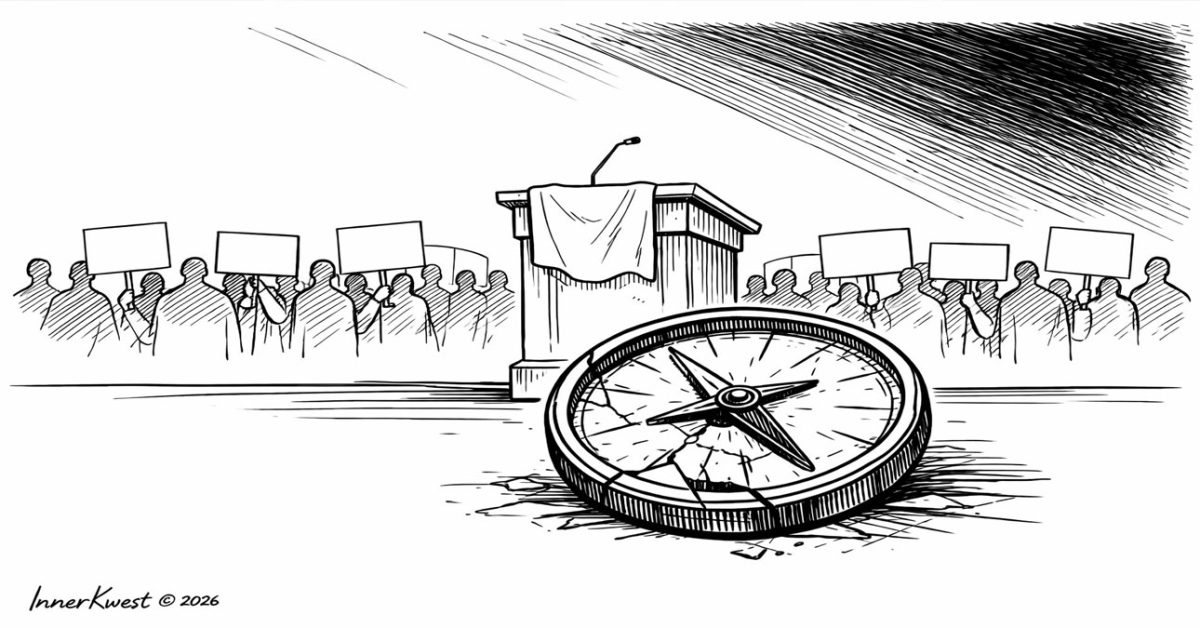
The Missing Moral Compass
A moral compass is not a slogan. It is not a hashtag. It is not a press release.
A moral compass is a set of prohibitions as much as it is a set of ideals.
Traditionally, faith demanded answers to uncomfortable questions:
- What do you refuse to do because of your faith?
- What violence do you not excuse?
- What power do you reject?
- Who do you defend when it costs you?
- What truth do you not bend?
Modern faith discourse avoids these questions because they fracture coalitions. But faith was never meant to be coalition-friendly. It was meant to be truth-bound.
When Faith Is Used to Sanctify Harm
The most dangerous moment is not when faith is absent—but when it is invoked to excuse the inexcusable.
When faith is used to justify:
- State violence without accountability
- Dehumanization of entire populations
- Collective punishment
- Indifference to suffering
- Murder framed as necessity
—faith has inverted its purpose.
At that point, faith is no longer a moral compass. It is a moral alibi.
And unnamed faith is the most effective alibi of all.
The Reckoning Faith Cannot Avoid
We have reached a point where faith must choose what it will be.
Either faith will be reclaimed as a discipline that restrains behavior, or it will remain a language of permission that sanctifies power.
There is no neutral outcome.
If faith is to matter again—if it is to recover credibility—it must do the one thing modern discourse resists most:
It must name its object.
Faith that cannot name what it serves is not moral.
It is strategic.
Real faith names what it serves.
Real faith limits behavior.
Real faith invites judgment—because it believes it can withstand it.
Anything else is noise dressed up as holiness.
The Unapologetic Line (Non-Negotiable)
This is the line that must be drawn without apology:
Faith without an object is not faith.
It is permission.
And permission—unbounded, unexamined, and unaccountable—is how societies lose their moral center while insisting they still have one.
People have not lost faith because they are cynical.
They have lost faith because they have watched it excuse too much.
The hunger for moral clarity has not disappeared.
It has simply outgrown the language that refuses to provide it.
And until faith is willing to name what it is faithful to—and what it therefore refuses to become—it will remain not a compass, but a mask.
History is watching which one we choose.
At InnerKwest.com, we are committed to delivering impactful journalism, deep insights, and fearless social commentary. Your cryptocurrency contributions help us execute with excellence, ensuring we remain independent and continue to amplify voices that matter.
To help sustain our work and editorial independence, we would appreciate your support of any amount of the tokens listed below. Support independent journalism:
BTC: 3NM7AAdxxaJ7jUhZ2nyfgcheWkrquvCzRm
SOL: HxeMhsyDvdv9dqEoBPpFtR46iVfbjrAicBDDjtEvJp7n
ETH: 0x3ab8bdce82439a73ca808a160ef94623275b5c0a
XRP: rLHzPsX6oXkzU2qL12kHCH8G8cnZv1rBJh TAG – 1068637374
SUI – 0xb21b61330caaa90dedc68b866c48abbf5c61b84644c45beea6a424b54f162d0c
and through our Support Page.
InnerKwest maintains a revelatory and redemptive discipline, relentless in advancing parity across every category of the human experience.
© 2026 InnerKwest®. All Rights Reserved | Haki zote zimehifadhiwa | 版权所有. InnerKwest® is a registered trademark of Inputit™ Platforms Inc. Global. No part of this publication may be reproduced, distributed, or transmitted in any form or by any means without prior written permission. Unauthorized use is strictly prohibited. Thank you for standing with us in pursuit of truth and progress!