
By InnerKwest Intelligence Desk | March 8, 2026
A Conflict That Is Quietly Rewiring Global Logistics
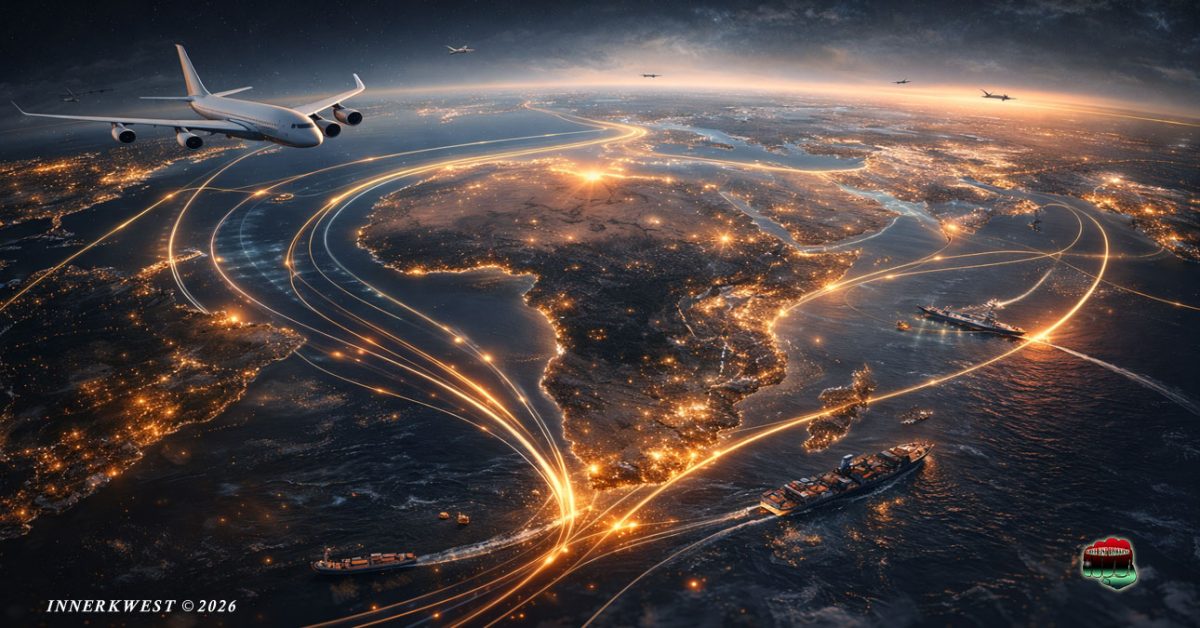
Wars rarely reshape the global system in only one place. The current confrontation involving the United States, Israel, and Iran is already rippling through energy markets, aviation routes, and maritime corridors. But another, less discussed shift may be unfolding further south. As airlines, shipping companies, and logistics planners adjust to instability across the Middle East, a continent long described as peripheral to global trade is emerging as an increasingly logical alternative.
Africa’s geography—spanning the Atlantic and Indian Oceans while sitting at the intersection of Europe, Asia, and the Middle East—places it in a position few regions can match. Additionally, the continent is accessible via the Mediterranean Sea to the north and the Red Sea to the northeast.
What was once viewed as a secondary route may be evolving into a central corridor for global movement of goods and people.
When Risk Forces a Reroute
Periods of geopolitical instability often trigger rapid changes in how companies move goods and people. Airlines recalculate flight paths to avoid risky airspace. Shipping companies adjust maritime routes based on insurance costs, security conditions, and fuel economics.
In recent weeks, concerns surrounding the Persian Gulf and regional airspace have encouraged some logistics operators to explore alternative pathways. Even minor disruptions in these corridors can cascade quickly because the Middle East sits astride key trade arteries linking Asia, Europe, and Africa.
The logic of rerouting is simple: when a region becomes unpredictable, supply chains seek stability elsewhere.
For many operators, that stability increasingly lies across the African continent.
Africa Between Two Oceans
Africa’s strategic geography is often overlooked in global economic discussions. Yet the continent sits between the world’s two largest maritime systems:
- the Atlantic Ocean, connecting Europe and the Americas
- the Indian Ocean, linking Asia and East Africa
This dual-ocean access allows Africa to serve as a bridge between major trading blocs. Historically, colonial trade routes and later Middle Eastern logistics hubs dominated these flows. But when those hubs face disruption, the geographic logic shifts.
Ports across Africa—from North Africa to the southern tip of the continent—suddenly gain renewed importance.
Countries including South Africa, Kenya, and Morocco already operate major maritime facilities capable of supporting expanded global shipping traffic. If risk around the Persian Gulf or Red Sea intensifies, traffic around the Cape of Good Hope could increase further.
Such shifts would place Africa directly at the center of global maritime flows.
Aviation’s Quiet Pivot
Air travel networks may also play a role in this transition.
Airlines operating between Asia, Europe, and the Americas constantly adjust routes based on safety, insurance costs, and operational efficiency. If parts of Middle Eastern airspace become less reliable, airlines may increasingly rely on African hubs as transit points.
Cities such as Addis Ababa, Nairobi, Johannesburg, and Lagos already serve as growing aviation centers linking the Global South.
One airline in particular has spent years quietly building this network: Ethiopian Airlines. The carrier has developed one of the most extensive route systems connecting Africa to Asia, Europe, and the Middle East, positioning its home base in Addis Ababa as a major intercontinental hub.
As global travel patterns evolve, these networks may become increasingly important.
The Geography of Opportunity
Africa’s position offers advantages beyond rerouted trade. The continent’s long coastlines, expanding port infrastructure, and rapidly growing population create opportunities for logistics, manufacturing, and regional distribution.
Several factors reinforce this potential:
- major infrastructure investments in ports and rail systems
- regional trade integration under the African Continental Free Trade Area
- growing consumer markets across the continent
Together, these developments support a broader transformation in how global supply chains view Africa—not simply as a source of raw materials but as an emerging node within the global logistics system.
Why Supply Chains Rarely Reverse
One of the most significant characteristics of global logistics networks is their inertia. Once companies redesign supply chains around new routes, warehouses, and transit hubs, those structures tend to persist long after the disruption that triggered them ends.
History offers many examples. Wars, economic crises, and technological shifts have repeatedly altered trade routes in ways that reshaped global commerce for decades.
If companies increasingly incorporate African hubs into their logistics planning today, those networks could remain in place long after tensions in the Middle East subside.
In that sense, temporary disruptions sometimes produce permanent geographic shifts.
A Third Phase of Africa’s Global Role
For centuries, Africa’s relationship with global trade followed a familiar pattern. The continent supplied resources—minerals, agricultural goods, and energy—while much of the value creation occurred elsewhere.
But a different role may now be emerging.
Africa’s strategic location allows it to serve as a logistical bridge between the world’s major economic regions. Instead of being simply a source of commodities, the continent could increasingly become a platform through which goods, capital, and people move across the global system.
If this transition continues, it would represent a profound shift in Africa’s economic position.

The Systemic Consequence of Conflict
The war in the Middle East may ultimately be remembered not only for its military dynamics but also for the systemic adjustments it triggered elsewhere.
Energy markets are reacting. Aviation networks are adapting. Maritime routes are being reconsidered.
And quietly, across ports, airports, and shipping lanes, Africa may be moving closer to the center of the global logistics map.
Conflicts often produce unintended outcomes.
In this case, the redirection of trade and travel flows could accelerate Africa’s emergence as one of the most strategically important crossroads in the 21st-century world economy.
If so, the war will have done more than disrupt supply chains.
It will have helped redraw them.
At InnerKwest.com, we are committed to delivering impactful journalism, deep insights, and fearless social commentary. Your cryptocurrency contributions help us execute with excellence, ensuring we remain independent and continue to amplify voices that matter.
To help sustain our work and editorial independence, we would appreciate your support of any amount of the tokens listed below. Support independent journalism:
BTC: 3NM7AAdxxaJ7jUhZ2nyfgcheWkrquvCzRm
SOL: HxeMhsyDvdv9dqEoBPpFtR46iVfbjrAicBDDjtEvJp7n
ETH: 0x3ab8bdce82439a73ca808a160ef94623275b5c0a
XRP: rLHzPsX6oXkzU2qL12kHCH8G8cnZv1rBJh TAG – 1068637374
SUI – 0xb21b61330caaa90dedc68b866c48abbf5c61b84644c45beea6a424b54f162d0c
and through our Support Page.
InnerKwest maintains a revelatory and redemptive discipline, relentless in advancing parity across every category of the human experience.
© 2026 InnerKwest®. All Rights Reserved | Haki zote zimehifadhiwa | 版权所有. InnerKwest® is a registered trademark of Inputit™ Platforms Inc. Global. No part of this publication may be reproduced, distributed, or transmitted in any form or by any means without prior written permission. Unauthorized use is strictly prohibited. Thank you for standing with us in pursuit of truth and progress!