
By InnerKwest Intelligence Desk | March 14, 2026
Across several regions of Africa, instability has persisted for decades. Countries such as Sudan, Chad, and Somalia have experienced recurring cycles of civil conflict, political fragmentation, and humanitarian crisis.
These conditions are usually explained through internal dynamics: fragile state institutions, historical rivalries, economic pressures, and the enduring impact of colonial borders that rarely aligned with ethnic or cultural realities.
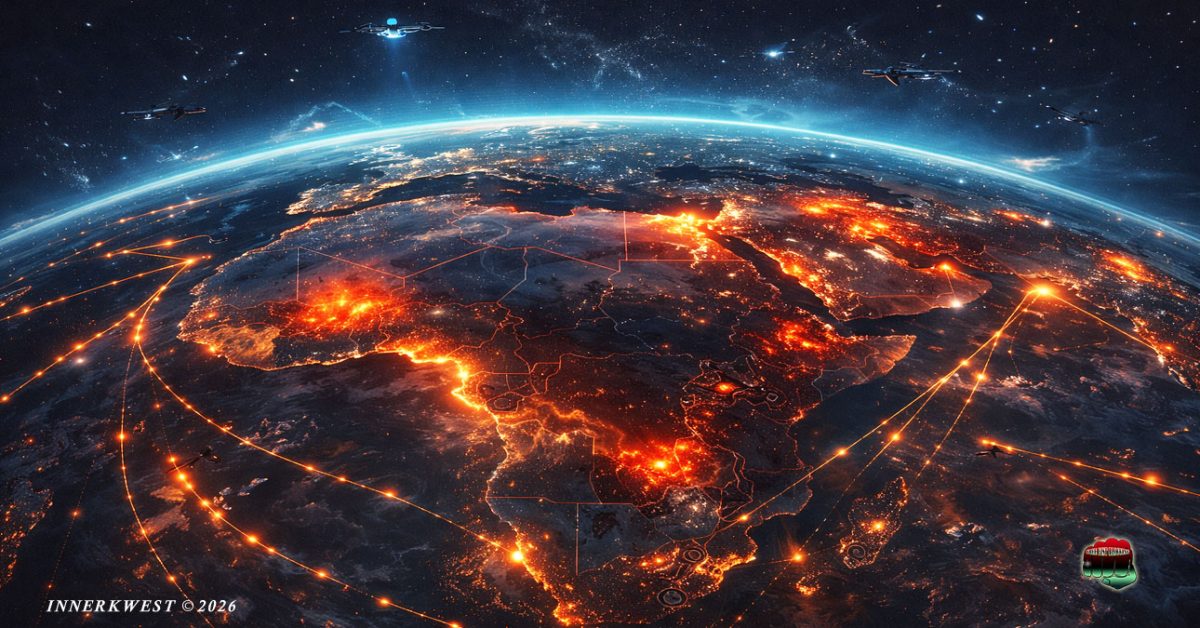
Yet when viewed on a map, another pattern emerges.
Many of the regions most affected by long-term instability also occupy geographically strategic terrain—territories positioned along major maritime routes, continental transit corridors, and zones that connect multiple geopolitical systems.
This intersection of geography and conflict raises a deeper question about Africa’s role in the evolving architecture of global power.
The Strategic Geography of the Horn and the Sahel
Two of the most geopolitically sensitive regions on the continent stretch across northeastern Africa and the Sahel.
The Horn of Africa—anchored by Somalia—sits near the entrance to the Red Sea and the Bab el-Mandeb Strait, a narrow maritime corridor through which a significant share of global trade and energy shipments pass each year.
Further inland, the Sahel belt running through Sudan and Chad forms a vast corridor linking North Africa with sub-Saharan regions.
These territories connect multiple geopolitical theaters:
- the Mediterranean and Red Sea shipping systems
- trans-Saharan trade and migration routes
- emerging energy and mineral supply chains
- security corridors linking Africa and the Middle East.
In strategic terms, these regions function as connective terrain between continents.
The Military Presence
Because of their geographic importance, these regions have drawn the attention of global powers.
One of the most striking examples can be found in Djibouti, where several countries—including the United States, China, and European powers—maintain military installations within a small coastal state near the Bab el-Mandeb Strait.
These bases support maritime patrols, counter-terrorism missions, and regional surveillance operations.
Their presence also reflects a broader reality: strategic geography often attracts long-term military and logistical infrastructure.
Across Africa, foreign security partnerships, training missions, and intelligence cooperation programs have expanded steadily over the past two decades.
The Global Competition for Influence
Africa has increasingly become an arena of geopolitical competition.
Several global powers have expanded their engagement across the continent in recent years.
China has invested heavily in infrastructure and port development through financing initiatives and trade agreements.
Russia has strengthened security relationships and military cooperation with several governments.
Gulf states such as United Arab Emirates and Saudi Arabia have pursued port investments and logistics projects along key maritime corridors.
Western governments continue to maintain security partnerships, development programs, and diplomatic initiatives throughout the region.
The result is an increasingly complex geopolitical landscape where multiple powers are pursuing overlapping strategic interests.
The Paradox of Persistent Instability
Despite the strategic value of these regions, stability has proven difficult to achieve.
Civil war in Sudan has re-emerged in cycles. Somalia has experienced decades of fragmented governance. The Sahel corridor has witnessed repeated insurgencies and political upheavals.
The persistence of these crises raises a difficult question.
If these regions occupy such important strategic positions, why has sustained stability remained elusive?
The answer lies partly in the complexity of internal political dynamics and partly in the competing interests of external actors whose priorities may not always align with long-term institutional development.
Strategic Terrain and Contingency Planning
For military planners and geopolitical strategists, geography is rarely viewed only through the lens of current events.
Defense institutions routinely conduct long-term assessments of terrain, infrastructure potential, and logistical corridors as part of contingency planning.
In these assessments, several geographic characteristics tend to carry particular strategic significance:
- access to major oceans
- proximity to global trade routes
- large territories capable of supporting logistical networks
- distance from primary conflict zones
- potential for infrastructure development.
Several regions across northeastern and central Africa meet many of these criteria.
The Horn of Africa connects the Red Sea to the Indian Ocean, while vast interior territories stretching across Sudan and Chad link North Africa with sub-Saharan trade corridors.
For strategic planners evaluating long-term scenarios—from supply chain disruptions to large-scale geopolitical crises—such terrain inevitably appears on planning maps.
This reality does not imply deliberate instability.
It does, however, underscore the enduring strategic importance of these regions within global geopolitical calculations.
Africa and the Emerging Global Map
Africa’s strategic relevance is expanding for several structural reasons.
The continent sits at the crossroads of major maritime routes linking Europe, Asia, and the Americas. Its mineral reserves play an increasingly central role in the global energy transition and advanced manufacturing sectors.
At the same time, Africa’s population is projected to grow faster than any other continent over the coming decades.
These factors mean that Africa is becoming progressively more central to the global system—not only economically but also strategically.

The Competition for the Future
As geopolitical competition intensifies, the strategic value of geography is once again becoming a central factor in global planning.
Regions that connect trade routes, resources, and infrastructure networks often become focal points of international attention.
Across parts of Africa, the intersection of conflict and geography has created territories that remain simultaneously unstable and strategically significant.
Understanding that intersection may be essential to understanding the future trajectory of global power.
Because when viewed from a global strategic map, Africa is not simply a continent of individual states navigating domestic challenges.
It is increasingly a central arena where geography, resources, and geopolitical ambition converge in shaping the competition for the future.
At InnerKwest.com, we are committed to delivering impactful journalism, deep insights, and fearless social commentary. Your cryptocurrency contributions help us execute with excellence, ensuring we remain independent and continue to amplify voices that matter.
To help sustain our work and editorial independence, we would appreciate your support of any amount of the tokens listed below. Support independent journalism:
BTC: 3NM7AAdxxaJ7jUhZ2nyfgcheWkrquvCzRm
SOL: HxeMhsyDvdv9dqEoBPpFtR46iVfbjrAicBDDjtEvJp7n
ETH: 0x3ab8bdce82439a73ca808a160ef94623275b5c0a
XRP: rLHzPsX6oXkzU2qL12kHCH8G8cnZv1rBJh TAG – 1068637374
SUI – 0xb21b61330caaa90dedc68b866c48abbf5c61b84644c45beea6a424b54f162d0c
and through our Support Page.
InnerKwest maintains a revelatory and redemptive discipline, relentless in advancing parity across every category of the human experience.
© 2026 InnerKwest®. All Rights Reserved | Haki zote zimehifadhiwa | 版权所有. InnerKwest® is a registered trademark of Inputit™ Platforms Inc. Global. No part of this publication may be reproduced, distributed, or transmitted in any form or by any means without prior written permission. Unauthorized use is strictly prohibited. Thank you for standing with us in pursuit of truth and progress!