
By InnerKwest Global Desk | January 28, 2026
For much of the postwar era, the United States has enjoyed a rare geopolitical privilege: when it faltered, the world assumed it would correct itself. That assumption—more emotional than legal, more psychological than procedural—has functioned as America’s quietest form of power. It allowed allies to look past contradiction, critics to tolerate excess, and ordinary people abroad to separate American citizens from American policy.
That grace is thinning.
Across global media, sporting communities, and diplomatic back-channels, the United States is increasingly being discussed not as a stabilizing host, but as an unpredictable environment—one whose political posture bleeds into everyday encounters. The language being used is no longer about disagreement. It is about resemblance. Comparisons between President Donald Trump and historical strongmen—most pointedly Benito Mussolini—are circulating not only among critics, but among casual observers abroad. Whether those comparisons are fair is, in a sense, beside the point. What matters is that they are being made at scale.
Reputation, once destabilized, does not wait for rebuttal.
Power, optics, and the loss of emotional trust
Nations rarely lose standing because of a single policy. They lose it when their behavior begins to feel coherent in the wrong direction. Over the past year, the United States has projected a mix of signals—militarized enforcement optics, confrontational rhetoric, and institutional strain—that many outside the country interpret not as temporary turbulence, but as directional change.
This perception has consequences. Americans abroad increasingly report unease in spaces once neutral. Cultural exchanges feel more brittle. And in places where political memory runs long—Latin America, parts of Europe, much of Africa—the imagery of centralized authority and populist defiance evokes historical chapters people hoped were closed.
The discomfort is not rooted in anti-Americanism. It is rooted in uncertainty. The world is less concerned with what the United States believes than with how it might behave when stressed.
The World Cup problem
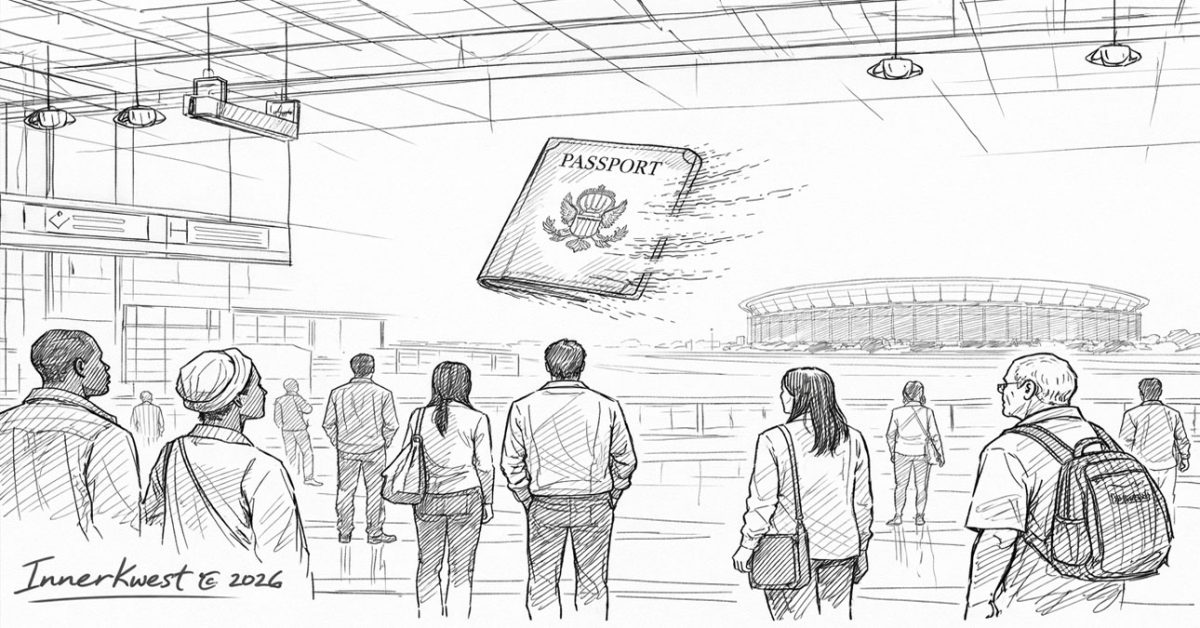
No event exposes this dynamic more clearly than the impending FIFA World Cup.
The World Cup is not a diplomatic summit. It is a mass psychological convergence—millions of people crossing borders not as officials, but as citizens carrying memory, pride, and vulnerability. Host nations are judged not by policy papers, but by atmosphere. Fans ask simple questions: Will we be welcomed? Will we be safe? Will we be respected?
In recent months, murmurs within international fan communities about avoiding the United States have grown louder. These are not organized boycotts. They are emotional calculations. And they are deeply consequential.
A country can secure a border and still fail to host the world.
The quiet injury to ordinary Americans
Perhaps the most under-acknowledged cost of this moment is the burden placed on ordinary Americans—people who neither authored nor endorse the tone now associated with their country. As national posture hardens, individuals are increasingly treated as proxies for a political mood they did not choose.
This is where the hurt settles.
It is one thing for a government to lose prestige. It is another for its citizens to lose the benefit of distinction. When the world stops separating people from power, the social contract fractures outward, not inward.
Trade, sport, and leverage without consent
What is unfolding in sport mirrors what is unfolding in economics. Across the Global South, governments have begun to speak more openly about trade, visas, and access being used as instruments of pressure rather than partnership. This frankness marks a shift. Where deference once softened disagreement, now diversification replaces loyalty.
The implication is not that the United States is being abandoned. It is that it is being re-priced—emotionally and strategically.
Power still matters. But so does tone.
A warning, not a condemnation
This is not an argument that America is finished, nor that its institutions are irredeemable. It is a warning that legitimacy erodes faster than it is rebuilt, and that emotional trust—once lost—cannot be summoned by statute.
The United States does not need applause. It needs coherence. It needs restraint. And it needs to remember that hosting the world is not a security exercise, but a trust exercise.
The rest of the world is not turning on Americans. It is bracing itself.
Whether that brace becomes distance remains an open question. But the window for reassurance is narrowing—and the world is watching less for reassurance than for proof.
At InnerKwest.com, we are committed to delivering impactful journalism, deep insights, and fearless social commentary. Your cryptocurrency contributions help us execute with excellence, ensuring we remain independent and continue to amplify voices that matter.
To help sustain our work and editorial independence, we would appreciate your support of any amount of the tokens listed below. Support independent journalism:
BTC: 3NM7AAdxxaJ7jUhZ2nyfgcheWkrquvCzRm
SOL: HxeMhsyDvdv9dqEoBPpFtR46iVfbjrAicBDDjtEvJp7n
ETH: 0x3ab8bdce82439a73ca808a160ef94623275b5c0a
XRP: rLHzPsX6oXkzU2qL12kHCH8G8cnZv1rBJh TAG – 1068637374
SUI – 0xb21b61330caaa90dedc68b866c48abbf5c61b84644c45beea6a424b54f162d0c
and through our Support Page.
InnerKwest maintains a revelatory and redemptive discipline, relentless in advancing parity across every category of the human experience.
© 2026 InnerKwest®. All Rights Reserved | Haki zote zimehifadhiwa | 版权所有. InnerKwest® is a registered trademark of Inputit™ Platforms Inc. Global. No part of this publication may be reproduced, distributed, or transmitted in any form or by any means without prior written permission. Unauthorized use is strictly prohibited. Thank you for standing with us in pursuit of truth and progress!