
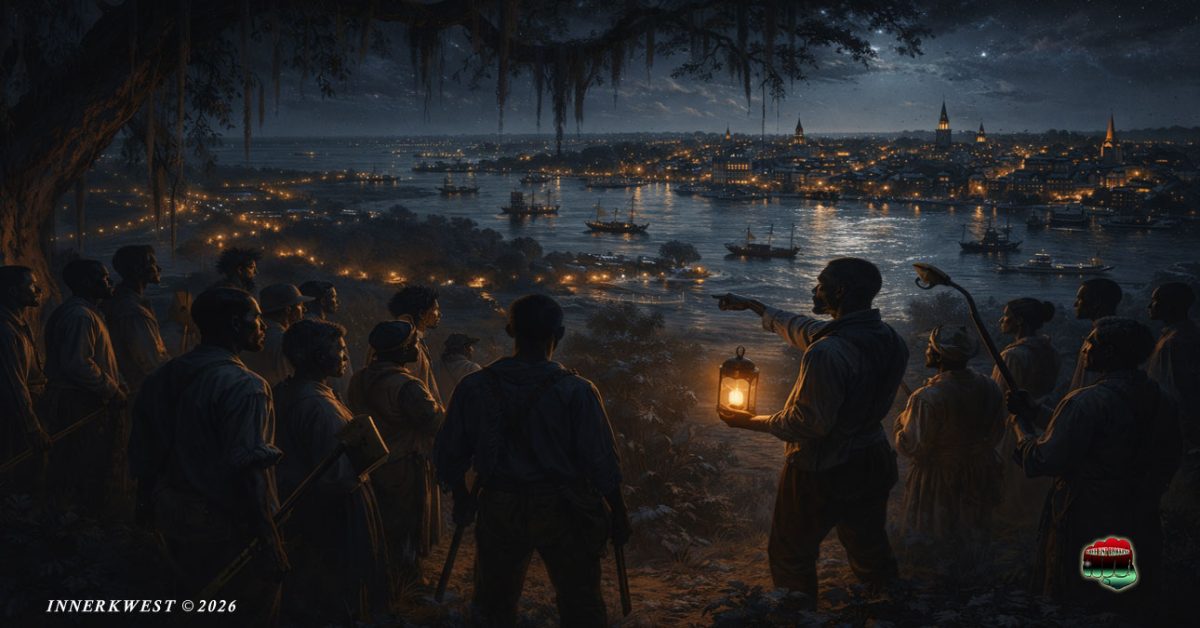
A Revolution That Nearly Began on American Soil
By InnerKwest Intelligence Desk | March 10, 2026
Four decades before the first shots of the American Civil War were fired at Fort Sumter, a different war nearly began in the same city. In 1822, Charleston, South Carolina—one of the wealthiest and most fortified slave-holding cities in the United States—became the center of a conspiracy that terrified the slave South.
The alleged leader was Denmark Vesey, a formerly enslaved man who had purchased his freedom but refused to accept the system that still held thousands of others in bondage. According to contemporary reports from authorities, Vesey helped organize a network that could have mobilized tens of thousands of enslaved people across the region. Some estimates suggested that as many as 47,000 individuals might have joined the uprising if it had begun.
The rebellion never happened. But the fear it generated reshaped Southern policy and revealed how unstable the institution of slavery truly was.
A Port City Built on Slavery
In the early nineteenth century, Charleston, South Carolina stood at the heart of the American slave economy. Its harbor connected the plantation system of the Deep South to global markets, exporting cotton, rice, and indigo produced by enslaved labor.
Enslaved Africans and their descendants made up the majority of the population in many surrounding counties. This demographic reality created constant anxiety among slaveholders who feared organized resistance.
That fear intensified after the success of the Haitian Revolution, which had overthrown French colonial rule and established the first Black republic in the Western Hemisphere in 1804.
For slave societies across the Americas, Haiti represented something far more dangerous than rebellion—it represented proof that rebellion could succeed.
Denmark Vesey’s Vision
Denmark Vesey himself embodied the contradictions of the slave South.
Born into slavery in the Caribbean, Vesey won a lottery prize in 1799 that allowed him to purchase his freedom. Yet freedom did not erase the reality around him. His wife and many members of his community remained enslaved.
Vesey became active in Charleston’s African Methodist Episcopal congregation, a Black church community that served as a center of spiritual life and political discussion among free and enslaved Black residents.
According to historical accounts and court records, Vesey and his collaborators began quietly organizing a rebellion that would unfold across multiple plantations and neighborhoods.
The plan allegedly included:
- seizing weapons
- coordinating uprisings across the region
- capturing Charleston
- escaping by ship to Haiti, where a Black republic had already been established.
If successful, the revolt could have triggered a chain reaction throughout the slaveholding South.
The Army That Never Marched
Authorities later claimed that Vesey’s network extended deep into the enslaved population of South Carolina.
Testimony gathered during the investigation suggested that thousands of enslaved individuals were aware of the plan, and some accounts speculated that as many as 40,000 to 50,000 people might eventually have joined the uprising.
While historians debate the accuracy of these numbers, even conservative estimates indicate that the conspiracy was extensive.
The rebellion was scheduled to begin in the summer of 1822.
But before it could unfold, the plan was betrayed.
Informants alerted authorities, triggering a sweeping crackdown across Charleston.
A Trial Without Mercy
Charleston officials quickly moved to suppress the conspiracy.
Special tribunals were established, and dozens of suspected participants were arrested. In a series of closed trials, authorities sentenced many of the accused to death.
Denmark Vesey and more than thirty others were executed.
Dozens more were deported or imprisoned.
The rebellion had been stopped before it began—but the panic it caused spread rapidly across the South.
The Slave South Responds
The Vesey conspiracy convinced slave-holding elites that the institution of slavery faced a permanent internal threat.
Southern legislatures responded by tightening control over Black communities:
- Black churches were restricted or dismantled
- education for enslaved people was further limited
- curfews and surveillance expanded
- militias increased patrols.
Charleston itself took a particularly dramatic step.
To prevent future uprisings, the city constructed a permanent military installation that would later become the The Citadel, originally designed to house troops capable of suppressing slave rebellions.
In effect, the city fortified itself against the possibility of another Vesey.
The Pattern of Resistance
The Vesey conspiracy was not an isolated event.
Before the Civil War, multiple uprisings and attempted rebellions shook the slave-holding South.
Among the most significant were:
- the 1800 rebellion led by Gabriel Prosser in Virginia
- the 1831 uprising led by Nat Turner in Virginia
- the 1822 Denmark Vesey conspiracy in South Carolina.
Together, these events demonstrated that slavery in the United States faced persistent resistance from those it oppressed.
The Civil War, often portrayed as the first major rupture in the slave system, was preceded by decades of tension, conspiracy, and rebellion.
A Revolution That Never Happened
Historians continue to debate the scale and feasibility of Vesey’s plan. Some scholars argue that Charleston authorities exaggerated the size of the conspiracy to justify harsh crackdowns. Others believe the rebellion could indeed have spread rapidly across the region.
What remains clear is that the fear of such a revolt profoundly shaped Southern politics.
Slaveholders increasingly saw abolitionist ideas, Black churches, and free Black communities as existential threats to their social order.
The result was a society that became even more rigid and defensive in the decades leading up to the Civil War.
The Legacy of the Unseen Army
The story of Denmark Vesey’s planned uprising reveals an often-overlooked dimension of American history.
Slavery did not persist simply because enslaved people accepted it. It endured through a combination of force, surveillance, and legal repression designed to prevent organized resistance.
The conspiracy of 1822 demonstrated how fragile the system could be.
Had Vesey’s plan succeeded—or even partially unfolded—the trajectory of American history might have changed decades earlier.
Instead, the rebellion remained unrealized, remembered mostly through court records, historical debates, and the fears it inspired among those determined to preserve slavery.
Yet the idea behind it—that thousands might rise together against the institution—would echo throughout the decades that followed.
When the Civil War finally erupted in 1861, it did not begin a struggle that had never existed.
It ignited a conflict that had been building, quietly and dangerously, for generations.
At InnerKwest.com, we are committed to delivering impactful journalism, deep insights, and fearless social commentary. Your cryptocurrency contributions help us execute with excellence, ensuring we remain independent and continue to amplify voices that matter.
To help sustain our work and editorial independence, we would appreciate your support of any amount of the tokens listed below. Support independent journalism:
BTC: 3NM7AAdxxaJ7jUhZ2nyfgcheWkrquvCzRm
SOL: HxeMhsyDvdv9dqEoBPpFtR46iVfbjrAicBDDjtEvJp7n
ETH: 0x3ab8bdce82439a73ca808a160ef94623275b5c0a
XRP: rLHzPsX6oXkzU2qL12kHCH8G8cnZv1rBJh TAG – 1068637374
SUI – 0xb21b61330caaa90dedc68b866c48abbf5c61b84644c45beea6a424b54f162d0c
and through our Support Page.
InnerKwest maintains a revelatory and redemptive discipline, relentless in advancing parity across every category of the human experience.
© 2026 InnerKwest®. All Rights Reserved | Haki zote zimehifadhiwa | 版权所有. InnerKwest® is a registered trademark of Inputit™ Platforms Inc. Global. No part of this publication may be reproduced, distributed, or transmitted in any form or by any means without prior written permission. Unauthorized use is strictly prohibited. Thank you for standing with us in pursuit of truth and progress!