
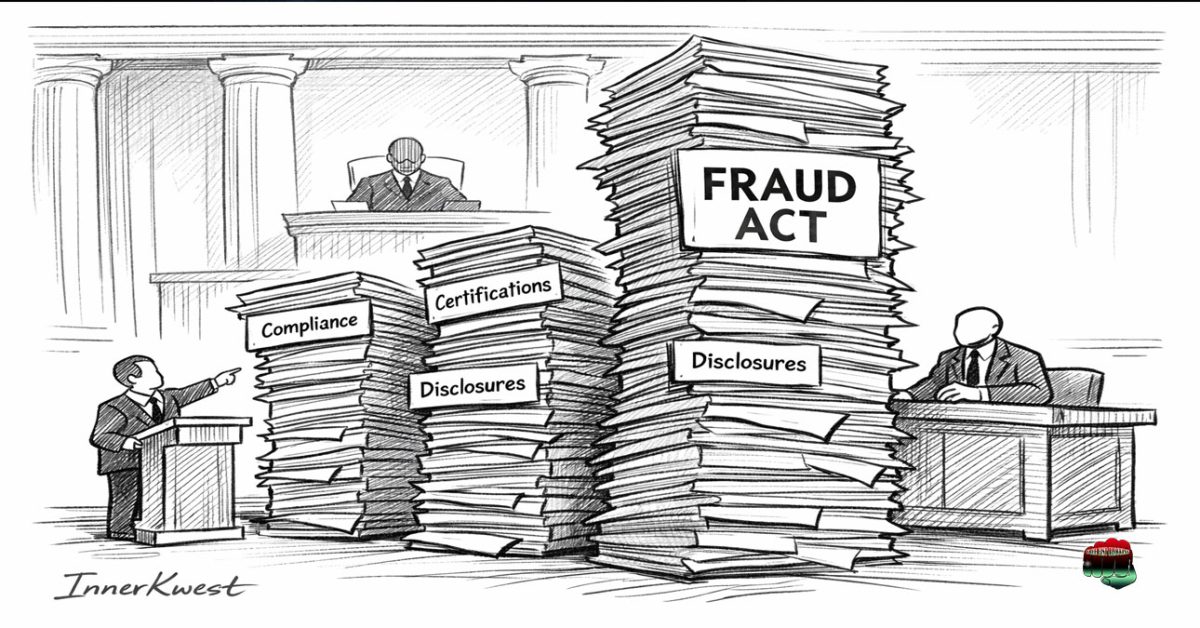
The Justice Department, DEI, and the Quiet Repurposing of Power
By InnerKwest DC Correspondent | December 30, 2025
A consequential shift is underway in the mechanics of American governance.
The United States Department of Justice has begun approaching corporate Diversity, Equity, and Inclusion (DEI) programs not through civil rights statutes or employment law, but through the architecture of fraud enforcement. What was once treated as workplace policy and regulatory guidance is now framed as a question of truth, misrepresentation, and liability.
This is not rhetorical drift.
It is an enforcement recalibration.
The Enforcement Turn
For more than a decade, DEI programs occupied a broadly accepted regulatory space. Federal guidance, investor pressure, and institutional norms converged around the assumption that diversity initiatives were not merely permissible but encouraged—particularly for firms engaged in federal contracting.
That assumption has fractured.
The Justice Department has signaled that certain DEI structures may conflict with anti-discrimination law, and that companies certifying compliance with federal requirements while maintaining such programs could face allegations of misrepresentation. DEI is thereby recast—not as a social commitment—but as a compliance risk.
Why Fraud Law Alters the Terrain
At the center of this shift is the False Claims Act, a Civil War–era statute designed to punish financial deception against the federal government.
Its relevance rests on three features:
- Severe civil penalties tied to government funds
- Expansive prosecutorial discretion
- Whistleblower provisions that invite internal scrutiny
Applied to DEI, the statute converts cultural policy into contractual exposure. The governing question becomes whether a company’s certifications are deemed accurate under an evolving enforcement theory—not whether a program advances equity or inclusion.
The distinction is decisive.
From Civil Rights Frameworks to Balance-Sheet Risk
Historically, disputes over diversity initiatives were mediated through civil rights law, administrative guidance, and negotiated compliance. Remedies were corrective; exposure was contained.
Fraud law operates differently.
It introduces punitive leverage, retroactive scrutiny, and reputational escalation. What once sat within human resources and compliance now reaches the boardroom. DEI shifts from values discourse to material financial risk.
The terrain changes accordingly.
Political Authority and Moral Framing
This enforcement posture aligns with the broader ideological stance of Donald Trump, whose administration has challenged the legitimacy of DEI frameworks, arguing incompatibility with strict interpretations of equal protection.
What distinguishes the current moment is not opposition alone, but the moral framing used to justify it. Appeals to neutrality, fairness, and even religious conscience have entered the discourse—often in explicitly Christian terms.
That framing invites scrutiny.
Moral authority presumes submission to moral constraint. When religious language is employed instrumentally—untethered from ethical restraint—the result is not clarity but contradiction. Faith becomes rhetoric. Scripture becomes scaffolding.
V. Christianity as Instrument, Not Constraint
The mobilization of Christian language to justify state power is not new. Historically, such language has repeatedly sanctified legal and economic arrangements later recognized as coercive.
In this context, religious framing functions less as a restraint on power than as an accelerant. It lends gravity without accountability and authority without submission. When enforcement posture is justified through moral language unbound by ethical discipline, law hardens rather than humbles.
The Corporate Bind
Corporations now operate within narrowing margins.
On one side stand investor expectations, workforce demographics, and international norms. On the other stand federal contracting requirements, shifting enforcement theories, and heightened exposure under fraud statutes.
What was compliant yesterday may be contestable tomorrow.
What was encouraged may now be scrutinized.
The response is defensive governance: policies rewritten for survivability rather than coherence or conviction.
Selectivity as Signal
Enforcement in this domain will not be universal. It will be selective.
Selectivity functions as signal. A limited number of investigations can recalibrate behavior across entire sectors. Firms need not be targeted to feel the pressure; visibility alone reshapes institutional conduct.
This is governance by precedent rather than statute.
Implications Beyond DEI
The deeper significance of this shift extends beyond diversity policy.
When fraud law becomes the vehicle for adjudicating social norms, the boundary between legal compliance and ideological alignment erodes. Ethical disagreement is converted into financial exposure. Policy debate yields to prosecutorial risk.
Once normalized, the mechanism is portable.
Conclusion
This is not merely a dispute over DEI.
It is a demonstration of how modern states discipline institutional behavior without legislating—by repurposing existing law to govern evolving norms. Fraud statutes were never designed to arbitrate social architecture. Yet once deployed, they become among the most formidable tools available: precise, punitive, and resistant to challenge.
What is being rewritten is not only corporate policy, but the relationship between law, morality, and power. The consequences will extend well beyond the present controversy, long after the language that justified it has moved on.
Support InnerKwest: Powering Truth & Excellence with Bitcoin
At InnerKwest.com, we are committed to delivering impactful journalism, deep insights, and fearless social commentary. Your Bitcoin contributions help us execute with excellence, ensuring we remain independent and continue to amplify voices that matter.
Support our mission—send BTC today!
🔗 Bitcoin Address: 3NM7AAdxxaJ7jUhZ2nyfgcheWkrquvCzRm© 2026 InnerKwest®. All Rights Reserved | Haki zote zimehifadhiwa | 版权所有.
InnerKwest® is a registered trademark of Inputit™ Platforms Inc. Global
No part of this publication may be reproduced, distributed, or transmitted in any form or by any means without prior written permission. Unauthorized use is strictly prohibited.
Thank you for standing with us in pursuit of truth and progress!