
System Design, Constraint, and the Architecture of Endurance
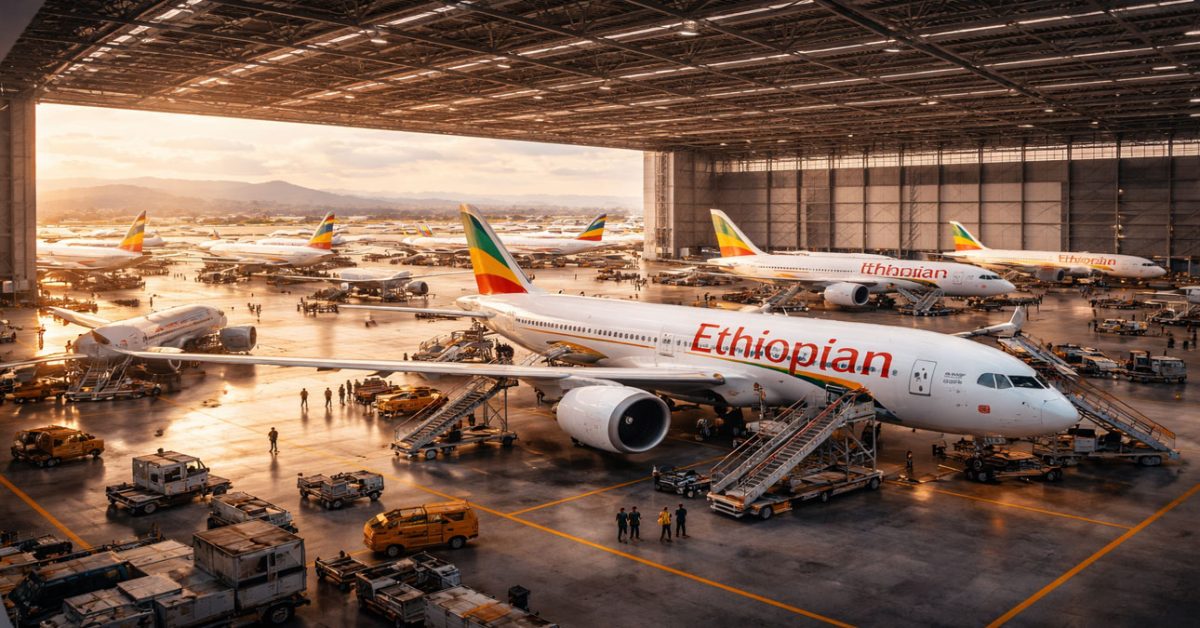
In one of the most difficult aviation environments on earth, a single carrier sustained growth while others stalled, collapsed, or reset. The difference was not luck. It was system design, applied consistently over time.
By Intelligence Desk | March 30, 2026
A Different Outcome in the Same Environment
Across much of Africa, national carriers have struggled to maintain continuity.
Some have cycled through restructuring. Others have reduced operations, merged, or disappeared entirely. External pressures—currency instability, infrastructure limitations, political interference, and global competition—have created an environment where consistency is difficult to sustain.
These conditions are not theoretical. They are structural.
They shape how airlines access capital, maintain fleets, expand routes, and manage operational risk. For many carriers, these pressures compound faster than they can be addressed.
Within that same environment, Ethiopian Airlines followed a different trajectory.
Founded in 1945 with five aircraft and a single route, it has expanded into one of the most extensive aviation systems on the continent. It now connects dozens of African destinations, operates a global cargo network, and serves as a training hub for aviation professionals across multiple regions.
The contrast is not subtle.
It is structural.
Geography as Starting Point, Not Outcome
Addis Ababa occupies a position that naturally connects Africa to Europe, the Middle East, and Asia.
That geographic placement provides opportunity—but opportunity alone does not create a hub.
Many regions sit at strategic intersections. Few convert that positioning into sustained advantage.
Ethiopian Airlines approached geography as a system component rather than a passive condition. Route networks were designed to pass through Addis Ababa, not simply originate from it. Over time, this created a reinforcing loop:
- more routes increased connectivity
- increased connectivity attracted more traffic
- increased traffic justified further expansion
The system fed itself.
Geography did not determine the outcome.
It was incorporated into it.
Discipline Through Disruption
The airline’s operating history includes prolonged periods of instability—economic downturns, regional conflict, global aviation shocks, and the disruption caused by the COVID-19 pandemic.
These events affected every carrier operating in similar conditions.
What differed was response.
Ethiopian Airlines did not attempt to eliminate exposure to disruption. That would not have been possible.
Instead, it maintained a consistent operating discipline:
- expansion aligned with capacity
- cost management tied to operational reality
- reinvestment directed toward long-term capability
There were no abrupt shifts in direction, no visible resets in strategy.
The system absorbed pressure without abandoning its structure.
Over time, that consistency reduced volatility.
Building Internal Capacity
One of the most significant differences between Ethiopian Airlines and many of its counterparts lies in how it approached dependency.
Rather than relying extensively on external providers, it developed internal capabilities across critical functions:
- pilot training and aviation academies
- maintenance, repair, and overhaul operations
- cargo logistics and handling
- technical and operational support systems
This approach required long-term investment and coordination. It also required patience, as returns on such infrastructure are not immediate.
But the outcome is clear.
By internalizing key functions, the airline reduced exposure to external bottlenecks, pricing fluctuations, and service inconsistencies.
It built control where others remained dependent.
Over time, that control became a stabilizing force.
Constraint as a Design Problem
Not all limitations were external.
Some were physical.
Addis Ababa’s elevation—over 7,600 feet above sea level—creates measurable operational constraints. Aircraft departing from high altitude face reduced lift and engine efficiency, which limits how much weight they can carry and how far they can travel without adjustment.
For long-haul routes, particularly to North America, this becomes a defining constraint.
Many systems adapt to such limitations incrementally—adjusting loads, modifying routes, or accepting reduced efficiency.
Ethiopian Airlines chose a different path.
The development of a new airport near Bishoftu, at a lower elevation, represents a direct response to this constraint. By relocating certain operations to an environment with denser air, the airline increases:
- payload capacity
- fuel efficiency
- long-haul range
This is not a marginal improvement.
It is a structural correction.
Rather than working around the limitation indefinitely, the system is redesigned to remove it.
Time and Continuity
What distinguishes Ethiopian Airlines is not a single innovation or decision.
It is continuity across decades.
Decisions were made within a consistent framework. Adjustments were incorporated without disrupting direction. Expansion occurred without abandoning discipline.
This is not common.
Many systems begin with a clear strategy but lose alignment over time—through leadership changes, external pressure, or short-term incentives.
Ethiopian Airlines maintained continuity.
That continuity allowed incremental improvements to compound.
The result is not dramatic in any single moment.
It becomes visible only over time.
A System That Scales
Today, the airline operates at a scale that reflects the accumulation of those decisions:
- multi-billion-dollar annual revenue
- one of the largest cargo networks on the continent
- a central role in intra-African connectivity
- expanding reach into global aviation markets
These outcomes are not isolated indicators of success.
They are outputs of a system that has remained intact long enough to scale.

Structural Outcome
Ethiopian Airlines did not operate in a simplified environment.
It operated within the same structural constraints that limited others.
The difference lies in how those constraints were approached.
Where some systems reacted to pressure, this one was designed to absorb and adjust. Where dependency introduced fragility, internal capacity was developed. Where limitations emerged, they were addressed at the system level rather than managed at the margins.
Over time, those choices accumulated.
And when they did, the distinction between conditions and outcomes became clear.
At InnerKwest.com, we are committed to delivering impactful journalism, deep insights, and fearless social commentary. Your cryptocurrency contributions help us execute with excellence, ensuring we remain independent and continue to amplify voices that matter.
To help sustain our work and editorial independence, we would appreciate your support of any amount of the tokens listed below. Support independent journalism:
BTC: 3NM7AAdxxaJ7jUhZ2nyfgcheWkrquvCzRm
SOL: HxeMhsyDvdv9dqEoBPpFtR46iVfbjrAicBDDjtEvJp7n
ETH: 0x3ab8bdce82439a73ca808a160ef94623275b5c0a
XRP: rLHzPsX6oXkzU2qL12kHCH8G8cnZv1rBJh TAG – 1068637374
SUI – 0xb21b61330caaa90dedc68b866c48abbf5c61b84644c45beea6a424b54f162d0c
and through our Support Page.
InnerKwest maintains a revelatory and redemptive discipline, relentless in advancing parity across every category of the human experience.
© 2026 InnerKwest®. All Rights Reserved | Haki zote zimehifadhiwa | 版权所有. InnerKwest® is a registered trademark of Inputit™ Platforms Inc. Global. No part of this publication may be reproduced, distributed, or transmitted in any form or by any means without prior written permission. Unauthorized use is strictly prohibited. Thank you for standing with us in pursuit of truth and progress!