
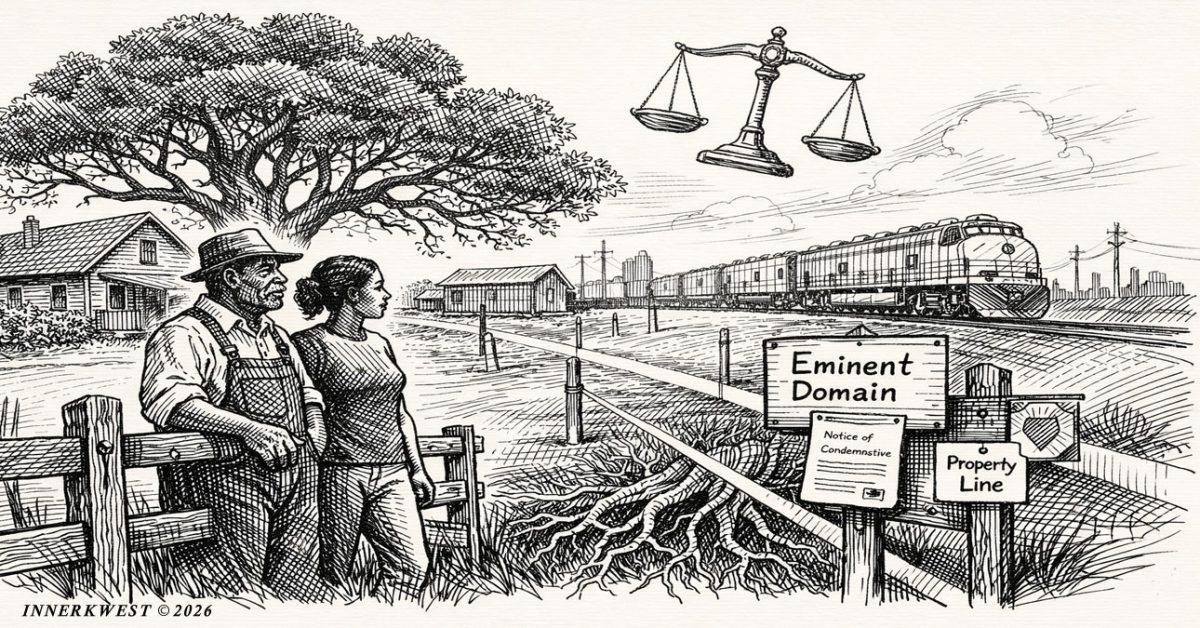
In rural Georgia, members of the Floyd family — descendants of enslaved black people who have stewarded their land for generations — are fighting to keep their property as a private rail project seeks to acquire parcels through eminent domain. Their legal battle is local, but the forces surrounding it are national, historic, and institutional.
InnerKwest Intelligence Desk | February 20, 2026
Development vs. Ownership: Where Public Power Meets Private Gain
The Floyd family’s land sits along the proposed route of a rail corridor intended to serve expanding logistics and freight networks. Project backers frame the line as essential infrastructure that will stimulate economic growth and regional connectivity. For the Floyds and neighboring landowners, however, the project represents a forced transfer of generational property under state authority for private enterprise.
Eminent domain has traditionally been justified as a tool for public necessity — highways, utilities, and flood control. Yet modern applications increasingly blur the line between public good and private economic gain. When development corridors intersect with historically Black landownership, the outcome can echo a familiar American pattern: dispossession carried out under legal authority.
Heirs’ Property and Legal Vulnerability
Families like the Floyds often face additional vulnerability tied to heirs’ property, a common ownership structure among Black families in the South in which land passes informally across generations without clear title. While rooted in shared stewardship and family continuity, such arrangements can leave landowners exposed in legal disputes, tax complications, and development acquisitions.
Partition actions and title fragmentation can weaken negotiating power precisely when large-scale development arrives.
The Long Decline of Black Landownership
The Floyd family’s struggle unfolds against a stark historical backdrop. In 1910, Black Americans owned an estimated 14–16 million acres of farmland. Today, that figure has declined by more than 90 percent.
This erosion stems from discriminatory lending, forced sales, partition actions, tax foreclosures, and infrastructure expansion. Eminent domain has not been the sole driver, but it has served as a lawful mechanism through which land transfers can occur with limited leverage for vulnerable owners.
For families whose ancestors secured land in the fragile decades following emancipation, ownership has represented autonomy, security, and a foothold in generational wealth. Losing that land can mean more than relocation; it can mean the erasure of a lineage’s economic foundation.
The Economic Promise — and Its Unequally Shared Costs
Supporters of rail expansion argue that logistics corridors reduce transportation costs, attract industry, and create jobs. Local officials often frame such projects as engines of modernization and competitiveness.
Critics counter that development benefits frequently bypass displaced residents, while compensation formulas fail to account for cultural value, community cohesion, and long-term wealth. Market value rarely reflects what land represents to families whose roots stretch across generations.
The Legal Battlefield After Kelo
The legal framework governing eminent domain remains contested. The Supreme Court’s 2005 ruling in Kelo v. City of New London broadened the interpretation of “public use” to include economic development. While some states enacted reforms afterward, definitions and enforcement remain uneven.
The Floyd family’s case illustrates how the boundary between public necessity and private enterprise continues to be tested, particularly in rural regions where infrastructure expansion meets historically marginalized ownership.
Land as Memory, Wealth, and Continuity
For the Floyd family, the fight is not framed in abstract legal terms. It is about burial grounds, homesteads, church routes, and continuity of place. It is about whether progress must always travel through the dispossession of those whose ownership has historically been most precarious.
This moment arrives amid renewed national attention to the racial wealth gap and the fragility of generational assets. Land, unlike wages, can anchor multi-generational stability. Its loss reverberates across decades.

A Familiar Pattern at a New Moment of Growth
The Floyd family’s resistance is more than a local dispute. It is part of a longer American negotiation over who bears the cost of development and who reaps its rewards. As infrastructure expansion accelerates across the South, similar conflicts are likely to emerge.
The question is not whether the nation will continue to build. It is whether development can proceed without repeating the patterns that have quietly eroded Black landownership for more than a century.
Progress, in a democratic society, should not require the surrender of inheritance by those who have historically possessed the least margin to lose it.
At InnerKwest.com, we are committed to delivering impactful journalism, deep insights, and fearless social commentary. Your cryptocurrency contributions help us execute with excellence, ensuring we remain independent and continue to amplify voices that matter.
To help sustain our work and editorial independence, we would appreciate your support of any amount of the tokens listed below. Support independent journalism:
BTC: 3NM7AAdxxaJ7jUhZ2nyfgcheWkrquvCzRm
SOL: HxeMhsyDvdv9dqEoBPpFtR46iVfbjrAicBDDjtEvJp7n
ETH: 0x3ab8bdce82439a73ca808a160ef94623275b5c0a
XRP: rLHzPsX6oXkzU2qL12kHCH8G8cnZv1rBJh TAG – 1068637374
SUI – 0xb21b61330caaa90dedc68b866c48abbf5c61b84644c45beea6a424b54f162d0c
and through our Support Page.
InnerKwest maintains a revelatory and redemptive discipline, relentless in advancing parity across every category of the human experience.
© 2026 InnerKwest®. All Rights Reserved | Haki zote zimehifadhiwa | 版权所有. InnerKwest® is a registered trademark of Inputit™ Platforms Inc. Global. No part of this publication may be reproduced, distributed, or transmitted in any form or by any means without prior written permission. Unauthorized use is strictly prohibited. Thank you for standing with us in pursuit of truth and progress!