
November 21, 2026
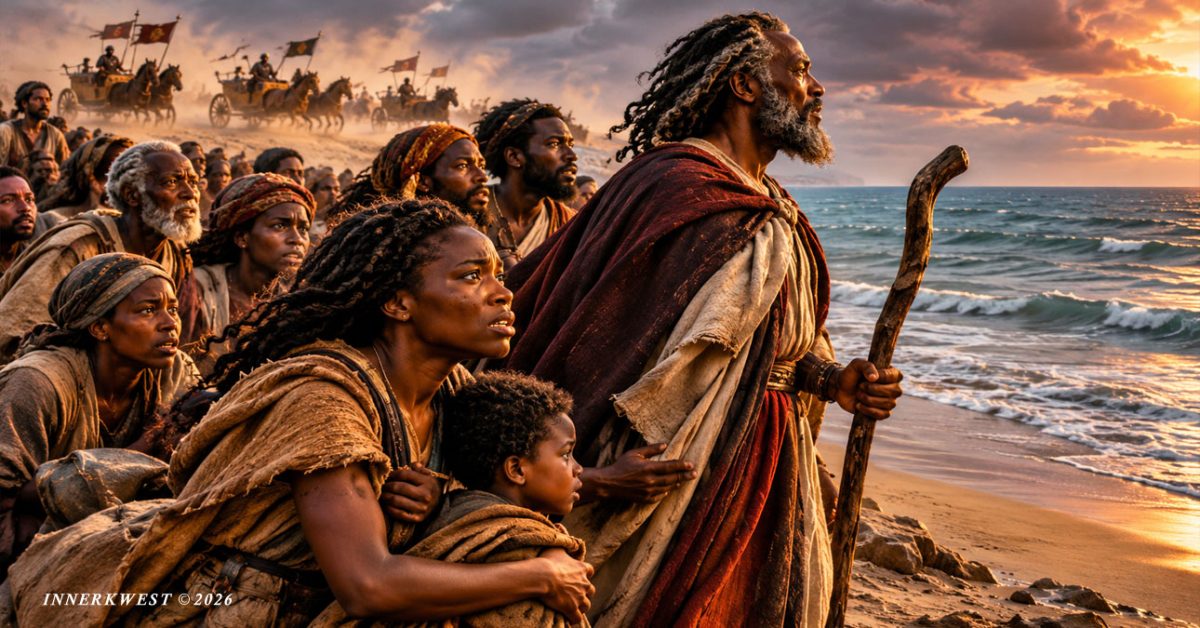
The Israelites had escaped Egypt, but the sound of Pharaoh’s approaching chariots awakened the fear of captivity. Their journey offers a lasting reflection on faith, historical memory and the difficult work of moving forward.
By Kairos Reed
There must have been something terrible about hearing the chariots.
The Israelites had already left Egypt. Whatever awaited them in the wilderness, they were no longer standing where they had once stood. They had walked away from generations of bondage carrying possessions, children, memories and the uncertain expectations of people who had never before been responsible for building a life in freedom.
Then they looked behind them.
Pharaoh was coming.
Exodus 14:10 says that when the Israelites saw the Egyptians advancing, they became terrified and cried out to the Lord. Their next words to Moses are even more revealing. They asked whether he had brought them into the wilderness because there were no graves in Egypt. Then came the sentence that exposes how quickly fear can rearrange one’s understanding of freedom: they said it would have been better to serve the Egyptians than to die in the wilderness (Exodus 14:11–12).
They had escaped Egypt.
Egypt had not yet lost its influence over what they believed was possible.
It is easy to read those words centuries later and wonder how people who had just been liberated could contemplate returning to the place that enslaved them. It becomes less difficult when we consider how human beings live with the past.
Leaving a place does not necessarily mean that the place has left us.
An abusive relationship can end while its voice remains. A person can leave poverty and continue making decisions as though tomorrow’s meal may disappear. Communities can obtain rights once denied to them and still carry memories of what happened when those rights did not exist. Institutions can change faster than expectations.
Freedom can alter circumstances before it alters what people have learned to expect.
That does not make fear a failure of faith.
The Israelites had reason to be afraid. Pharaoh’s army was real. The sea in front of them was real. The wilderness was real. Scripture does not require us to pretend that danger disappears because faith exists.
Instead, Exodus places two instructions remarkably close together.
Moses tells the frightened people, “Do not be afraid, stand firm” (Exodus 14:13). He assures them that God will fight for them and tells them to keep still.
Then, almost immediately, God asks Moses why he is crying out and tells him to instruct the Israelites to “go forward” (Exodus 14:15).
Stand firm.
Go forward.
At first they sound contradictory. They are not.
One concerns what fear is doing inside them. The other concerns what they must do next.
They are not being told to manufacture confidence before moving. They are being told not to surrender their judgment to panic—and then to walk toward a future for which no visible road yet exists.
The Israelites could see Egypt behind them.
They could not yet see a road through the sea.
That is often the uncomfortable geography of change.
The old life is recognizable even when it was harmful. The new one may offer possibility without familiarity. Beginning again can mean surrendering expertise, status or routines that once told us who we were. A person accomplished in one field may become a novice in another. A community accustomed to depending upon an institution may eventually have to build one of its own.
Sometimes the temptation to go backward is not really a desire for the past.
It is a desire for certainty.
Exodus makes that clearer after the sea has already been crossed.
By the sixteenth chapter, the Israelites are hungry. Once again they complain to Moses and Aaron. This time they remember Egypt as a place where they sat beside pots of meat and ate bread until they were full (Exodus 16:2–3).
The slavery had not suddenly become good.
The wilderness had made parts of Egypt look better.
That is one of the quieter warnings in the Exodus story. Memory does not always preserve the past exactly as it was. Under pressure, it can preserve what was predictable about the past while allowing what was destructive about it to fade.
Bondage at least came with a schedule.
Freedom came with questions.
This is one reason Exodus has carried such resonance through generations, including within Black religious life. People living through slavery, segregation and their aftermath could recognize the biblical language of bondage and deliverance without requiring their own history to become identical to ancient Israel’s. The spiritual power was found partly in the insistence that present circumstances did not have to determine the final destination.
But Exodus offers no sentimental picture of liberation.
Crossing the sea did not instantly prepare the Israelites for everything freedom would require of them. Their journey continued. There would be uncertainty, disagreement, failure, hunger and fear.
Deliverance began a process. It did not finish one.
There are things we survive that continue speaking long after they have lost the authority they once possessed. A previous failure tells us not to try again. Rejection tells us not to risk acceptance. An old institution convinces us that independence is impossible. The familiar warns us that uncertainty is more dangerous than remaining where we have always been.
At such moments, courage should not be confused with fearlessness.
Courage may simply be the decision that fear will not receive the only vote.
At the sea, the Israelites were confronted by what had ruled them and by what they could not yet imagine. Behind them stood an authority they understood. Ahead of them was a future for which they had no map.
They moved.
When the Israelites reached the other side, Exodus says the waters returned. The army that had pursued them could pursue them no farther (Exodus 14:26–30).
Not every hardship ends that completely. Not every painful memory disappears. Faith should never be used to tell wounded people that remembering means they have failed to heal.
But there is something profound in the biblical image.
God did not simply provide Israel with a way out.
The waters also closed behind them.
There would be other difficulties. Other fears. Other temptations to remember Egypt more kindly than Egypt deserved. But the road they had traveled could no longer function as their route back into captivity.
Perhaps that is part of what beginning again requires.
Not forgetting where we have been.
Not pretending it did not shape us.
But refusing to allow what once held us to become the authority that determines where we are permitted to go.
Sometimes deliverance is the opening of a path forward.
Sometimes it is also the closing of a path backward.
At InnerKwest.com, we are committed to delivering impactful journalism, deep insights, and fearless social commentary. Your cryptocurrency contributions help us execute with excellence, ensuring we remain independent and continue to amplify voices that matter.
To help sustain our work and editorial independence, we would appreciate your support of any amount of the tokens listed below. Support independent journalism:
BTC: 3NM7AAdxxaJ7jUhZ2nyfgcheWkrquvCzRm
SOL: HxeMhsyDvdv9dqEoBPpFtR46iVfbjrAicBDDjtEvJp7n
ETH: 0x3ab8bdce82439a73ca808a160ef94623275b5c0a
XRP: rLHzPsX6oXkzU2qL12kHCH8G8cnZv1rBJh TAG – 1068637374
SUI – 0xb21b61330caaa90dedc68b866c48abbf5c61b84644c45beea6a424b54f162d0c
and through our Support Page.
InnerKwest maintains a revelatory and redemptive discipline, relentless in advancing parity across every category of the human experience.
© 2026 InnerKwest®. All Rights Reserved | Haki zote zimehifadhiwa | 版权所有. InnerKwest® is a registered trademark of Inputit™ Platforms Inc. Global. No part of this publication may be reproduced, distributed, or transmitted in any form or by any means without prior written permission. Unauthorized use is strictly prohibited. Thank you for standing with us in pursuit of truth and progress!