
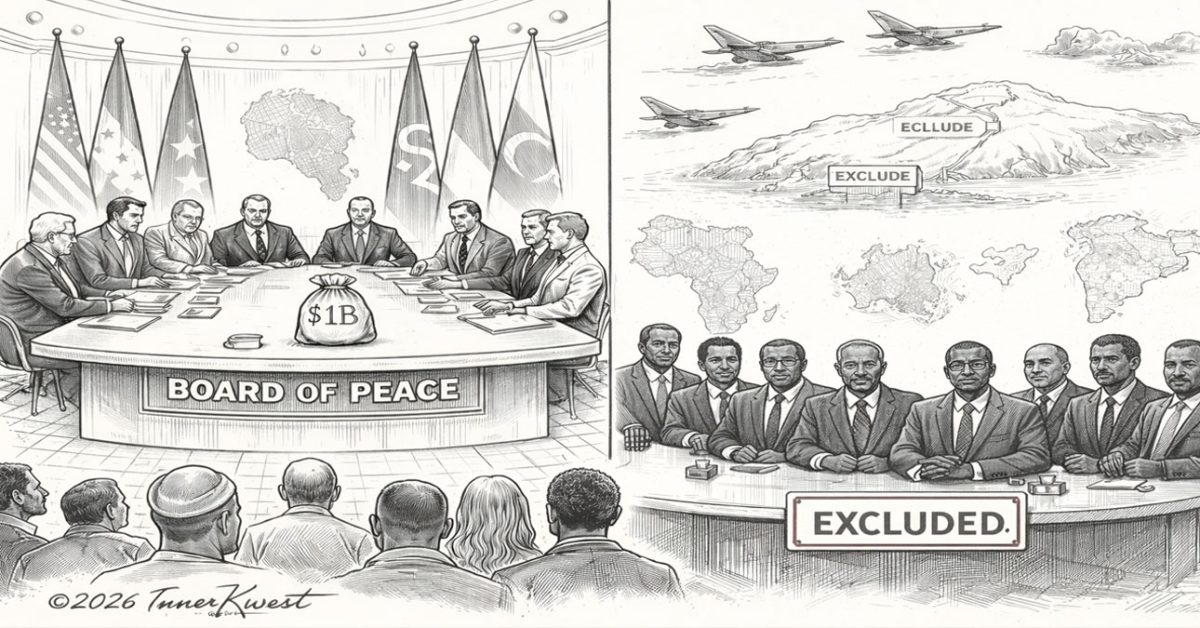
How the Board of Peace Reveals the Architecture of Exclusion in a Fragmenting World Order
By InnerKwest Global Desk | January 20, 2026
In the space of a single weekend in January 2026, a proposed multilateral governance body and a high-stakes territorial dispute have intersected in ways that reveal structural tensions in international order. President Donald J. Trump has extended invitations to a select group of nations to participate in a newly outlined Board of Peace, an initiative framed as a mechanism for coordinating post-conflict reconstruction and stabilization. At the same time, rhetoric and policy actions surrounding Greenland — a self-governing territory of Denmark — have fractured relations with long-standing allies in NATO, prompting questions about cohesion, legitimacy, and the alignment of peace objectives with geopolitical strategy.
The simultaneous eruption of these developments raises a fundamental question: Can a peace architecture that explicitly conditions participation on capital and alignment thrive amid deepening distrust among major powers and their partners?
Selective Invitation Meets Conditional Authority
The Board of Peace was introduced with language emphasizing peace-building and reconstruction following conflict. A central tenet in recent reporting is that permanent membership within the body’s governance structure is contingent on a financial contribution reported to approximate $1 billion from participating states, with renewable three-year terms available without such a contribution.
This approach ties legitimacy of long-term governance influence to capital capacity, rather than equitable representation, demonstrated experience, or exposure to the consequences of conflict. Fiscal thresholds as criteria for authority depart from established norms in multilateral institutions, where sovereign equality and rotational representation underpin decision-making.
Crucially, Africa — the continent host to numerous long-term peacekeeping operations and with extensive experience in externally administered transitions — is nearly absent from the invitation lists that have been reported, with only Egypt publicly named so far. This pattern continues a long-standing dynamic in which those most affected by fragile peace frameworks are often excluded from their design, further entrenching asymmetries of power and legitimacy.
Greenland Crisis: A Parallel Source of Distrust
At roughly the same time, tensions between the United States and key European allies have escalated sharply over Greenland — a territory of strategic interest in the Arctic. In recent days, the U.S. administration has pressed for a transition of Greenland from Danish sovereignty to U.S. control, citing concerns about Chinese and Russian influence in the region. President Trump has framed this ambition in terms of broader strategic security imperatives.
Denmark, Greenland’s government, and European states have uniformly rejected such efforts. Greenland’s leadership reaffirmed that the territory remains part of the Kingdom of Denmark and is not for sale, while thousands have taken to the streets in protests against any transfer of control.
Furthermore, European NATO members have collectively condemned threats from Washington, including tariffs on eight allied countries opposed to the U.S. proposal. Nations such as France, Germany, Sweden, and others warned that such coercive measures jeopardize transatlantic unity. British Prime Minister Keir Starmer explicitly characterized the tariff threats as detrimental to alliance cohesion.
Under the umbrella of Operation Arctic Endurance, European NATO states have increased their military presence in Greenland, a defensive signaling measure intended to affirm sovereignty and deterrence without escalating confrontation.
Disjunction Between Peace Architecture and Alliance Trust
These developments — one framed as peace institution building, the other as territorial realignment — illustrate a broader disjunction between declarative peace objectives and allied trust structures.
The Board of Peace concept advances a model in which permanence is tied to capital, and authority flows from contribution thresholds rather than representative accountability. Such design may alienate countries that are not wealthy but whose stakes in peace and stability are deep, prolonged, and material. The invocation of new tariff regimes in unrelated alliances only exacerbates perceptions that influence is being bought, not negotiated.
Meanwhile, the Greenland dispute has revealed strain in alliances built on collective defense and shared strategic interests. To parties in Europe and within NATO, coercive economic tactics and unilateral territorial ambitions represent a departure from the cooperative frameworks that have sustained transatlantic security since the mid-20th century.
The friction is not merely rhetorical. It has produced genuine diplomatic pushback, including potential shifts in NATO member positions regarding U.S. basing rights and joint security operations — signals that alliance cohesion cannot be presumed even among long-standing partners.
Structural Exclusion as a Signal
Viewed together, these parallel developments illuminate a broader pattern in 21st-century global politics: institutions and initiatives labeled as “peace-oriented” or “security-oriented” may nonetheless embed exclusionary logic in their designs.
For a peace framework to withstand strategic distrust among major powers, it must bridge the gap between participatory legitimacy and power distribution. Institutional arrangements that condition influence on capital contributions risk reproducing hierarchies that marginalize less-wealthy states, while geopolitical tensions between allies over strategic territories undermine the shared foundation for cooperation that any peace architecture requires.
Implications for Global Governance
- Legitimacy shortfall: When participation is tied to wealth, global governance risks consolidating authority among a select subset of states, reducing broader legitimacy.
- Alliance erosion: Political posturing that strains alliances — particularly through economic coercion or territorial ambition — weakens the foundational trust needed for collective security and peace initiatives to function.
- Fragmented peace infrastructure: Parallel or competing institutions with divergent membership criteria and goals could fragment global governance rather than strengthen it, complicating coordinated responses to conflict and instability.
- Exclusionary precedent: Excluding major regions from peace-building design processes may entrench patterns of conditional participation that limit the sustainability of peace initiatives.
Looking Ahead
The simultaneous emergence of the Board of Peace framework and heightened tension over Greenland underscores a central challenge in international affairs: peace mechanisms must be anchored in inclusive legitimacy and mutual trust if they are to be durable. A body predicated on selective participation and financial thresholds may struggle to gain traction amid fractures in alliance solidarity and divergent strategic priorities among key actors.
The architecture of peace cannot simply be declared; it must be collectively shaped. Until that foundational condition is met, proposed mechanisms risk reflecting the divisions they claim to resolve.
At InnerKwest.com, we are committed to delivering impactful journalism, deep insights, and fearless social commentary. Your cryptocurrency contributions help us execute with excellence, ensuring we remain independent and continue to amplify voices that matter.
To help sustain our work and editorial independence, we would appreciate your support of any amount of the tokens listed below. Support independent journalism:
BTC: 3NM7AAdxxaJ7jUhZ2nyfgcheWkrquvCzRm
SOL: HxeMhsyDvdv9dqEoBPpFtR46iVfbjrAicBDDjtEvJp7n
ETH: 0x3ab8bdce82439a73ca808a160ef94623275b5c0a
XRP: rLHzPsX6oXkzU2qL12kHCH8G8cnZv1rBJh TAG – 1068637374
SUI – 0xb21b61330caaa90dedc68b866c48abbf5c61b84644c45beea6a424b54f162d0c
and through our Support Page.
InnerKwest maintains a revelatory and redemptive discipline, relentless in advancing parity across every category of the human experience.
© 2026 InnerKwest®. All Rights Reserved | Haki zote zimehifadhiwa | 版权所有. InnerKwest® is a registered trademark of Inputit™ Platforms Inc. Global. No part of this publication may be reproduced, distributed, or transmitted in any form or by any means without prior written permission. Unauthorized use is strictly prohibited. Thank you for standing with us in pursuit of truth and progress!