
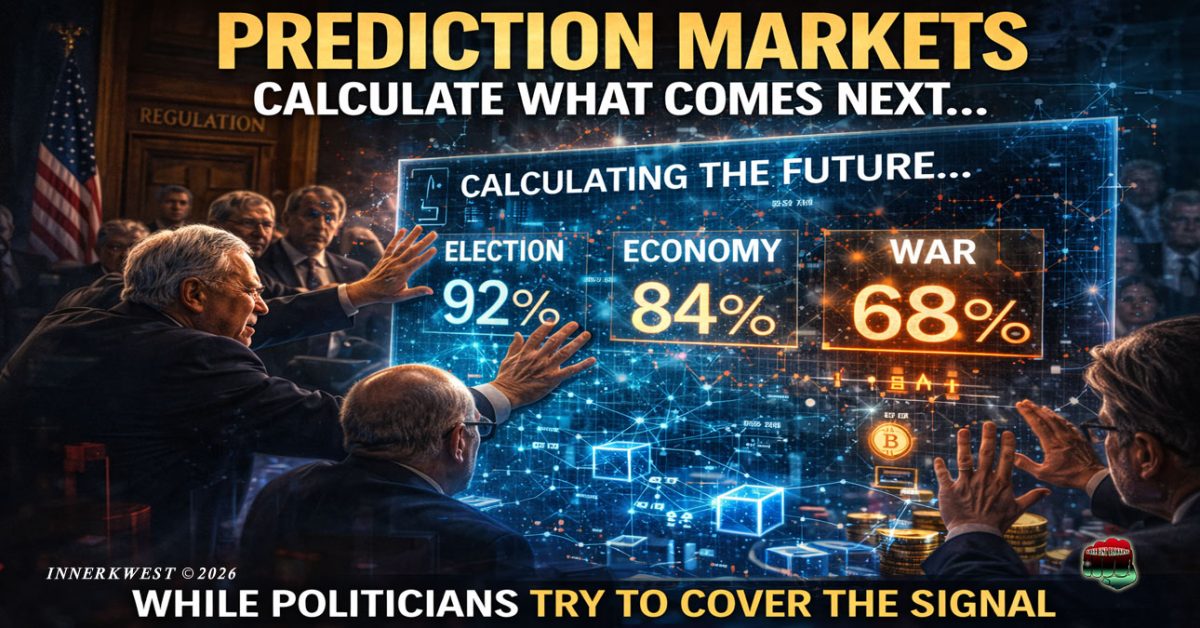
Polymarket, Kalshi, and the rising battle over markets that trade probabilities about the future.
By InnerKwest Monetary Systems Desk | March 17, 2026
Prediction markets are rapidly becoming one of the most controversial developments in the digital economy.
Platforms such as Polymarket and Kalshi allow participants to trade contracts on the outcomes of real-world events—from elections and economic indicators to geopolitical developments and policy decisions.
Supporters argue these platforms represent a new form of market-based forecasting, where financial incentives drive participants to reveal what they genuinely believe will happen.
Critics—including state regulators and segments of the gaming industry—argue they resemble unlicensed gambling operations.
But the debate over prediction markets is increasingly revealing something deeper.
As these platforms grow in scale and influence, they are beginning to raise a larger question about the future architecture of information itself.
The Structural Difference Between Sports-books and Prediction Markets
Much of the regulatory criticism surrounding prediction markets stems from the assumption that they function like traditional betting platforms.
In reality, the mechanics are fundamentally different.
In a conventional sportsbook, participants wager against the house. The platform sets the odds and profits through the vigorish, or “VIG,” ensuring the operator maintains a statistical advantage.
For casual bettors, the probability of sustained profitability is extremely low.
Prediction markets operate under an entirely different structure.
Instead of wagering against a centralized bookmaker, participants trade contracts with one another in a peer-to-peer marketplace.
Prices fluctuate based on supply and demand, reflecting the collective sentiment of traders about the probability of future events.
In practice, prediction markets function much closer to derivatives exchanges than casinos.
Participants buy and sell contracts representing outcomes, and as trading occurs the price of those contracts becomes a real-time probability signal about the likelihood of the event.
In effect, the market itself becomes a continuously updating forecast.
Built on Blockchain Infrastructure
Many modern prediction platforms are built directly on blockchain networks.
Polymarket operates on the Polygon network, a layer-2 scaling system connected to Ethereum.
This infrastructure allows trades, settlements, and market updates to occur almost instantly while transactions remain permanently recorded on a public ledger.
The use of blockchain also enables global participation without relying on traditional financial intermediaries.
For participants, the result is a market that operates continuously, with prices adjusting in real time as new information emerges.
A Market Measuring Belief
The core innovation behind prediction markets lies in what they measure.
Traditional polling systems attempt to capture opinions by surveying participants.
Prediction markets capture something different: conviction.
Participants are required to risk capital on their beliefs about future events. That financial stake encourages traders to incorporate information quickly and reassess probabilities as conditions change.
Economists have studied this phenomenon for decades.
Academic research suggests that prediction markets often outperform polling models and expert forecasts when predicting political and economic outcomes.
During the 2024 U.S. election cycle, prediction markets correctly projected the outcome in nearly every state while polling models missed several key contests.
This dynamic has led some analysts to describe prediction markets as information aggregation engines.
The Scale of the Market
What began as a niche experiment in digital finance has rapidly evolved into a large and growing sector.
Prediction market platforms collectively generated more than $44 billion in trading volume in recent years, reflecting rising global interest in market-based forecasting.
Monthly trading volumes have grown from millions of dollars to billions as political events, macroeconomic indicators, and geopolitical developments become tradable contracts.
Some analysts believe the sector could expand dramatically over the coming decade as institutional traders and financial firms enter the space.
Economists Are Paying Attention
The rise of prediction markets has attracted attention from academic researchers and financial economists.
A working paper circulated by economists associated with the Federal Reserve Board—titled “Kalshi and the Rise of the Macro Markets”—examines how platforms like Kalshi are enabling trading on macroeconomic outcomes.
These markets allow participants to buy and sell contracts tied to events such as inflation data, policy decisions, and economic indicators.
In this sense, prediction markets are evolving beyond political forecasts.
They are becoming markets that trade probabilities about the future itself.
The Regulatory Paradox
Despite growing academic interest and market activity, prediction markets face increasing regulatory resistance.
State regulators often classify these platforms as unlicensed gambling operations, a position that aligns closely with concerns raised by segments of the traditional gaming industry.
At the same time, a number of institutions—including researchers, analysts, and emerging media outlets—are exploring ways to use prediction market data as a forecasting tool.
This creates a striking contradiction.
The same markets facing regulatory scrutiny are simultaneously being studied and adopted as real-time intelligence systems capable of aggregating global information about future events.
As prediction markets grow in size and forecasting accuracy, another question is quietly emerging among policymakers and researchers: if markets can price the probability of future events, how might governments use that information?
The “Minority Report” Question
The concept behind the film Minority Report is predictive intelligence—using data to forecast actions before they occur.
Prediction markets don’t predict individual crimes, but they do create probability signals about future events.
Those signals could theoretically be used by governments or institutions to anticipate:
- geopolitical conflicts
- economic crises
- election outcomes
- policy decisions
- supply chain disruptions.
In fact, governments have experimented with similar ideas.
In the early 2000s, the U.S. Department of Defense explored a project called the Policy Analysis Market, which proposed using prediction markets to forecast geopolitical instability and security risks.
The program was ultimately canceled after public backlash, but the underlying idea—using markets as forecasting engines—never disappeared.
Why Governments Might Be Interested
Prediction markets have several properties that intelligence agencies and policymakers find valuable:
1. Real-time probability signals
Prices update instantly as new information enters the market.
2. Incentivized truth discovery
Participants must risk money on their beliefs.
3. Distributed knowledge
Thousands of participants contribute information simultaneously.
4. Resistance to narrative bias
Markets can sometimes contradict official messaging or media narratives.
For intelligence analysis, that combination can be powerful.
The Ethical and Political Risk
But this is where the Minority Report concern appears.
If governments or large institutions begin relying heavily on prediction markets for forecasting, several questions arise:
- Could markets be manipulated to influence policy decisions?
- Could governments trade in markets tied to events they influence?
- Could predictive probabilities shape policy responses before events occur?
In extreme scenarios, prediction signals could begin to influence how authorities react to potential future events.
That’s where the philosophical tension emerges.
Prediction markets are designed to measure probabilities, not determine outcomes.
But if institutions begin acting on those probabilities, the line between forecasting the future and shaping it becomes less clear.
A Larger Question About Information
As prediction markets continue to expand, the debate surrounding them is beginning to move beyond questions of gambling regulation.
At stake is the possibility that markets themselves may become a new form of knowledge infrastructure.
By allowing participants to trade on the probability of events, prediction platforms transform collective beliefs into quantifiable signals.
In theory, this process can reveal information faster than traditional polling, commentary, or expert analysis.
Which leads to a deeper question now emerging across the digital financial ecosystem.

The Question Behind the Markets
Are prediction markets simply online gambling platforms operating outside existing regulations?
Or are they evolving into something far more consequential—a decentralized system for discovering truth through financial incentives?
If the latter proves correct, the battle over prediction markets may ultimately be less about gambling law and more about who controls the world’s most powerful forecasting engines.
Because in a system where probabilities themselves can be traded, the ability to price the future may become one of the most valuable forms of information in the global economy.
Prediction markets may become the data layer feeding AI policy models, which means the next evolution could be AI systems reading markets to anticipate crises before governments do.
At InnerKwest.com, we are committed to delivering impactful journalism, deep insights, and fearless social commentary. Your cryptocurrency contributions help us execute with excellence, ensuring we remain independent and continue to amplify voices that matter.
To help sustain our work and editorial independence, we would appreciate your support of any amount of the tokens listed below. Support independent journalism:
BTC: 3NM7AAdxxaJ7jUhZ2nyfgcheWkrquvCzRm
SOL: HxeMhsyDvdv9dqEoBPpFtR46iVfbjrAicBDDjtEvJp7n
ETH: 0x3ab8bdce82439a73ca808a160ef94623275b5c0a
XRP: rLHzPsX6oXkzU2qL12kHCH8G8cnZv1rBJh TAG – 1068637374
SUI – 0xb21b61330caaa90dedc68b866c48abbf5c61b84644c45beea6a424b54f162d0c
and through our Support Page.
InnerKwest maintains a revelatory and redemptive discipline, relentless in advancing parity across every category of the human experience.
© 2026 InnerKwest®. All Rights Reserved | Haki zote zimehifadhiwa | 版权所有. InnerKwest® is a registered trademark of Inputit™ Platforms Inc. Global. No part of this publication may be reproduced, distributed, or transmitted in any form or by any means without prior written permission. Unauthorized use is strictly prohibited. Thank you for standing with us in pursuit of truth and progress!