
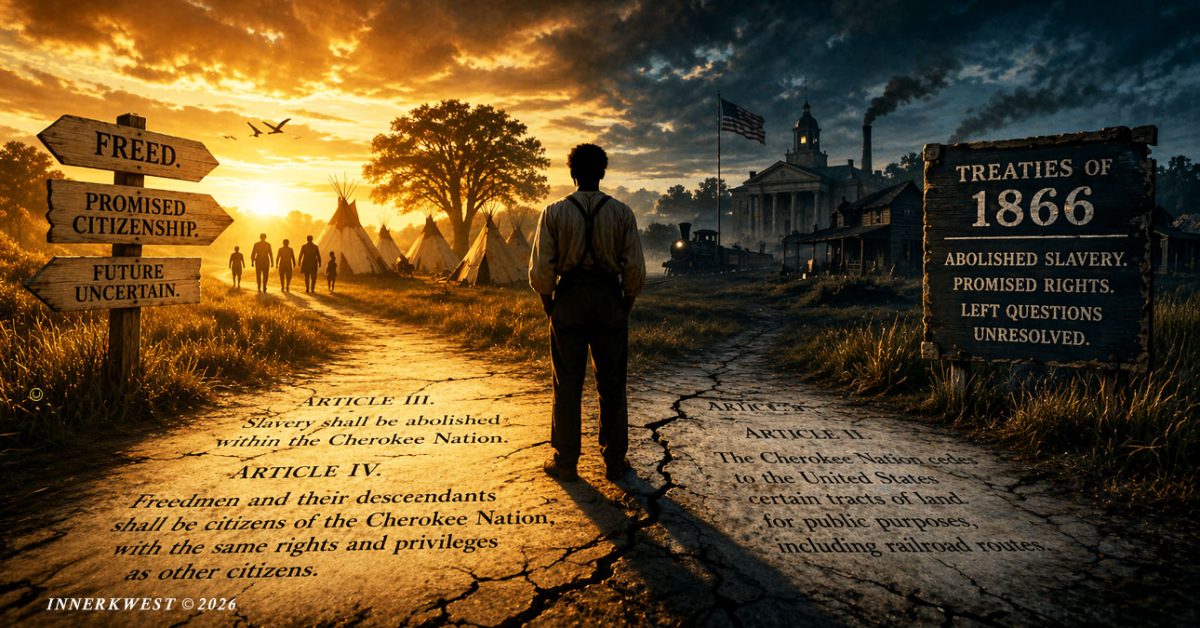
Freedom was declared.
Belonging was negotiated.
By Intelligence Desk | April 20, 2026
A War Ends. A System Rewrites Itself.
The American Civil War did not end in a vacuum.
It ended with terms.
And those terms extended beyond the former Confederacy.
They reached into Indian Territory—modern-day Oklahoma—where several Native nations had aligned, in varying degrees, with the South.
The United States responded accordingly.
Through the 1866 treaties, it restructured relationships with the Cherokee Nation, Choctaw Nation, Chickasaw Nation, Creek Nation, and Seminole Nation.
The outcome was not just political.
It was structural.
Alignment Was Not Accidental
Several of the so-called Five Civilized Tribes aligned with the Confederacy.
That is fact.
And in some cases, it was not reluctant.
Within the Choctaw Nation and Chickasaw Nation, segments of the leadership class owned enslaved African Americans and operated economies that depended on that system. Alignment with the Confederacy, for them, was consistent with existing structure.
That part cannot be softened.
Pressure, Geography, and Memory
But it was not the only force at work.
Indian Territory was bordered by Confederate states. Union protection was limited early in the war. Confederate forces moved quickly, and tribal governments were pressed—politically and militarily—into decisions that did not come with clean alternatives.
There was also history.
The United States had already removed these nations from their lands through the Trail of Tears. Trust was not intact. The Confederacy offered recognition of sovereignty—whether that promise would have held is another matter.
Choices were made inside that context.
Division Within Nations
There was no unified position.
The Cherokee Nation split.
Leaders diverged.
Communities fractured.
Some fought for the Confederacy. Others for the Union.
What is often described as alignment was, in practice, internal conflict.
A civil war within nations already under pressure.

What Followed Was Not Neutral
When the war ended, these distinctions collapsed into a single outcome.
The United States did not sort nuance.
It treated the tribes as having aligned with the Confederacy.
And the treaties that followed reflected that judgment.
A Reality Often Overlooked
Slavery did not exist only in the American South.
It existed within certain Native nations as well.
Enslaved African Americans lived, labored, and were legally held within these tribal systems—sometimes integrated into them, but never equal within them.
When the war ended, that system could not remain intact.
Not under the new national order.
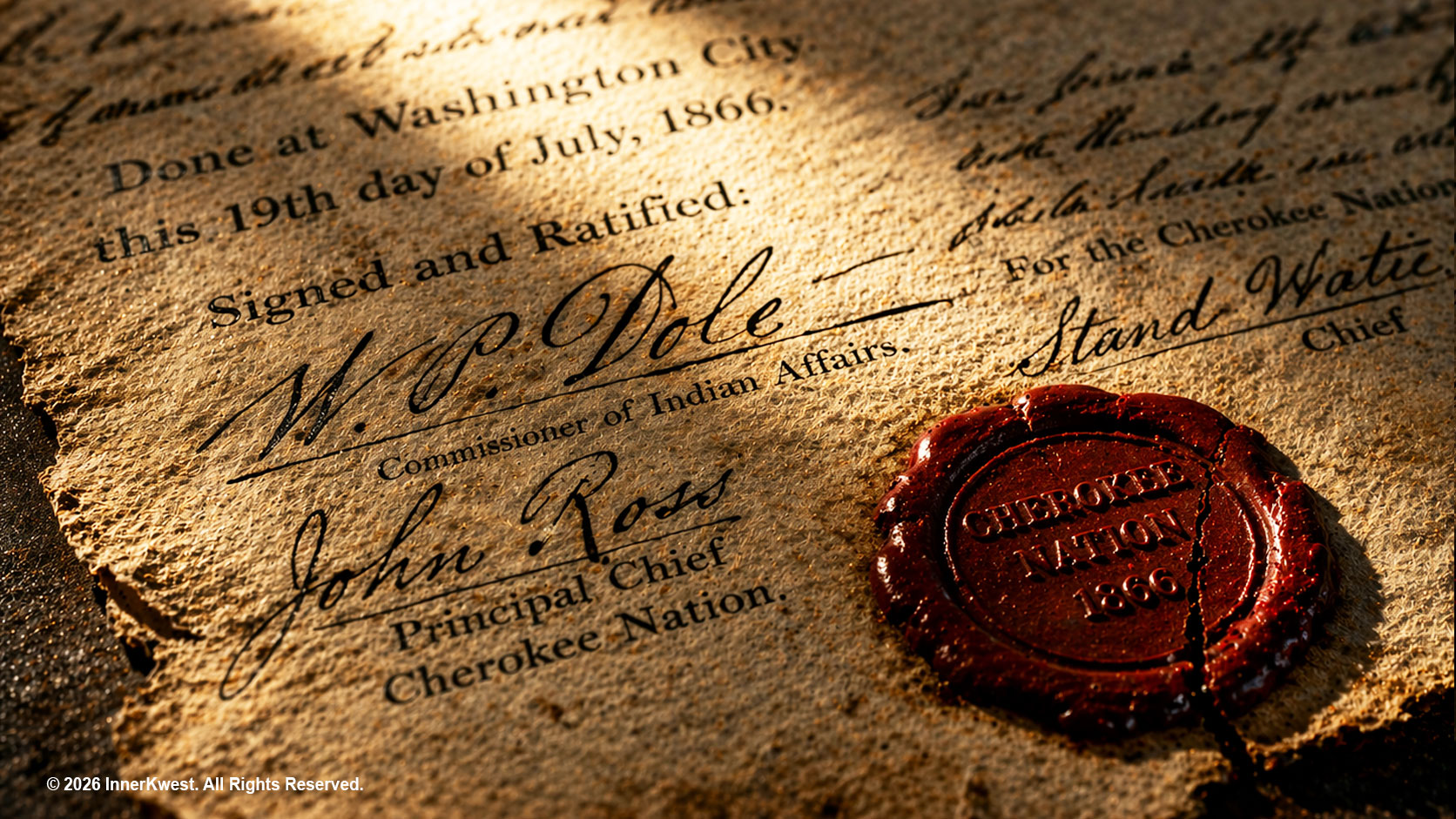
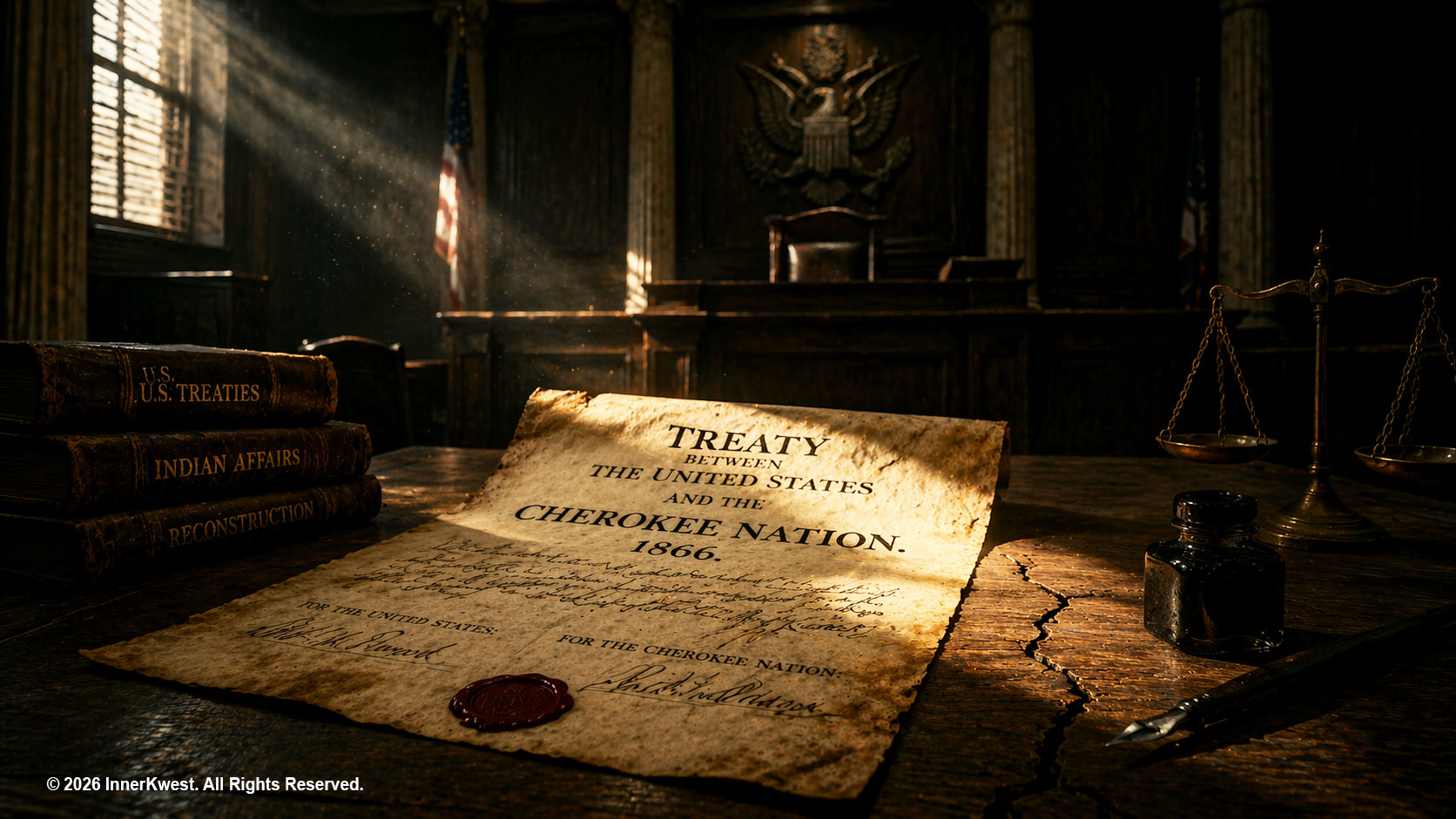
What the Treaties Required
The 1866 agreements imposed a clear framework:
- abolition of slavery within tribal nations
- emancipation of enslaved people—now called Freedmen
- citizenship rights for Freedmen within certain tribes
- land concessions and infrastructure access granted to the United States
This was not optional.
It was a condition of reintegration.
Freedom, Immediately
For those enslaved within these nations, the shift was immediate.
Legal status changed.
Ownership ended.
Movement, in theory, became possible.
Freedom was declared.
But declaration is not the same as stability.
Citizenship: Where Structure Begins to Fracture
The treaties went further than emancipation.
They addressed belonging.
And this is where the system became uneven.
Different Nations, Different Outcomes
The Cherokee Nation treaty explicitly granted Freedmen and their descendants full citizenship.
The Seminole Nation incorporated Freedmen in many cases.
But the response was not uniform.
The Choctaw Nation and Chickasaw Nation resisted.
Citizenship was delayed.
Restricted.
In some cases, effectively denied.
The result was not a single outcome.
It was a spectrum:
- full inclusion
- conditional recognition
- prolonged exclusion
A Category Without Certainty
Freedmen became something new.
Not enslaved.
But not fully integrated.
They occupied a space between systems:
- recognized by federal authority
- contested by tribal governance
- marginalized within broader American society
They were free.
But their place was not fixed.
Land, Economy, and the Limits of Promise
In the broader United States, the idea of land redistribution—“40 acres and a mule”—was largely abandoned.
Within Native nations, the situation was no more stable.
Some Freedmen later received land allotments during the Dawes Act era.
Many did not.
Economic participation was often limited by:
- tribal policy
- social structure
- lack of enforcement
Freedom opened the door.
It did not guarantee access.
A Legal Foundation That Never Settled
The treaties did something enduring.
They created a legal basis for Freedmen rights.
But enforcement remained inconsistent.
And inconsistency, over time, becomes conflict.
A Question That Did Not End
Into the 20th and 21st centuries, descendants of Freedmen have continued to challenge their status within tribal nations.
Most notably within the Cherokee Nation, where legal battles have addressed:
- citizenship rights
- voting access
- recognition tied to treaty language
In several cases, courts have affirmed:
the treaties still apply.
This is not closed history.
It is active structure.
System-Level Reading
The 1866 treaties did more than end slavery within Native nations.
They attempted to define:
- who belongs
- who decides
- and which authority holds final weight
But they did so across overlapping systems:
- U.S. federal power
- Native sovereignty
- racial hierarchy
And those systems did not align cleanly.
Recognition Without Stability
Freedmen were:
- legally freed
- partially recognized
- unevenly integrated
They were given status.
But not certainty.

Final Observation
The treaties resolved one condition.
They exposed another.
Freedom was declared.
Citizenship was promised.
But belonging—real, stable, uncontested—remained unresolved.
And in that space, the structure becomes visible.
Recognition, on its own, is not enough.
Because without alignment across the systems that define it,
recognition does not settle.
It lingers.
At InnerKwest.com, we are committed to delivering impactful journalism, deep insights, and fearless social commentary. Your cryptocurrency contributions help us execute with excellence, ensuring we remain independent and continue to amplify voices that matter.
To help sustain our work and editorial independence, we would appreciate your support of any amount of the tokens listed below. Support independent journalism:
BTC: 3NM7AAdxxaJ7jUhZ2nyfgcheWkrquvCzRm
SOL: HxeMhsyDvdv9dqEoBPpFtR46iVfbjrAicBDDjtEvJp7n
ETH: 0x3ab8bdce82439a73ca808a160ef94623275b5c0a
XRP: rLHzPsX6oXkzU2qL12kHCH8G8cnZv1rBJh TAG – 1068637374
SUI – 0xb21b61330caaa90dedc68b866c48abbf5c61b84644c45beea6a424b54f162d0c
and through our Support Page.
InnerKwest maintains a revelatory and redemptive discipline, relentless in advancing parity across every category of the human experience.
© 2026 InnerKwest®. All Rights Reserved | Haki zote zimehifadhiwa | 版权所有. InnerKwest® is a registered trademark of Inputit™ Platforms Inc. Global. No part of this publication may be reproduced, distributed, or transmitted in any form or by any means without prior written permission. Unauthorized use is strictly prohibited. Thank you for standing with us in pursuit of truth and progress!