
May 19, 2026
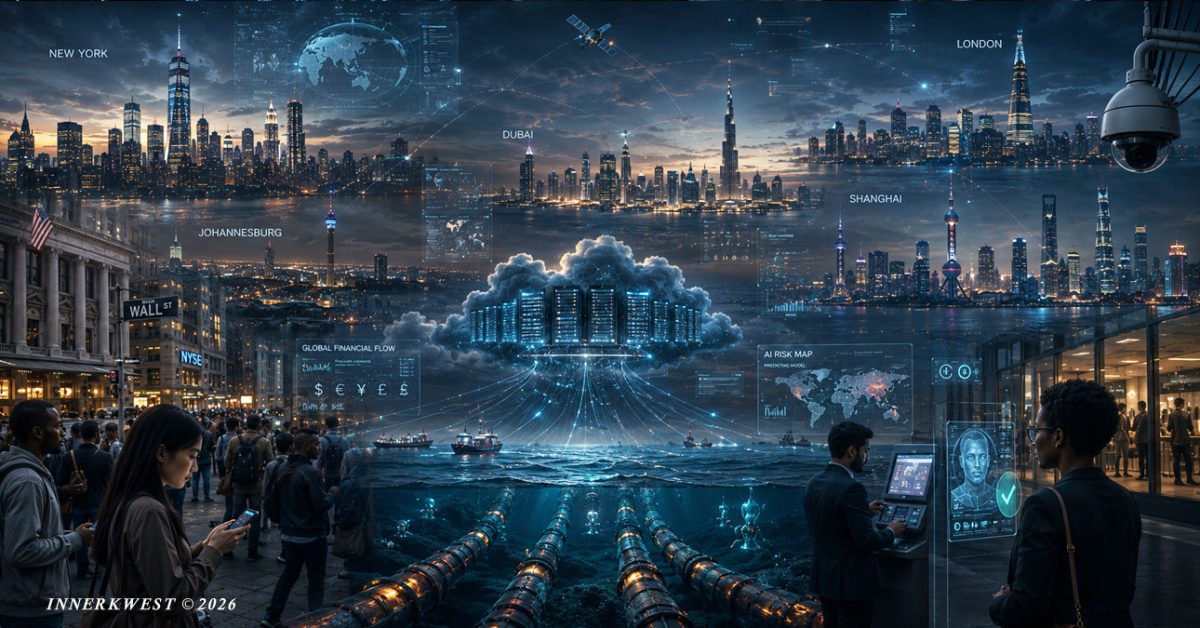
The modern struggle for power is no longer defined primarily by territory or military occupation. Increasingly, it is being shaped by invisible infrastructure — data systems, cloud networks, AI governance, and financial architecture operating beneath everyday life also referenced as the digital control grid
By InnerKwest Intelligence Desk
There was once a time when power was visible.
It wore uniforms, occupied territory, controlled ports, and raised flags over conquered land. Nations projected influence through military bases, shipping lanes, industrial capacity, and direct resource control. Power was physical. Borders were tangible. Infrastructure could be seen with the naked eye.
But the architecture of modern influence has changed.
Today, power increasingly flows through invisible systems:
fiber-optic cables beneath oceans,
cloud servers inside fortified data centers,
AI moderation algorithms,
digital identity frameworks,
financial compliance engines,
and the telecommunications infrastructure connecting billions of people to the internet every second.
This emerging framework is often described as a “Digital Control Grid” — not as a singular machine or centralized conspiracy, but as the convergence of technologies capable of shaping behavior, regulating access, and concentrating influence at unprecedented scale.
The grid is not one government.
Not one corporation.
Not one ideology.
It is an ecosystem.
And it is expanding rapidly.
From Physical Borders to Digital Infrastructure
Modern civilization now depends on digital systems as heavily as previous generations depended on railways, oil pipelines, shipping lanes, and electrical grids.
The global economy increasingly runs on:
- cloud computing,
- telecommunications backbones,
- AI-driven analytics,
- payment networks,
- and real-time data transmission.
Every bank transfer, biometric verification, crypto transaction, streaming service, social media interaction, or AI prompt now travels through interconnected layers of infrastructure concentrated among a relatively small number of governments, hyperscale cloud providers, telecom operators, and financial institutions.
In the 20th century, nations competed for control over oil reserves and maritime chokepoints.
In the 21st century, strategic competition increasingly revolves around:
- semiconductor manufacturing,
- cloud sovereignty,
- undersea cable routes,
- satellite networks,
- AI compute infrastructure,
- and financial data systems.
The battlefield has become digital.
The Backbone Beneath the Surface
Much of the modern internet travels through undersea fiber-optic cables stretching silently across the ocean floor.
Systems such as:
- WACS,
- SEACOM,
- SAT-3,
- ACE,
- Equiano,
- and 2Africa
form part of the invisible circulatory system of the global internet.
South Africa has emerged as one of the continent’s most strategically important digital gateways because multiple systems converge there before routing traffic into Africa, Europe, and Asia.
This is not merely telecommunications infrastructure.
It is geopolitical infrastructure.
Who owns the cables,
who controls the landing stations,
who hosts the cloud regions,
and who manages the internet exchange points increasingly determines:
- data sovereignty,
- cyber resilience,
- economic leverage,
- and informational influence.
Infrastructure once measured in steel and concrete is now measured in bandwidth and latency.
Cloud Power and the Rise of the Hyperscalers
A growing percentage of global digital activity now depends on a handful of hyperscale cloud providers.
Amazon Web Services,
Microsoft Azure,
Google Cloud,
and a small number of others now host enormous portions of:
- enterprise computing,
- AI workloads,
- fintech systems,
- government services,
- media platforms,
- and global communications.
This concentration creates extraordinary efficiencies.
It also creates extraordinary chokepoints.
When infrastructure centralizes, power centralizes alongside it.
The implications are no longer theoretical.
Cloud outages can disrupt banking systems.
Platform moderation policies can reshape political discourse.
Financial compliance engines can instantly freeze access.
Algorithmic visibility can determine which narratives spread globally and which disappear into digital obscurity.
Modern governance increasingly operates through infrastructure itself.
Finance as Behavioral Infrastructure
Financial systems are evolving beyond simple payment rails.
The emergence of:
- Central Bank Digital Currencies (CBDCs),
- programmable payments,
- real-time transaction monitoring,
- and AI-driven compliance systems
signals the rise of deeply integrated financial oversight architecture.
Supporters argue these systems improve:
- fraud prevention,
- tax compliance,
- economic efficiency,
- and financial inclusion.
Critics warn they may also create systems capable of:
- granular surveillance,
- automated restrictions,
- behavioral conditioning,
- and political misuse if left unchecked.
This tension partially explains the explosive global growth of cryptocurrency ecosystems over the last decade.
Bitcoin and decentralized finance did not emerge solely from technological curiosity.
They also emerged from growing concerns surrounding centralized monetary control and financial gatekeeping.
The African Digital Frontier
Africa occupies a unique position inside this transformation.
Unlike many developed economies whose digital systems matured decades ago, large portions of Africa’s:
- telecommunications networks,
- fintech ecosystems,
- cloud infrastructure,
- digital identity systems,
- and AI governance frameworks
are still being constructed.
That creates opportunity.
But it also creates vulnerability.
External powers increasingly compete for influence across the continent through:
- telecom financing,
- cloud investment,
- undersea cable projects,
- fintech partnerships,
- and AI infrastructure deployment.
China,
the United States,
Europe,
the Gulf states,
and multinational technology firms all recognize that Africa represents one of the last major digital frontiers of the 21st century.
The next phase of geopolitical influence may not arrive through direct military occupation or traditional colonial administration.
It may arrive through:
- cloud dependency,
- payment ecosystems,
- digital identity frameworks,
- and ownership of the infrastructure through which modern society functions.
Surveillance Without Walls
Historically, surveillance required physical presence.
Today, metadata itself has become power.
Modern systems can now analyze:
- location patterns,
- financial behavior,
- online interactions,
- communication networks,
- purchasing habits,
- and social sentiment
at scales previously unimaginable.
Artificial intelligence accelerates this transformation further.
AI systems are increasingly capable of:
- behavioral prediction,
- sentiment analysis,
- facial recognition,
- anomaly detection,
- and automated risk scoring.
Some governments deploy these systems openly.
Others utilize softer forms of algorithmic governance through:
- platform moderation,
- financial compliance systems,
- digital visibility controls,
- and behavioral filtering mechanisms.
The methods differ.
But the convergence is global.
The Future of Sovereignty
The central geopolitical question of the coming decade may not simply be:
“Who controls territory?”
But rather:
Who controls the infrastructure through which reality itself is increasingly mediated?
Digital sovereignty is becoming as strategically important as military sovereignty.
Governments increasingly recognize that dependence on foreign-controlled:
- cloud regions,
- AI systems,
- financial rails,
- and telecommunications backbones
may eventually carry consequences comparable to dependence on foreign energy infrastructure in previous eras.
The nations and corporations controlling data flows, compute infrastructure, cloud ecosystems, and digital identity systems may shape the next global order as profoundly as industrial powers shaped the last one.

Conclusion
The Digital Control Grid is not a science-fiction machine hidden inside secret bunkers.
It is something far more consequential:
the gradual convergence of infrastructure, telecommunications, finance, artificial intelligence, cloud computing, and governance systems into a deeply interconnected architecture of influence.
Some of these systems will improve:
- efficiency,
- economic development,
- security,
- and technological access.
Others may challenge:
- decentralization,
- privacy,
- sovereignty,
- and civil liberty.
The defining issue may not be whether this infrastructure emerges.
Much of it already has.
The defining issue is whether societies remain aware of the systems increasingly shaping modern life from behind the screen — and who ultimately controls them.
At InnerKwest.com, we are committed to delivering impactful journalism, deep insights, and fearless social commentary. Your cryptocurrency contributions help us execute with excellence, ensuring we remain independent and continue to amplify voices that matter.
To help sustain our work and editorial independence, we would appreciate your support of any amount of the tokens listed below. Support independent journalism:
BTC: 3NM7AAdxxaJ7jUhZ2nyfgcheWkrquvCzRm
SOL: HxeMhsyDvdv9dqEoBPpFtR46iVfbjrAicBDDjtEvJp7n
ETH: 0x3ab8bdce82439a73ca808a160ef94623275b5c0a
XRP: rLHzPsX6oXkzU2qL12kHCH8G8cnZv1rBJh TAG – 1068637374
SUI – 0xb21b61330caaa90dedc68b866c48abbf5c61b84644c45beea6a424b54f162d0c
and through our Support Page.
InnerKwest maintains a revelatory and redemptive discipline, relentless in advancing parity across every category of the human experience.
© 2026 InnerKwest®. All Rights Reserved | Haki zote zimehifadhiwa | 版权所有. InnerKwest® is a registered trademark of Inputit™ Platforms Inc. Global. No part of this publication may be reproduced, distributed, or transmitted in any form or by any means without prior written permission. Unauthorized use is strictly prohibited. Thank you for standing with us in pursuit of truth and progress!