
May 18, 2026
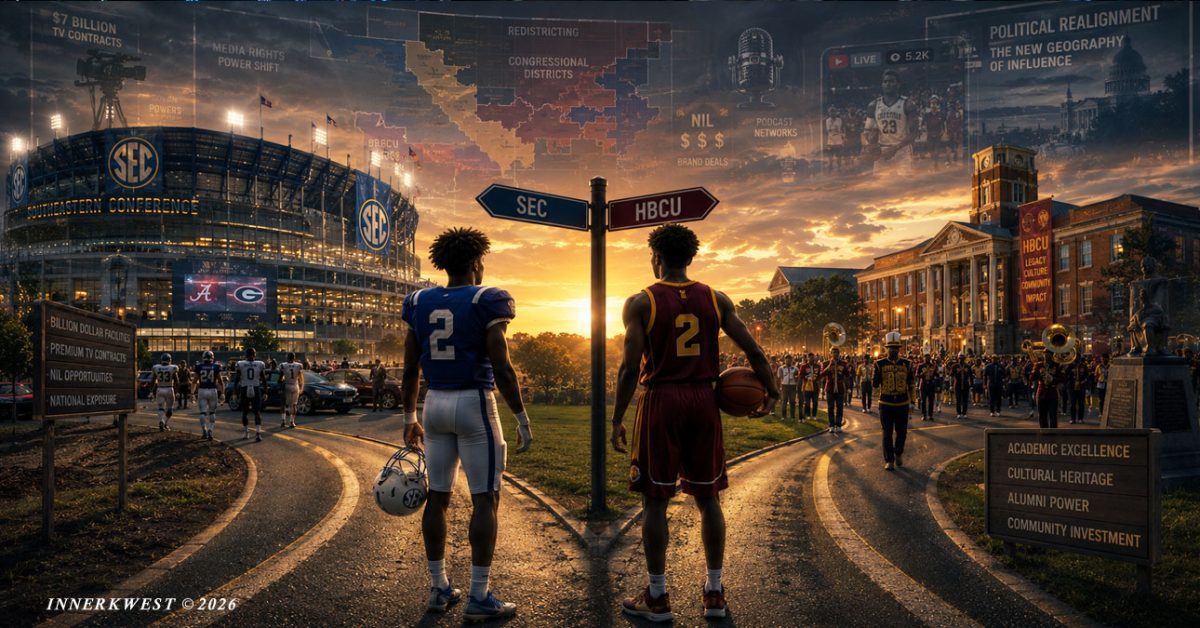
Voting rights battles, athlete empowerment, and shifting political tensions are beginning to intersect with college sports in ways that could reshape the future of HBCUs, recruiting pipelines, and Black institutional influence in America.
By Solomon Reed
for InnerKwest Intelligence Desk
There are moments in American history when political debates stop feeling procedural and begin feeling personal.
For many African Americans, the recent escalation of voting-rights disputes, aggressive redistricting battles, and constitutional reinterpretation debates no longer register as isolated legal developments. Increasingly, they are viewed as part of a broader institutional pattern — one many believe historically reappears whenever Black political, demographic, or economic influence begins materially expanding inside the American system.
That perception, whether dismissed or embraced depending on ideological perspective, is becoming difficult to ignore.
Recent Supreme Court rulings affecting enforcement mechanisms tied to the Voting Rights Act have reignited longstanding fears surrounding representation dilution, particularly across portions of the South where congressional district maps remain under ongoing legal scrutiny.
Among the states most frequently cited in active disputes involving minority representation and redistricting are:
- Alabama,
- Louisiana,
- Georgia,
- Florida,
- Texas,
- Mississippi,
- South Carolina,
- and North Carolina.
Supporters of these maps argue they are constitutionally lawful, politically routine, and reflective of ordinary electoral processes.
Critics counter that the cumulative effect weakens African American voting influence at a moment when demographic shifts are rapidly reshaping the American electorate.
But for many Black Americans, the issue extends beyond courtrooms and district maps alone.
It is psychological.
It is historical.
And increasingly, it is economic.
The Psychological Weight Beneath the Headlines
One of the most misunderstood aspects of the modern American racial conversation is the tendency to treat African American frustration as episodic rather than cumulative.
To many observers outside the lived experience, each controversy appears compartmentalized:
- a court ruling,
- a district map,
- a policing debate,
- a curriculum dispute,
- or a voting-law challenge.
But for many African Americans, these events are rarely experienced independently.
They are layered.
Accumulated.
Connected through generations of historical memory stretching from Reconstruction to Jim Crow, from redlining to mass incarceration, from voter-suppression battles to present-day institutional distrust.
This is where much of the national disconnect emerges.
Public commentary often urges emotional restraint without fully acknowledging that the historical conditions themselves were profoundly emotional:
- funerals,
- displacement,
- intimidation,
- violence,
- humiliation,
- and generations forced to navigate instability inside institutions they did not fully control.
For many African Americans, the frustration is not rooted in one headline.
It is rooted in repetition.
And while critics frequently dismiss such concerns as political grievance or emotional overreaction, others argue that exhaustion after centuries of structural instability may itself be rational.
The emerging question is therefore no longer merely political.
It is strategic.
The Athletic Economy Few Want to Discuss
College athletics represents one of the largest cultural and financial engines in modern America.
The SEC, ACC, Big Ten, Big 12, and other major conferences generate billions through:
- television contracts,
- merchandising,
- sponsorships,
- alumni engagement,
- and media rights.
African American athletes remain central to much of that economic architecture — particularly in football and basketball.
Read Related Article: The End of the One-Way Money Highway: College Sports’ Billion-Dollar Reckoning
Programs throughout states currently engaged in aggressive redistricting debates continue recruiting heavily from Black communities nationwide.
Schools frequently mentioned in conversations surrounding this emerging discussion include:
- University of Alabama,
- Auburn,
- LSU,
- University of Georgia,
- University of Florida,
- Florida State,
- Ole Miss,
- Mississippi State,
- South Carolina,
- University of Texas,
- and Texas A&M.
No organized boycott presently exists.
No formal athlete movement has materialized.
But NIL compensation, unrestricted transfer mobility, athlete-controlled branding, and independent media ecosystems have fundamentally altered the balance of power inside collegiate athletics.
For perhaps the first time in NCAA history, elite athletes possess both mobility and monetization simultaneously.
That matters.
Because historically, communities perceiving political contraction often begin reconsidering where they allocate:
- labor,
- capital,
- talent,
- institutional loyalty,
- and cultural influence.
The Federal Dependency Contradiction
Another layer beneath this emerging conversation involves economics — specifically the relationship between federal dependency, Black athletic labor, and political representation across portions of the South.
Many Southern states dominating college athletics while simultaneously engaging in intense voting-rights and redistricting disputes also receive:
- significant federal funding support,
- federal transfer payments,
- agricultural subsidies,
- military spending,
- infrastructure allocations,
- Medicaid support,
- and broader federal economic stabilization.
States such as:
- Mississippi,
- Louisiana,
- Alabama,
- Arkansas,
- Kentucky,
- and others
have historically ranked among the largest net recipients of federal dollars relative to taxes contributed back into the federal system.
That reality introduces a politically sensitive contradiction increasingly discussed within some academic, media, and cultural circles.
Critics argue that certain states benefit heavily from:
- federal redistribution,
- Black athletic labor,
- Black consumer spending,
- and federal civil-rights protections,
while simultaneously pursuing policies perceived by opponents as reducing Black political leverage, voting influence, or demographic representation.
Supporters of those policies reject that characterization, arguing their positions reflect constitutional interpretation, electoral integrity concerns, and ordinary political governance rather than targeted suppression.
But regardless of interpretation, the perception itself is becoming culturally significant.
Because once communities begin evaluating institutions not only emotionally, but economically, questions surrounding labor allocation and institutional loyalty often follow.
That possibility remains largely theoretical for now.
Yet the broader discussion increasingly reflects a deeper systems-level question emerging beneath modern American politics:
What happens when communities begin reassessing not only who receives their votes — but also who receives their talent, cultural capital, economic influence, and institutional participation?
The HBCU Opportunity Window
Historically Black Colleges and Universities may now sit at the intersection of athletics, economics, identity, and institutional renewal in ways not seen in decades.
Schools such as:
- Howard University,
- Jackson State,
- Florida A&M,
- North Carolina A&T,
- Tennessee State,
- Grambling State,
- Southern University,
- Prairie View A&M,
- Morgan State,
- and Morehouse
could become major beneficiaries if even a modest percentage of elite African American athletic talent intentionally redirected enrollment decisions.
The implications would extend far beyond sports.
Major athletic visibility often produces:
- expanded alumni donations,
- larger sponsorship agreements,
- increased national applications,
- infrastructure growth,
- stronger NIL collectives,
- enhanced recruiting,
- and broader institutional investment.
The Deion Sanders era at Jackson State briefly demonstrated how quickly national attention could shift toward HBCU athletics before Sanders departed for Colorado.
Many viewed that period not as an isolated media phenomenon, but as an early indication of untapped institutional potential.
Beyond Legacy Gatekeepers
What makes this moment different from previous eras is the collapse of centralized narrative control.
Conversations once confined to:
- barbershops,
- churches,
- dormitories,
- family gatherings,
- and local radio
now move through podcast networks, athlete-driven media, YouTube ecosystems, and algorithmic distribution systems capable of reaching millions within hours.
Figures such as:
- Shannon Sharpe,
- Cam Newton,
- Stephen A. Smith,
- Gilbert Arenas,
- Ryan Clark,
- Draymond Green,
- and LeBron James
now operate as independent media power centers beyond traditional newsroom structures.
If conversations surrounding:
- voting rights,
- institutional distrust,
- HBCUs,
- athlete economics,
- and representation
begin intersecting publicly inside these ecosystems, the cultural implications could become substantial.
Not because every athlete would suddenly abandon powerhouse programs overnight.
But because legitimacy often shifts culturally before institutions recognize the shift economically.
A single viral discussion questioning why billions in Black athletic labor continue concentrating inside states accused of weakening Black political representation could fundamentally alter recruiting conversations nationwide.
And unlike previous generations, athletes no longer require network approval to shape the national conversation.
They increasingly own:
- platforms,
- audiences,
- distribution,
- and investment capital.
The States Watching Closely
Some advocates have quietly floated the possibility of encouraging elite athletes and families to increasingly consider states perceived as more stable regarding:
- voting access,
- institutional protections,
- demographic representation,
- and broader political climate.
Potential beneficiary regions frequently mentioned include:
- Maryland,
- Illinois,
- Michigan,
- Minnesota,
- California,
- Virginia,
- Pennsylvania,
- and New Jersey.
Combined with expanding NIL opportunities in major metropolitan markets, some observers believe the traditional Southern recruiting pipeline could eventually face meaningful competition if political tensions continue escalating.
Whether such a realignment materializes remains uncertain.
But the conversation itself is no longer unthinkable.
A Question Larger Than Sports
Mainstream sports media has largely avoided sustained engagement with this conversation, likely because it sits at the combustible intersection of:
- race,
- economics,
- education,
- athletics,
- and politics.
Yet beneath the surface, the tension continues building.
For many African Americans, the concern is not rooted in one Supreme Court ruling or a single election cycle.
It is the cumulative perception that progress in America often remains conditional — vulnerable to restructuring whenever political power begins materially shifting.
And while some Americans remain insulated from that anxiety, history repeatedly demonstrates that societies ignoring deep institutional distrust eventually confront consequences extending far beyond politics alone.
College athletics may simply become one of the first arenas where those tensions begin translating into measurable economic behavior.
Because in modern America, influence no longer moves exclusively through legislatures or courtrooms.
It also moves through:
- enrollment decisions,
- television contracts,
- recruiting pipelines,
- cultural legitimacy,
- and the strategic allocation of talent itself.
The question quietly emerging beneath the national noise is no longer whether communities feel unheard.
It is whether those communities eventually decide to reposition their influence accordingly.

At InnerKwest.com, we are committed to delivering impactful journalism, deep insights, and fearless social commentary. Your cryptocurrency contributions help us execute with excellence, ensuring we remain independent and continue to amplify voices that matter.
To help sustain our work and editorial independence, we would appreciate your support of any amount of the tokens listed below. Support independent journalism:
BTC: 3NM7AAdxxaJ7jUhZ2nyfgcheWkrquvCzRm
SOL: HxeMhsyDvdv9dqEoBPpFtR46iVfbjrAicBDDjtEvJp7n
ETH: 0x3ab8bdce82439a73ca808a160ef94623275b5c0a
XRP: rLHzPsX6oXkzU2qL12kHCH8G8cnZv1rBJh TAG – 1068637374
SUI – 0xb21b61330caaa90dedc68b866c48abbf5c61b84644c45beea6a424b54f162d0c
and through our Support Page.
InnerKwest maintains a revelatory and redemptive discipline, relentless in advancing parity across every category of the human experience.
© 2026 InnerKwest®. All Rights Reserved | Haki zote zimehifadhiwa | 版权所有. InnerKwest® is a registered trademark of Inputit™ Platforms Inc. Global. No part of this publication may be reproduced, distributed, or transmitted in any form or by any means without prior written permission. Unauthorized use is strictly prohibited. Thank you for standing with us in pursuit of truth and progress!