
May 15, 2026
As Emmanuel Macron attempts to re-engage Africa from Kenyan soil, France confronts a continent increasingly unwilling to separate modern diplomacy from the emotional and structural memory of colonial rule.
By InnerKwest Intelligence Desk
When French President Emmanuel Macron stands before African audiences speaking of partnership, innovation, and a shared future, the reception is no longer shaped solely by economics or diplomacy.
It is shaped by memory.
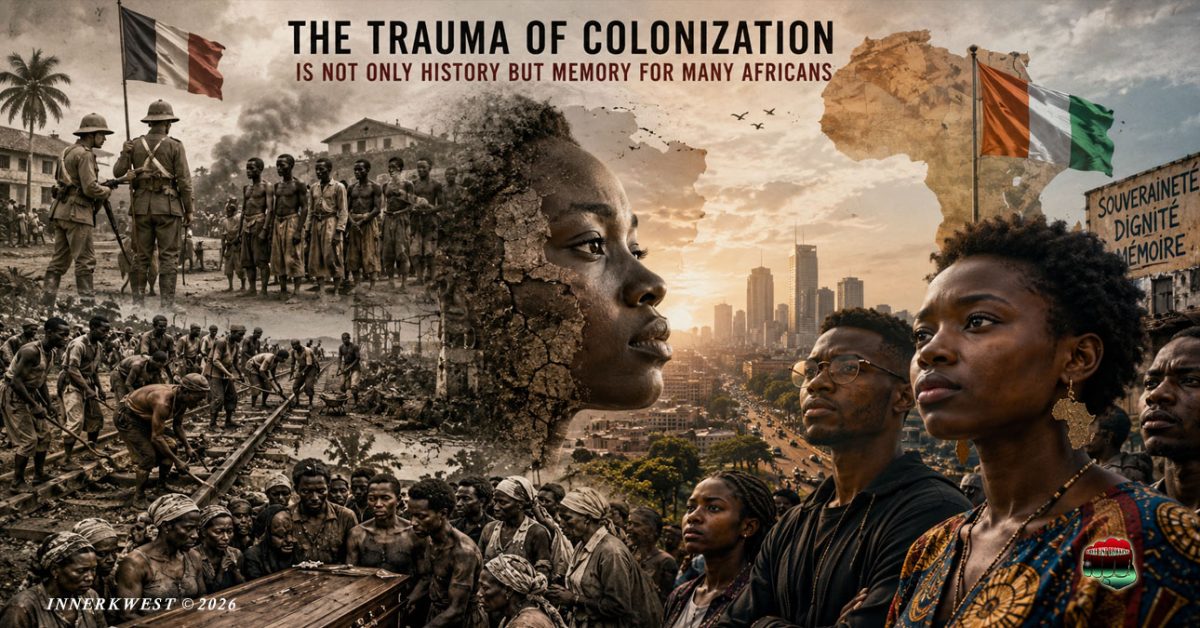
Not abstract historical memory confined to textbooks or academic debate, but inherited memory carried through families, funerals, oral histories, military occupations, economic dependency, and generations that experienced colonial power not as theory, but as force.
That distinction increasingly defines the challenge facing France across Africa.
The trauma of colonization is not only history for many Africans.
It remains psychological geography.
And that reality helps explain why France’s modern attempts to reposition itself across the continent continue colliding with resistance that Western policymakers often underestimate.
Macron Returns to a Changed Africa
Macron’s appearance on African soil this week in Kenya arrives during a period of profound geopolitical transition across the continent.
The Africa France once navigated through elite networks, military agreements, currency influence, and diplomatic familiarity is changing rapidly.
A younger, hyperconnected African population increasingly interprets international relationships through the language of sovereignty, institutional independence, and historical accountability rather than post-colonial accommodation.
That shift matters.
For decades, France operated through a strategic architecture often referred to as Françafrique — an informal but powerful system of political influence, military positioning, economic alignment, and institutional dependency that extended French influence long after formal colonialism ended.
But the collapse of French influence across parts of the Sahel revealed something larger than diplomatic fatigue.
It revealed a legitimacy crisis.
The rejection of French military presence in countries such as Mali, Burkina Faso, and Niger was not experienced merely as a security recalibration.
For many Africans, it symbolized a rejection of the psychological continuation of external control itself.
The Funeral Memory
Western geopolitical analysis often approaches colonization through statistics, treaties, trade relationships, and development language.
But populations rarely experience history through policy papers.
They experience it emotionally.
Entire communities across Africa carry generational memory tied to:
- forced labor,
- military violence,
- land extraction,
- public humiliation,
- resource exploitation,
- famine,
- and political suppression.
Families remember disappearances.
Villages remember occupations.
Countries remember systems designed around extraction rather than development.
The funerals mattered.
The humiliation mattered.
The loss of wealth, autonomy, and institutional continuity mattered.
And because those memories remain socially alive, modern diplomatic language centered on “partnership” can sometimes sound disconnected from unresolved historical realities.
This does not mean Africans are incapable of pragmatism or international cooperation.
It means emotional memory remains part of geopolitical reality itself.
That is where many Western analyses fail.
They often treat emotional responses to colonialism as obstacles to rational policy rather than understanding that those emotions were created by historical conditions that reshaped entire societies.
Why France Cannot Walk Away
Despite intensifying anti-French sentiment across parts of Africa, Paris continues attempting strategic re-engagement because the stakes are no longer optional.
Africa increasingly sits at the center of:
- demographic expansion,
- critical mineral access,
- energy transition infrastructure,
- maritime security,
- migration management,
- food systems,
- and future consumer markets.
At the same time, France’s relative geopolitical leverage is under pressure from multiple directions.
China has expanded economic influence.
Russia has increased security engagement.
Türkiye and Gulf states have accelerated investment and diplomatic outreach.
And African governments themselves are increasingly pursuing multipolar relationships designed to reduce dependency on any single external power.
France understands that losing long-term influence in Africa carries consequences extending far beyond economics.
It affects:
- military reach,
- diplomatic influence,
- strategic resources,
- language power,
- and France’s broader standing inside the Western alliance structure.
Macron’s challenge is therefore not simply diplomatic.
It is civilizational.
He is attempting to reintroduce France to populations that increasingly question whether the post-colonial relationship was ever fundamentally transformed in the first place.
A Continent No Longer Whispering
What has changed most dramatically is not only politics, but confidence.
Previous generations often navigated colonial memory within systems still heavily influenced by former powers institutionally, militarily, financially, and informationally.
Today’s Africa is more digitally connected, globally aware, and publicly vocal than at any previous period in post-colonial history.
Pan-African narratives once confined to intellectual circles now circulate across social media ecosystems in real time.
Young Africans increasingly debate:
- sovereign finance,
- resource nationalism,
- currency independence,
- military autonomy,
- and institutional decolonization
not as fringe ideas, but as mainstream political questions.
That shift has fundamentally altered the emotional atmosphere surrounding France’s presence on the continent.
The issue is no longer simply whether France can negotiate favorable agreements with governments.
The deeper question is whether populations themselves still psychologically accept the legitimacy of the old framework of influence.
And increasingly, many do not.
The Memory Gap
One of the defining geopolitical realities of the modern era may be the widening gap between how former colonial powers view history and how formerly colonized populations continue to experience it emotionally.
For France, colonialism is often treated as a concluded chapter requiring acknowledgment and strategic adaptation.
For many Africans, its consequences are viewed as continuous rather than historical.
That difference in perception changes diplomacy itself.
Because populations that perceive historical trauma as ongoing rarely separate modern policy from inherited memory.
And until that gap is fully understood, every attempt at strategic re-engagement risks colliding with realities deeper than politics alone.
At InnerKwest.com, we are committed to delivering impactful journalism, deep insights, and fearless social commentary. Your cryptocurrency contributions help us execute with excellence, ensuring we remain independent and continue to amplify voices that matter.
To help sustain our work and editorial independence, we would appreciate your support of any amount of the tokens listed below. Support independent journalism:
BTC: 3NM7AAdxxaJ7jUhZ2nyfgcheWkrquvCzRm
SOL: HxeMhsyDvdv9dqEoBPpFtR46iVfbjrAicBDDjtEvJp7n
ETH: 0x3ab8bdce82439a73ca808a160ef94623275b5c0a
XRP: rLHzPsX6oXkzU2qL12kHCH8G8cnZv1rBJh TAG – 1068637374
SUI – 0xb21b61330caaa90dedc68b866c48abbf5c61b84644c45beea6a424b54f162d0c
and through our Support Page.
InnerKwest maintains a revelatory and redemptive discipline, relentless in advancing parity across every category of the human experience.
© 2026 InnerKwest®. All Rights Reserved | Haki zote zimehifadhiwa | 版权所有. InnerKwest® is a registered trademark of Inputit™ Platforms Inc. Global. No part of this publication may be reproduced, distributed, or transmitted in any form or by any means without prior written permission. Unauthorized use is strictly prohibited. Thank you for standing with us in pursuit of truth and progress!