
May 2026
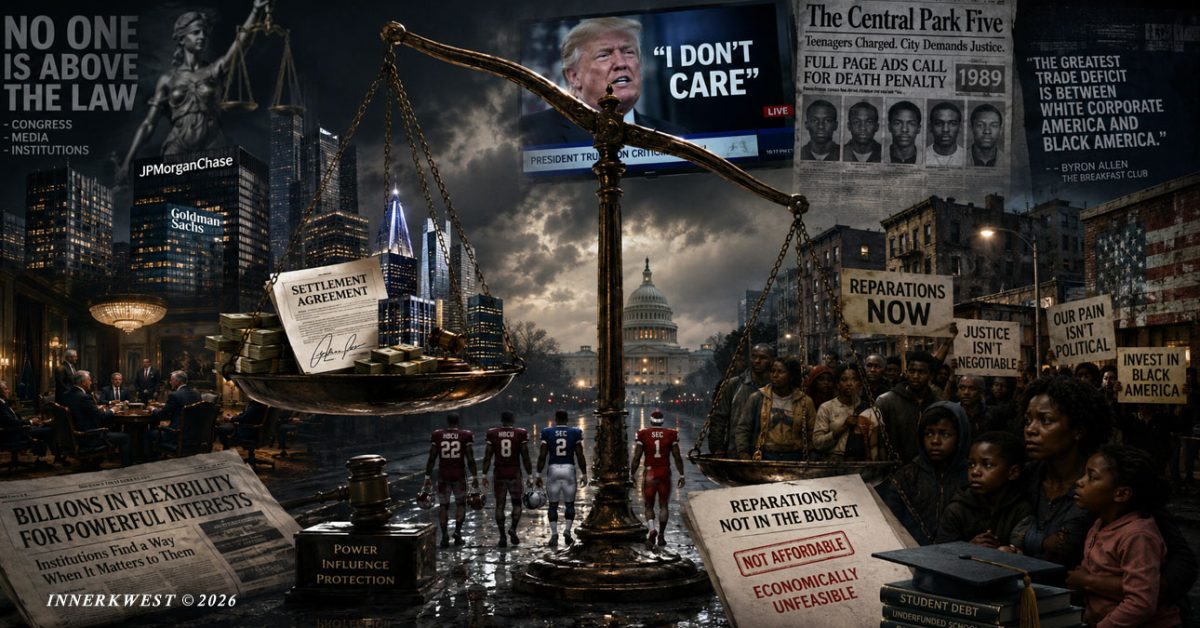
At a moment when America routinely frames historical repair as economically impossible, critics argue the nation continues demonstrating extraordinary financial and institutional flexibility when elite interests, political power, or strategic priorities are involved.
By Solomon Reed
for InnerKwest Intelligence Desk
For years, Americans were repeatedly told that “no one is above the law.”
The phrase became more than political rhetoric. It evolved into a civic principle — repeated across congressional hearings, media panels, campaign speeches, legal commentary, and institutional discourse as reassurance that the American system ultimately remained governed by accountability rather than power alone.
That repetition mattered psychologically.
Because public trust in institutions depends not only on laws themselves, but on the belief that:
- standards are applied consistently,
- accountability remains credible,
- and civic language still reflects observable reality.
But increasingly, many Americans no longer believe those alignments remain intact.
The controversy surrounding recent legal and financial accommodations connected to Donald Trump and affiliated structures has intensified a broader public perception already growing across ideological lines:
that America’s political and financial systems often display extraordinary flexibility when elite interests are involved, while simultaneously framing historical repair, economic equity, or systemic redress as fiscally unrealistic, socially destabilizing, or politically impossible.
That perception — whether fair or exaggerated depending on one’s political orientation — is becoming increasingly difficult to dismiss outright.
Because modern Americans are not merely reacting to one settlement, one politician, or one administration.
They are reacting to patterns.
The Politics of Selective Scarcity
America frequently describes itself as constrained.
There is rarely enough funding for:
- reparations,
- universal healthcare,
- infrastructure repair,
- affordable housing,
- debt relief,
- education reform,
- or long-term investment inside historically marginalized communities.
Political leaders routinely invoke:
- deficits,
- fiscal discipline,
- national debt,
- and economic caution
when discussions involve large-scale domestic repair programs.
And yet critics increasingly point toward what appears to be a recurring contradiction inside the American system itself.
Because the same nation that repeatedly frames certain forms of repair as economically impossible has consistently demonstrated enormous fiscal flexibility for:
- military interventions,
- banking rescues,
- emergency corporate stabilization,
- geopolitical priorities,
- tax accommodations,
- and institutional protection mechanisms when powerful interests appear exposed.
That contrast sits at the center of the growing discomfort surrounding recent legal arrangements involving Trump-affiliated entities and reported settlement structures that opponents describe as unprecedented in scale and optics.
For critics, the issue is not simply the legality of one agreement.
It is what the agreement appears to symbolize.
In an era of nearly $40 trillion in national debt, widening economic inequality, and constant political rhetoric surrounding fiscal limitations, many Americans increasingly question why scarcity seems rigorously enforced in some areas of public life while becoming remarkably negotiable in others.
Read Related Article: The New Athletic Migration? Voting Rights Battles, HBCUs, and the Future of Black Athlete Power
The Economics of Uneven Return
The debate surrounding reparations and selective scarcity increasingly extends beyond government spending alone.
For many critics, the issue is not simply whether America possesses resources.
It is how resources, opportunity, protection, and institutional flexibility are distributed — and who consistently benefits most from the system itself.
Media entrepreneur Byron Allen recently framed the issue in stark economic terms during an interview on The Breakfast Club, arguing that “the greatest trade deficit is between white corporate America and Black America.”
The phrase resonated because it reframed racial inequality through the language of economic extraction rather than purely social grievance.
Critics increasingly point toward disparities not only in wealth accumulation, but also in:
- capital access,
- media ownership,
- institutional protection,
- legal accommodation,
- investment distribution,
- and long-term economic participation.
For many Americans, the growing frustration is not rooted solely in individual outcomes.
It is rooted in the perception that the nation repeatedly demonstrates extraordinary capacity to stabilize powerful systems while insisting structural repair for historically marginalized communities remains economically unrealistic.
That contrast continues deepening public skepticism surrounding whether scarcity in America is truly financial — or selectively political.
“No One Is Above the Law”
The tension deepens because modern American political culture spent years elevating accountability rhetoric to near-sacred civic status.
“No one is above the law” was not presented merely as a slogan.
It was presented as reassurance that institutions still functioned independently of wealth, celebrity, political leverage, or elite influence.
But public confidence weakens whenever institutional outcomes appear inconsistent with institutional language.
That does not automatically mean laws were broken.
Nor does it require proving criminal conspiracy.
Perception alone can reshape legitimacy.
And in the current political climate, perception increasingly moves faster than institutional explanation.
This is part of why reactions surrounding Trump continue transcending ordinary partisan disagreement.
Supporters often interpret legal and political battles involving Trump as evidence of institutional weaponization against anti-establishment power.
Critics increasingly interpret visible accommodations, settlements, and procedural flexibility as evidence that power itself remains structurally insulated.
Those are radically different psychological realities operating simultaneously inside the same country.
Mercy, Punishment, and Public Memory
For many Americans — particularly African Americans — the conversation surrounding mercy and accommodation cannot be separated from historical memory itself.
Critics frequently reference the 1989 Central Park Five case, where Donald Trump publicly called for the reinstatement of the death penalty after five Black and Latino teenagers were arrested in New York.
Shortly afterward, Trump purchased full-page newspaper advertisements in major New York publications, including The New York Times, advocating harsher punishment during one of the country’s most racially charged criminal cases.
Years later, the young men were exonerated.
That history remains emotionally significant because it reinforces a broader perception surrounding asymmetrical mercy in America:
who receives public empathy,
who receives institutional grace,
who receives punishment,
and who receives accommodation once power becomes involved.
For critics, the contrast between historical calls for extreme punishment and modern appeals for legal leniency or institutional flexibility creates a moral contradiction difficult to ignore.
Again, the issue extends beyond one individual.
It speaks to a deeper civic question:
Is accountability in America fundamentally equal, or does it become increasingly negotiable alongside wealth, influence, and political proximity?
“I Don’t Care”
The psychological atmosphere surrounding these debates has intensified further because of repeated public expressions of indifference coming directly from the president himself.
Over time, phrases like:
- “I don’t care,”
- dismissals of criticism,
- and open rejection of institutional concern
begin carrying symbolic meaning beyond ordinary political rhetoric.
Supporters may interpret such language as:
- authenticity,
- anti-establishment strength,
- or refusal to submit to elite pressure.
Critics hear something else entirely:
institutional indifference,
erosion of civic responsibility,
and normalization of asymmetrical accountability.
That distinction matters.
Because leadership language shapes public expectations regarding moral boundaries.
And once populations begin concluding that powerful institutions themselves no longer appear emotionally invested in fairness, consistency, or restraint, institutional trust begins deteriorating very quickly.
This is especially true among communities already skeptical about:
- economic fairness,
- racial equity,
- political accountability,
- and historical repair.
In previous eras, many scenarios now openly discussed in American political life would have remained politically unimaginable.
Today, the unthinkable often becomes normalized with startling speed.
The Institutional Trust Crisis
The deeper issue emerging beneath these controversies is not simply Trump.
Nor is it solely reparations.
It is trust.
Modern societies require populations to believe:
- laws apply consistently,
- sacrifices are shared fairly,
- scarcity is genuine,
- and accountability standards remain recognizable.
Once citizens begin concluding that:
- financial flexibility exists primarily for the powerful,
- accountability becomes negotiable,
- or institutional morality changes depending on status,
the civic language holding democratic systems together begins weakening.
This is where reparations debates become psychologically explosive.
Because for decades, many Americans have been told:
- the country cannot afford historical repair,
- cannot sustain reparative investment,
- cannot finance structural redress,
- and cannot responsibly absorb large-scale compensation tied to historical injustice.
Yet critics increasingly point toward moments where America appears capable of finding enormous sums of money — very quickly — when elite institutions, financial systems, geopolitical interests, or politically connected actors require stabilization.
That contrast does not automatically prove corruption.
But it does reshape perception.
And perception, historically, has always mattered politically.

Believe People When They Tell You Who They Are
At some point, repeated declarations of indifference stop sounding rhetorical and begin sounding revelatory.
Societies often spend enormous energy explaining away what powerful people openly communicate — politically, morally, and institutionally.
But history repeatedly suggests that when leaders continuously tell populations who they are, many eventually conclude it is wiser to believe them.
That realization may ultimately prove more destabilizing than any single lawsuit, settlement, election, or presidency.
Because once large portions of a society stop believing:
- accountability is equal,
- scarcity is applied consistently,
- or institutional language reflects institutional behavior,
the crisis stops being partisan.
It becomes civic.
At InnerKwest.com, we are committed to delivering impactful journalism, deep insights, and fearless social commentary. Your cryptocurrency contributions help us execute with excellence, ensuring we remain independent and continue to amplify voices that matter.
To help sustain our work and editorial independence, we would appreciate your support of any amount of the tokens listed below. Support independent journalism:
BTC: 3NM7AAdxxaJ7jUhZ2nyfgcheWkrquvCzRm
SOL: HxeMhsyDvdv9dqEoBPpFtR46iVfbjrAicBDDjtEvJp7n
ETH: 0x3ab8bdce82439a73ca808a160ef94623275b5c0a
XRP: rLHzPsX6oXkzU2qL12kHCH8G8cnZv1rBJh TAG – 1068637374
SUI – 0xb21b61330caaa90dedc68b866c48abbf5c61b84644c45beea6a424b54f162d0c
and through our Support Page.
InnerKwest maintains a revelatory and redemptive discipline, relentless in advancing parity across every category of the human experience.
© 2026 InnerKwest®. All Rights Reserved | Haki zote zimehifadhiwa | 版权所有. InnerKwest® is a registered trademark of Inputit™ Platforms Inc. Global. No part of this publication may be reproduced, distributed, or transmitted in any form or by any means without prior written permission. Unauthorized use is strictly prohibited. Thank you for standing with us in pursuit of truth and progress!