
November 18, 2026
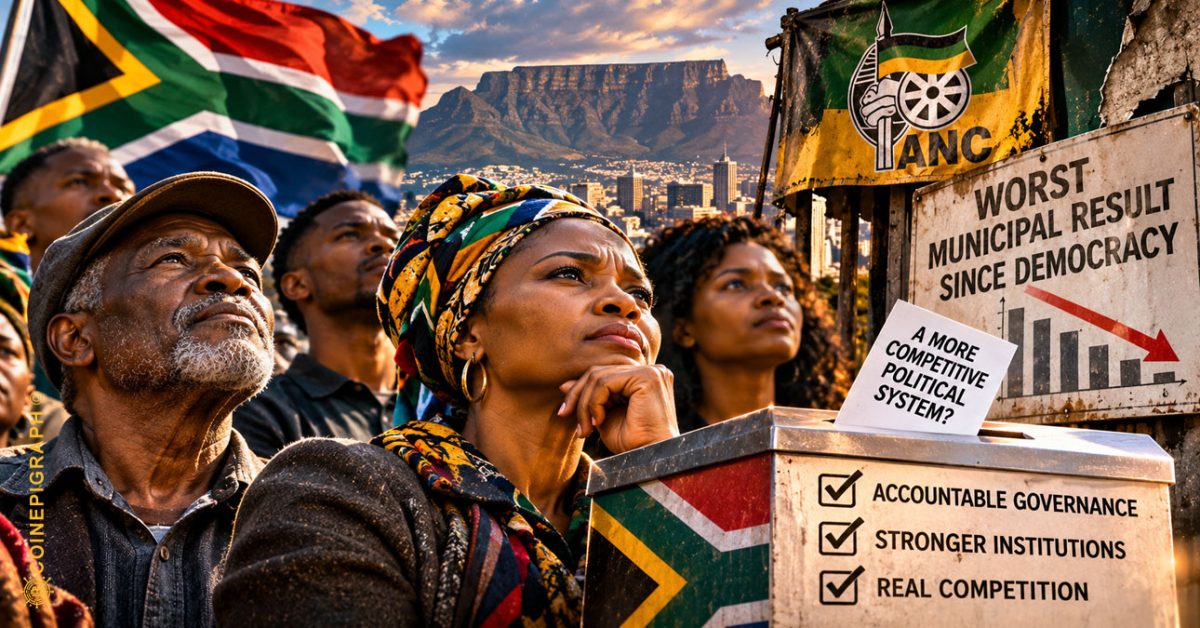
South African voters have delivered the African National Congress its worst municipal result since democracy began. Now a more difficult test emerges: whether a more competitive political system can build institutions capable of delivering what voters have demanded.
By the InnerKwest Editorial Desk
For three and a half years, water reportedly ran from a broken pipe in Douglasdale, a Johannesburg suburb.
Elsewhere in the city, the problem has been the opposite. Taps have gone dry. Residents have adapted with tanks, boreholes and other private alternatives. Solar panels have become familiar features on rooftops after years in which unreliable electricity taught households that the public system could not always be counted upon.
There is a temptation to treat these as separate failures: a leaking pipe here, an electrical problem there, another municipal administration struggling somewhere else.
Taken together, they describe something larger.
Johannesburg’s own audited financial statements put non-revenue water at 44.79 percent for the year ending June 2025. That represents water lost through physical leakage, commercial losses and other deficiencies before the city can collect revenue from it. The city’s documents valued non-revenue water at R3.837 billion.
The problem did not appear overnight. Research presented through the University of the Witwatersrand shows Johannesburg’s non-revenue water increasing from 29.4 percent in 2007 to 44.8 percent in 2025. The same analysis puts the city’s infrastructure-renewal backlog at roughly R26 billion.
Water is supposed to move through pipes.
Here it also tells a political story.
On November 4, South Africans went to the polls in municipal elections and delivered the African National Congress a result that would once have been difficult to imagine. The ANC received 30.76 percent of the national municipal vote, down from 45.59 percent in 2021. The Democratic Alliance received 24.64 percent, while uMkhonto weSizwe received 9.76 percent.
Johannesburg was more striking still. The DA finished at roughly 35 percent. The ANC, the party that had governed South Africa nationally since the first democratic election of 1994, received roughly 20 percent. ActionSA took approximately 16 percent. No party won enough to govern the city alone.
The ANC’s secretary-general, Fikile Mbalula, called the result catastrophic.
It is certainly historic.
Whether it is transformative is another matter.
From Liberation to Government
The ANC cannot be understood as an ordinary incumbent political party that happened to remain in office for three decades.
Its legitimacy was born somewhere else.
The movement carried the history of resistance to apartheid. Nelson Mandela carried its name from imprisonment to the presidency. The election of 1994 did more than replace one administration with another. It established democratic rule after a political and racial order that had denied most South Africans meaningful participation in their own government.
That history matters.
It also creates a problem that eventually confronts liberation movements when they become governing institutions.
The legitimacy earned by defeating an unjust system is not identical to the legitimacy required to administer a water system.
One is historical.
The other must be renewed.
For years, the distinction could remain partially obscured because the ANC’s political dominance was so great. Even serious failures did not necessarily threaten its hold on power. The supplied source material points to the 2011 municipal election as an example: power shortages and controversy around enormous Eskom contracts had already emerged, yet the ANC still received roughly 62 percent of the vote nationally.
The relationship among the governing party, state institutions and commercial interests was not merely a matter of political accusation.
In 2015, the U.S. Securities and Exchange Commission charged Hitachi with violations of American anti-corruption law arising from its South African operations. The SEC alleged that Hitachi had sold a 25 percent interest in its South African subsidiary to Chancellor House, which the SEC described as a funding vehicle for the ANC.
According to the SEC, Hitachi knew of that relationship while pursuing contracts from Eskom, the state-owned electricity utility, and encouraged Chancellor House to use its political influence. Hitachi subsequently secured power-station contracts worth approximately $5.6 billion. The SEC said Chancellor House received approximately $5 million in dividends and another $1 million in what were described as success fees. Hitachi paid $19 million to settle the case without admitting or denying the allegations.
The distinction matters. The settlement did not amount to a criminal conviction of the ANC.
The institutional question remains.
What happens when the boundaries separating a governing party, the state and commercial interests become difficult to see?
For a dominant political movement, accountability can weaken long before elections disappear. Elections continue. Opposition parties continue. Newspapers continue. Courts continue.
But the expectation of losing becomes remote.
And an institution that does not seriously expect to lose power operates under a different discipline from one that does.
South African voters have been changing that equation.
The ANC lost its national parliamentary majority in 2024. Two years later, its municipal support has fallen below one-third of the vote. Analysts interviewed by Reuters after the November election described an electorate moving away from historical loyalty and increasingly judging parties on performance, particularly around corruption and public services.
That does not mean every voter who abandoned the ANC did so for the same reason. South Africa’s electorate is too large, regional and politically varied for such a conclusion.
But the direction is difficult to miss.
Liberation history remains history.
Government is being graded in the present.
The Trouble After Winning
There is an appealing democratic assumption that competition corrects dominance.
Sometimes it does.
Johannesburg also shows why the answer is incomplete.
The ANC first lost its majority in the city in 2016. Opposition parties assembled a governing coalition, and Herman Mashaba became mayor.
If the central problem had simply been ANC control, Johannesburg should have begun a relatively straightforward institutional recovery.
It did not.
Coalitions fractured. Alliances changed. Mayors came and went.
Between 2016 and 2026, Johannesburg went through 10 mayoral administrations involving eight different people. The city’s long-term Growth and Development Strategy stalled while infrastructure deterioration continued.
Research from Wits has examined the consequences of that instability. One study of Johannesburg’s political-administrative relationship under coalition government describes frequent changes in political leadership alongside declining service delivery. Earlier Wits analysis found that changes after the 2016 election also drove skilled administrative personnel from the city, further affecting institutional capacity.
This is where the South African story becomes more complicated than the fall of a dominant party.
Political competition can make government accountable.
Political instability can make government incapable.
A water network does not operate on an electoral calendar. Reservoirs, pumping systems, treatment plants and underground mains require planning that survives individual mayors. Engineers need budgets they can expect to exist several years from now. Procurement must outlast coalition negotiations. Institutional knowledge has to remain somewhere even when politicians change offices.
Johannesburg has been attempting long-term infrastructure management while repeatedly changing the people at the top.
The city’s own 2026 budget documents now describe its three core trading services—electricity, water and sanitation, and waste management—as weakened by declining revenue collection, insufficient capital investment, governance failures and what the city calls “institutional fatigue.” The combined infrastructure-renewal backlog across Johannesburg Water, City Power and the Johannesburg Roads Agency exceeds R185 billion.
That is not a problem any mayor can repair during a press conference.
It may not be repairable during a single term.
When Citizens Build Their Own State
There is another consequence when public institutions fail gradually rather than catastrophically.
People adapt.
A household that cannot rely upon electricity buys solar panels if it can afford them. A household worried about water installs storage. Security becomes a private expense. Education and healthcare can follow similar patterns.
The state remains.
Dependence upon it does not.
There is resilience in this. South Africans have repeatedly demonstrated an ability to improvise around institutional failures.
There is also danger.
Private substitutes are not distributed equally.
A family able to install solar generation, water storage and private security can reduce its exposure to government failure. A poorer household remains dependent upon the same public system as it deteriorates.
Two experiences of citizenship begin to emerge.
One population purchases reliability.
The other waits for it.
This is where service delivery becomes more than an administrative question. If enough people who possess political and economic influence can purchase alternatives to public institutions, the constituency most capable of demanding that those institutions work may become less dependent upon whether they do.
The failure becomes easier to live with for those most capable of escaping it.
And more concentrated among those who cannot.

The Second Transition
South Africa’s first democratic transition is written into world history.
Apartheid ended. Political prisoners walked free. Elections opened to the country’s Black majority. Mandela became president. Institutions that had enforced racial domination were placed under a constitutional democracy.
The transition unfolding now is less dramatic.
There is no single election day that will complete it.
South Africa is discovering what happens when a liberation movement becomes an ordinary competitor for political power.
That is not a repudiation of liberation.
It may be one of liberation’s consequences.
Democracy eventually asks citizens to distinguish gratitude from permission.
A party can deserve recognition for what it helped accomplish without receiving indefinite authority over what comes next.
The 2026 municipal elections suggest that growing numbers of South Africans are prepared to make that distinction. But the election produced another complication. No party won outright control in Johannesburg, and coalition negotiations are again determining who will govern the country’s economic center. Similar negotiations are occurring elsewhere.
South Africa may therefore have weakened one democratic problem before solving another.
For years, the concern was political inevitability: one movement possessed such historical and electoral strength that losing power seemed remote.
Now the concern may be governability.
Can a competitive multiparty system produce coalitions stable enough to plan beyond the next political dispute?
Can professional administrations retain engineers, managers and institutional knowledge while political leadership changes?
Can parties that know they may lose office nevertheless preserve projects begun by their predecessors?
Can voters punish failure without receiving another version of it from those who replace the people they removed?
These are not uniquely South African questions.
They are questions that mature democracies eventually encounter when political competition becomes easier than institutional competence.
The electorate has already demonstrated something important.
South Africans will remove support from institutions that once appeared politically immovable. The ANC’s liberation history did not prevent the loss of its parliamentary majority in 2024. It did not prevent its municipal vote from falling below one-third in 2026. And Johannesburg voters have previously demonstrated that they are willing to change who governs their city.
But a ballot cannot repair a water main.
It cannot retain an engineer.
It cannot make coalition partners trust one another.
It cannot separate party interests from state institutions or turn a municipal budget into functioning infrastructure.
What it can do is remove something that can be equally dangerous to democratic government:
the assumption of permanence.
South Africans have done that.
What follows will determine whether the country’s changing politics can produce something more difficult than electoral change.
A government that works.
At InnerKwest.com, we are committed to delivering impactful journalism, deep insights, and fearless social commentary. Your cryptocurrency contributions help us execute with excellence, ensuring we remain independent and continue to amplify voices that matter.
To help sustain our work and editorial independence, we would appreciate your support of any amount of the tokens listed below. Support independent journalism:
BTC: 3NM7AAdxxaJ7jUhZ2nyfgcheWkrquvCzRm
SOL: HxeMhsyDvdv9dqEoBPpFtR46iVfbjrAicBDDjtEvJp7n
ETH: 0x3ab8bdce82439a73ca808a160ef94623275b5c0a
XRP: rLHzPsX6oXkzU2qL12kHCH8G8cnZv1rBJh TAG – 1068637374
SUI – 0xb21b61330caaa90dedc68b866c48abbf5c61b84644c45beea6a424b54f162d0c
and through our Support Page.
InnerKwest maintains a revelatory and redemptive discipline, relentless in advancing parity across every category of the human experience.
© 2026 InnerKwest®. All Rights Reserved | Haki zote zimehifadhiwa | 版权所有. InnerKwest® is a registered trademark of Inputit™ Platforms Inc. Global. No part of this publication may be reproduced, distributed, or transmitted in any form or by any means without prior written permission. Unauthorized use is strictly prohibited. Thank you for standing with us in pursuit of truth and progress!