
August 15, 2026
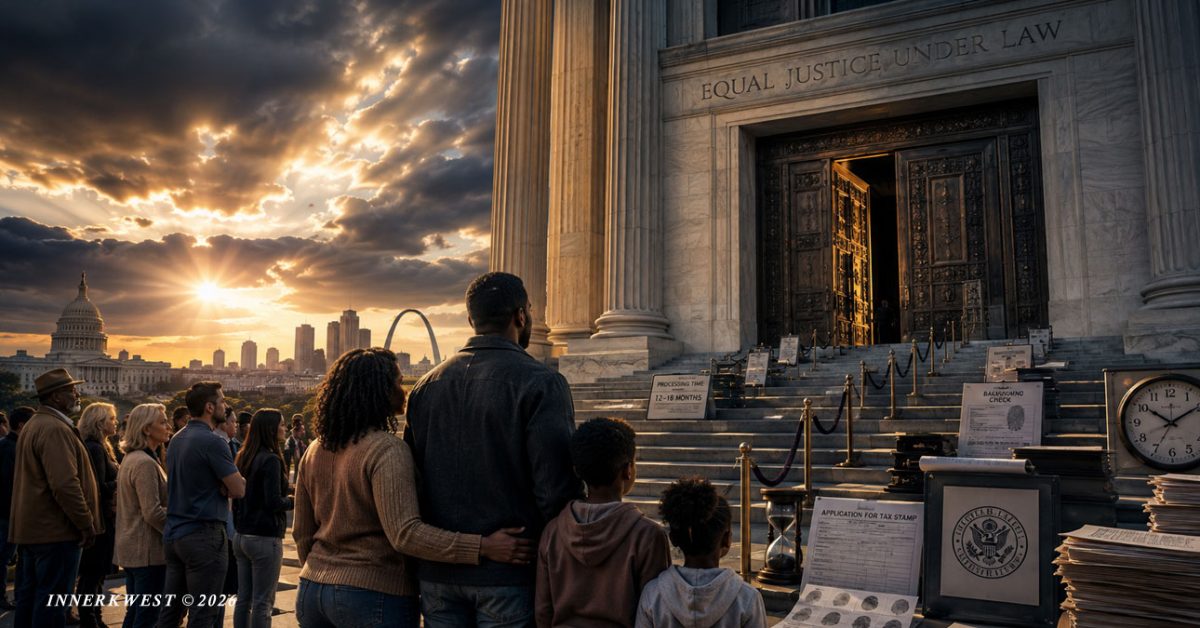
The Missouri lawsuit challenging the National Firearms Act asks more than a constitutional question. It forces America to confront whether regulations that appear equal on paper can impose unequal burdens in practice of the Second Amendment.
By the InnerKwest Editorial Desk
The National Firearms Act has survived for nearly a century.
Generations of Americans have accepted its registration requirements, fingerprinting, taxation, federal approval process, and months-long waiting periods as the cost of purchasing certain firearms regulated under federal law. For many, those procedures have simply become part of the legal landscape.
Now a lawsuit emerging from Missouri may challenge far more than the mechanics of federal firearms regulation.
It may force the country to confront a question that extends well beyond the courtroom.
Who bears the burden of regulation?
That question deserves far more attention than whether another lawsuit succeeds or fails.
The complaint identifies Prime Protection STL as a Black-owned federally licensed firearms retailer serving a predominantly Black customer base. That detail was not inserted accidentally. It signals that the plaintiffs believe this case involves more than statutory interpretation. They argue that the practical burdens imposed by the National Firearms Act discourage ordinary, law-abiding citizens from exercising a constitutional right.
Whether that argument ultimately prevails is for the courts to determine.
The broader public question belongs to everyone else.
History Has Left Black America Skeptical
Many Americans approach firearms regulation as a contemporary political debate.
Many Black Americans do not.
History provides ample reason for skepticism.
Following the Civil War, numerous states adopted Black Codes that restricted the ability of newly freed African Americans to possess firearms. Throughout Reconstruction and well into the twentieth century, the practical ability of Black citizens to lawfully defend themselves was often shaped not only by written law, but by selective enforcement, unequal treatment, intimidation, and political power.
Those experiences became part of America’s institutional memory.
They explain why assurances alone no longer satisfy everyone.
When government insists that a policy is entirely neutral, many Black Americans understandably ask another question.
Neutral for whom?
History teaches that laws can be facially neutral while producing unequal practical effects.
Housing.
Education.
Voting.
Criminal justice.
Economic opportunity.
The American legal landscape contains numerous examples where equal language produced unequal outcomes.
Whether firearms regulation belongs in that conversation deserves examination rather than dismissal.
The Cost of Compliance
Supporters of the National Firearms Act frequently describe its requirements as reasonable administrative safeguards.
Critics describe something different.
They point to registration.
Fingerprints.
Photographs.
Federal databases.
Lengthy approval periods.
Legal uncertainty.
Administrative complexity.
For experienced firearms collectors, those requirements may represent inconvenience.
For first-time purchasers—or citizens who already distrust government—they may represent something else entirely.
Deterrence.
Constitutional rights are rarely evaluated only by whether government technically allows them.
Access matters.
Cost matters.
Time matters.
Complexity matters.
A right delayed long enough can become a right abandoned.
When Equal Treatment Is Not Equal Access
America often confuses equality of law with equality of access.
The two are not necessarily the same.
If one community possesses greater financial resources, easier access to legal counsel, stronger institutional relationships, and greater familiarity with regulatory systems, identical administrative requirements may produce very different practical outcomes.
That observation is hardly revolutionary.
Public policy scholars have documented similar patterns across numerous areas of American life.
The Missouri lawsuit simply asks whether firearms regulation deserves to be examined through the same lens.
That is not a radical question.
It is an investigative one.
Government Cannot Simply Declare Trust
Government officials often assure the public that regulations exist solely to promote public safety.
Perhaps they do.
Perhaps they do not.
Either way, public confidence cannot be manufactured through official statements.
It must be earned.
That principle applies equally to every administration regardless of political party.
Trust cannot be demanded.
Transparency must replace assumption.
Evidence must replace reassurance.
Accountability must replace institutional certainty.
That is precisely why skepticism remains healthy within a constitutional republic.
Citizens are not obligated to suspend their questions simply because government offers confident answers.
The Question America Should Be Asking
The Missouri case is not merely about suppressors or federal paperwork.
It raises a broader constitutional question.
Can government impose sufficient administrative burdens upon the exercise of a constitutional right that lawful citizens gradually decide exercising that right is no longer worth the effort?
If that burden falls more heavily upon one community than another, should that concern simply be dismissed as coincidence?
Or should it be investigated?
Those questions should not frighten policymakers.
They should welcome them.
Strong institutions do not fear scrutiny.
They survive it.
Conclusion
For generations, Black Americans have often been told to trust institutions that many believed had not earned that trust.
Today, many of those same institutions ask the public to believe that regulatory burdens affect everyone equally.
Perhaps they do.
Perhaps they do not.
But neither government officials nor media organizations should expect citizens to accept those assurances without examination.
The burden does not rest upon the public to prove why it should be skeptical.
The burden rests upon institutions to demonstrate why skepticism is unwarranted.
That is not cynicism.
It is citizenship.
And until that evidence is presented, Americans should continue asking the question that every healthy republic depends upon:

At InnerKwest.com, we are committed to delivering impactful journalism, deep insights, and fearless social commentary. Your cryptocurrency contributions help us execute with excellence, ensuring we remain independent and continue to amplify voices that matter.
To help sustain our work and editorial independence, we would appreciate your support of any amount of the tokens listed below. Support independent journalism:
BTC: 3NM7AAdxxaJ7jUhZ2nyfgcheWkrquvCzRm
SOL: HxeMhsyDvdv9dqEoBPpFtR46iVfbjrAicBDDjtEvJp7n
ETH: 0x3ab8bdce82439a73ca808a160ef94623275b5c0a
XRP: rLHzPsX6oXkzU2qL12kHCH8G8cnZv1rBJh TAG – 1068637374
SUI – 0xb21b61330caaa90dedc68b866c48abbf5c61b84644c45beea6a424b54f162d0c
and through our Support Page.
InnerKwest maintains a revelatory and redemptive discipline, relentless in advancing parity across every category of the human experience.
© 2026 InnerKwest®. All Rights Reserved | Haki zote zimehifadhiwa | 版权所有. InnerKwest® is a registered trademark of Inputit™ Platforms Inc. Global. No part of this publication may be reproduced, distributed, or transmitted in any form or by any means without prior written permission. Unauthorized use is strictly prohibited. Thank you for standing with us in pursuit of truth and progress!