
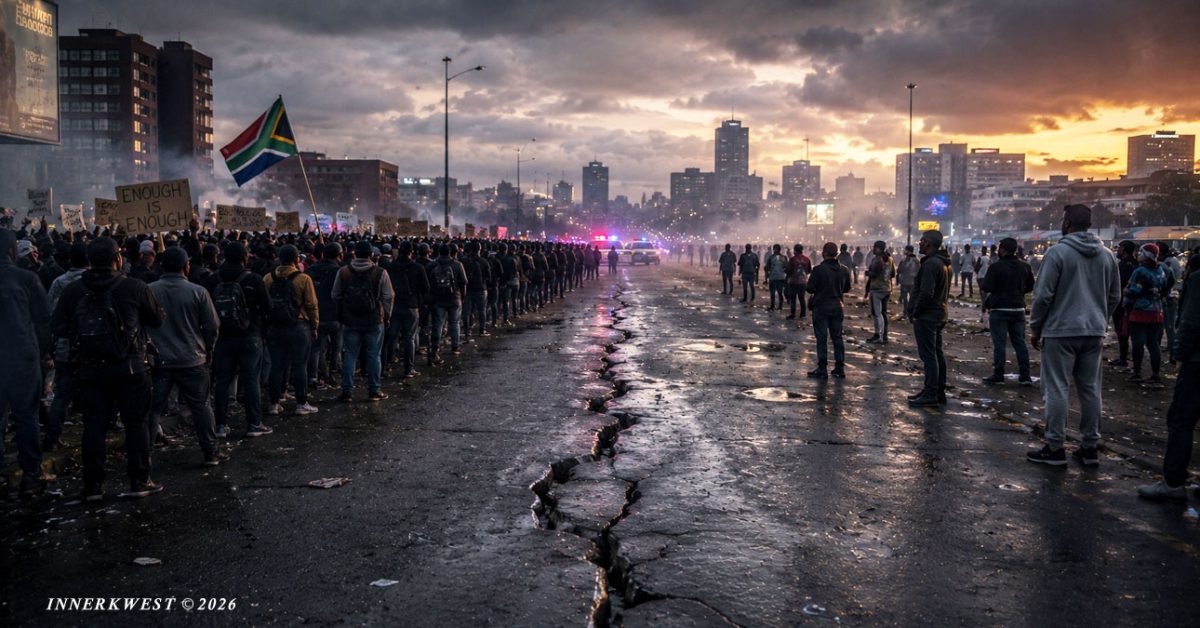
The pressure is real. The direction of it matters more.
By Intelligence Desk | May 2026
A Country Under Strain
The xenophobia protests are not imagined.
They are happening—visible, organized, and growing.
Across cities like Pretoria and Johannesburg, demonstrators have taken to the streets calling for stricter immigration enforcement, arguing that undocumented migrants are placing pressure on jobs, public services, and security.
That frustration is not without context.
South Africa continues to face:
- persistent unemployment
- inequality rooted in history
- pressure on public infrastructure
But something else is happening alongside that pressure.
The focus is shifting.
When Economic Pressure Becomes Social Targeting
In recent weeks, protests have moved beyond policy demands.
They have crossed into confrontation.
Foreign nationals—many from across the continent—have been:
- targeted in demonstrations
- blamed for systemic strain
- subjected to intimidation and, in some cases, violence
Some have begun seeking repatriation—not out of choice, but out of concern.
This is not unfamiliar territory.
Xenophobia has surfaced in South Africa before—often during periods of economic stress.
But the current moment carries a different weight.
Because it is widening.
The Narrative That Gains Traction
The claim being repeated is simple:
migrants are taking what belongs to citizens
Jobs.
Services.
Opportunity.
It is a narrative that spreads quickly.
Because it offers something under pressure people look for:
Clarity.
A visible cause.
A target.
But clarity is not the same as accuracy.
What the System Actually Reflects
South Africa’s challenges are structural.
They are rooted in:
- long-standing inequality
- uneven economic distribution
- slow post-apartheid transformation
- limited growth across key sectors
These conditions were not created by migrants.
They existed long before the current movement across borders.
And when structural problems are assigned to visible outsiders—
The system itself avoids scrutiny.
Leadership Signals—and the Line Being Drawn
Government officials have begun responding.
Authorities have:
- warned against xenophobic violence
- emphasized the rule of law
- acknowledged legitimate concerns around immigration
That distinction matters.
Because once it disappears—
The situation shifts from policy debate to social fracture.
A Memory Worth Holding
There was a time—not long ago—when South Africa stood in need of support that did not come from within.
In the years following apartheid, as segments of institutional capacity thinned and skilled departure created gaps across critical sectors, assistance arrived from many directions.
Often quietly.
Often without condition.
And often without regard for origin.
The work that followed did not pause to ask:
Who belongs?
Who qualifies?
Who should be excluded?
It moved where it was needed.
That history matters.
Not as sentiment.
But as context.
Because a nation that once received support without interrogation now finds itself questioning presence at a different moment of strain.
That contrast should not be ignored.
It should be considered.
Not to dismiss present frustration—
But to widen the lens through which it is understood.
Support once moved without question.
Now presence is being questioned.
The Risk Beneath the Surface
History has already shown what happens when this line is crossed.
Previous waves of xenophobic violence have resulted in:
- loss of life
- displacement
- long-term damage to regional trust
And this moment carries an additional layer of risk.
It is no longer just internal.
It is continental.
South Africa’s relationships with neighboring countries—and the broader African community—are directly impacted when citizens of those nations become targets.
This is not just a domestic issue.
It is a regional signal.
Read Article Of Interest: The State Within the State: South Africa’s Madlanga Reckoning
Where This Leads If Unchecked
If frustration continues to move in its current direction, the outcome is predictable.
Not resolution.
Escalation.
Because targeting migrants does not resolve:
- unemployment
- inequality
- economic stagnation
It redirects attention.
Temporarily.
And when the underlying pressures remain—
The cycle repeats.
Often with greater intensity.
Final Observation
South Africa is at a critical point.
Not because of immigration alone—
But because of how it is choosing to interpret it.
Frustration is real.
But where it is directed will determine what follows.
Because when a nation begins to misidentify the source of its challenges—
It doesn’t just delay progress.
It risks turning inward against itself.

Closing Reflection
The question is not whether pressure exists.
It does.
The question is:
Will that pressure produce solutions…
or targets?
At InnerKwest.com, we are committed to delivering impactful journalism, deep insights, and fearless social commentary. Your cryptocurrency contributions help us execute with excellence, ensuring we remain independent and continue to amplify voices that matter.
To help sustain our work and editorial independence, we would appreciate your support of any amount of the tokens listed below. Support independent journalism:
BTC: 3NM7AAdxxaJ7jUhZ2nyfgcheWkrquvCzRm
SOL: HxeMhsyDvdv9dqEoBPpFtR46iVfbjrAicBDDjtEvJp7n
ETH: 0x3ab8bdce82439a73ca808a160ef94623275b5c0a
XRP: rLHzPsX6oXkzU2qL12kHCH8G8cnZv1rBJh TAG – 1068637374
SUI – 0xb21b61330caaa90dedc68b866c48abbf5c61b84644c45beea6a424b54f162d0c
and through our Support Page.
InnerKwest maintains a revelatory and redemptive discipline, relentless in advancing parity across every category of the human experience.
© 2026 InnerKwest®. All Rights Reserved | Haki zote zimehifadhiwa | 版权所有. InnerKwest® is a registered trademark of Inputit™ Platforms Inc. Global. No part of this publication may be reproduced, distributed, or transmitted in any form or by any means without prior written permission. Unauthorized use is strictly prohibited. Thank you for standing with us in pursuit of truth and progress!