
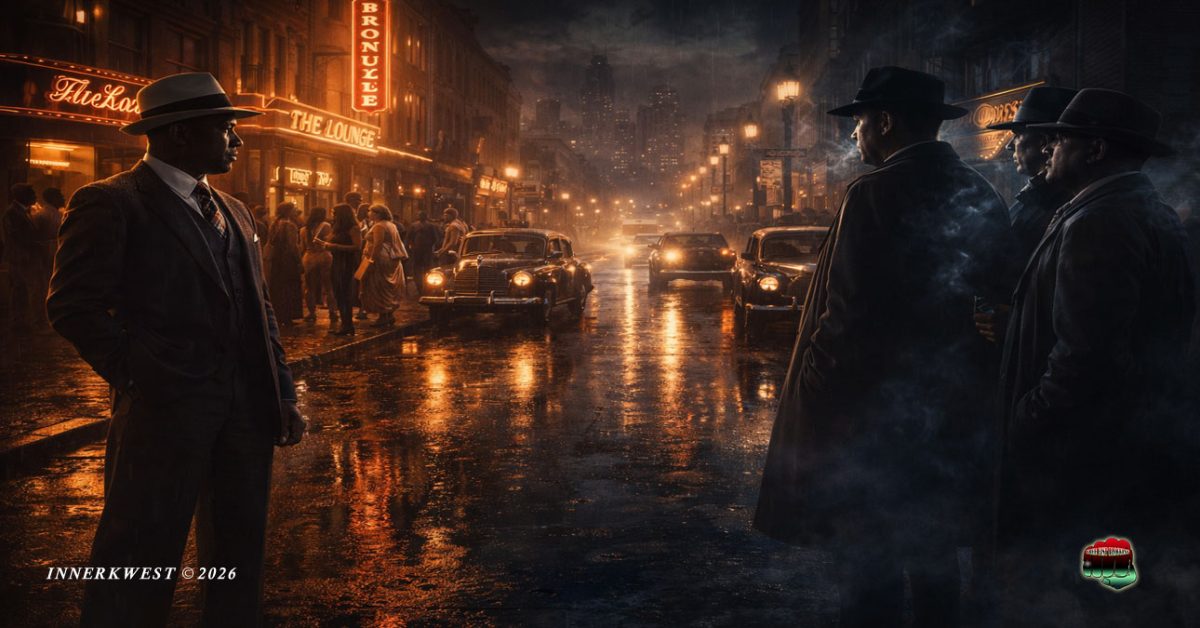
The Man Who Wouldn’t Bow
By InnerKwest Historical Desk | March 21, 2026
In mid-20th century Chicago, power didn’t only sit in city hall or corporate boardrooms. It flowed quietly through back rooms, barbershops, and storefronts—measured not in legislation, but in cash.
At the center of that shadow economy stood Theodore Roe, better known as Teddy Roe—a figure who, depending on who you ask, was either a crime boss, a community pillar, or something far more complex: an independent operator in a system designed to deny independence.
Roe didn’t just run numbers. He ran an ecosystem.
And unlike many before and after him, he refused to sell it.
The Policy Economy: A Parallel Financial System
Before institutional banking reached deep into Black neighborhoods, informal systems filled the void. In Chicago’s South Side, that system was known as “policy”—a numbers game that functioned as both gambling network and financial infrastructure.
At its peak, Roe’s operation generated millions annually.
But the real story wasn’t the money—it was the structure.
Policy networks:
- Employed hundreds, sometimes thousands
- Circulated cash within the community
- Provided informal credit and emergency support
- Acted as a de facto redistribution mechanism
In neighborhoods cut off from capital, this wasn’t just vice.
It was liquidity.
And Roe understood that better than anyone.
By the late 1940s, the Chicago Outfit had already consolidated power across much of the city’s illicit economy.
But Bronzeville was different.
It wasn’t just territory—it was a functioning, internally controlled economic zone.
For the Outfit, that meant one thing: untapped revenue.
Their approach was predictable:
- Apply pressure
- Demand a cut
- Absorb the operation
Most complied.
Roe did not.
The Line in the Sand
The conflict escalated when mob enforcer Leonard Caifano—known as “Fat Lenny”—was sent to eliminate Roe.
Instead, Roe killed him.
And then did something even more unusual:
He beat the case in court, arguing self-defense.
For a Black man in 1940s Chicago to kill a Mafia-connected enforcer and walk free was more than rare—it was destabilizing.
It signaled that Roe wasn’t just resisting quietly.
He was openly defying the established order.
A “Crook with Honor” or a Local Institution?
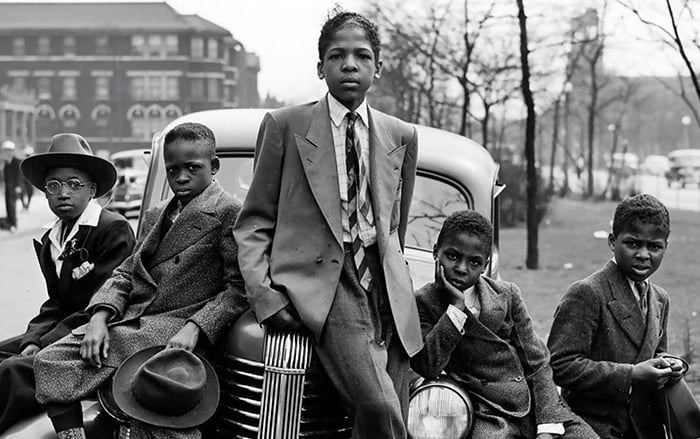
In Bronzeville, Roe’s reputation diverged sharply from the official narrative.
He was known to:
- Pay hospital bills
- Cover funeral expenses
- Distribute money to struggling families
To some, he was a criminal.
To others, he was infrastructure.
This duality wasn’t unique—but it was amplified in communities where formal systems had long failed to deliver access or equity.
Roe’s operation blurred the line between exploitation and support, profit and protection.
Assassination and Absorption
In 1952, the standoff ended.
Roe was shot and killed outside his home.
The order was widely believed to be connected to rising figures within the Outfit, including Sam Giancana.
With Roe gone, the outcome was swift and familiar:
- Independent control collapsed
- The policy racket was absorbed
- Revenue streams were redirected
What had once been locally controlled became externally governed.
Not eliminated—just reassigned.
What Teddy Roe Actually Represented
Roe’s story is often reduced to crime history.
But that framing misses the larger architecture.
He represented:
- Economic sovereignty under constraint
- Community-controlled cash flow in a segregated system
- Resistance to centralized extraction—legal or otherwise
The conflict wasn’t just about gambling.
It was about who controls the rails of money movement.
From Policy to Protocol
There’s a reason this story still resonates.
The structure Roe operated within—informal, decentralized, community-driven—echoes in modern systems:
- Peer-to-peer finance
- Informal lending networks
- Even elements of decentralized finance (DeFi)
The tools have changed.
The tension has not.
Control vs. access.
Centralization vs. independence.
Extraction vs. circulation.
The Unfinished Question
Teddy Roe lost his life.
But the underlying question he forced into the open remains unresolved:
Who gets to control economic systems when formal institutions fail to serve entire populations?
And perhaps more importantly:
When alternative systems emerge—are they absorbed, regulated, or eliminated?

InnerKwest Intelligence Note
Roe’s story is not an anomaly. It is a recurring pattern—wherever capital access is restricted, parallel systems form. The outcome is rarely determined by legality alone, but by who ultimately controls enforcement, narrative, and scale.
At InnerKwest.com, we are committed to delivering impactful journalism, deep insights, and fearless social commentary. Your cryptocurrency contributions help us execute with excellence, ensuring we remain independent and continue to amplify voices that matter.
To help sustain our work and editorial independence, we would appreciate your support of any amount of the tokens listed below. Support independent journalism:
BTC: 3NM7AAdxxaJ7jUhZ2nyfgcheWkrquvCzRm
SOL: HxeMhsyDvdv9dqEoBPpFtR46iVfbjrAicBDDjtEvJp7n
ETH: 0x3ab8bdce82439a73ca808a160ef94623275b5c0a
XRP: rLHzPsX6oXkzU2qL12kHCH8G8cnZv1rBJh TAG – 1068637374
SUI – 0xb21b61330caaa90dedc68b866c48abbf5c61b84644c45beea6a424b54f162d0c
and through our Support Page.
InnerKwest maintains a revelatory and redemptive discipline, relentless in advancing parity across every category of the human experience.
© 2026 InnerKwest®. All Rights Reserved | Haki zote zimehifadhiwa | 版权所有. InnerKwest® is a registered trademark of Inputit™ Platforms Inc. Global. No part of this publication may be reproduced, distributed, or transmitted in any form or by any means without prior written permission. Unauthorized use is strictly prohibited. Thank you for standing with us in pursuit of truth and progress!