
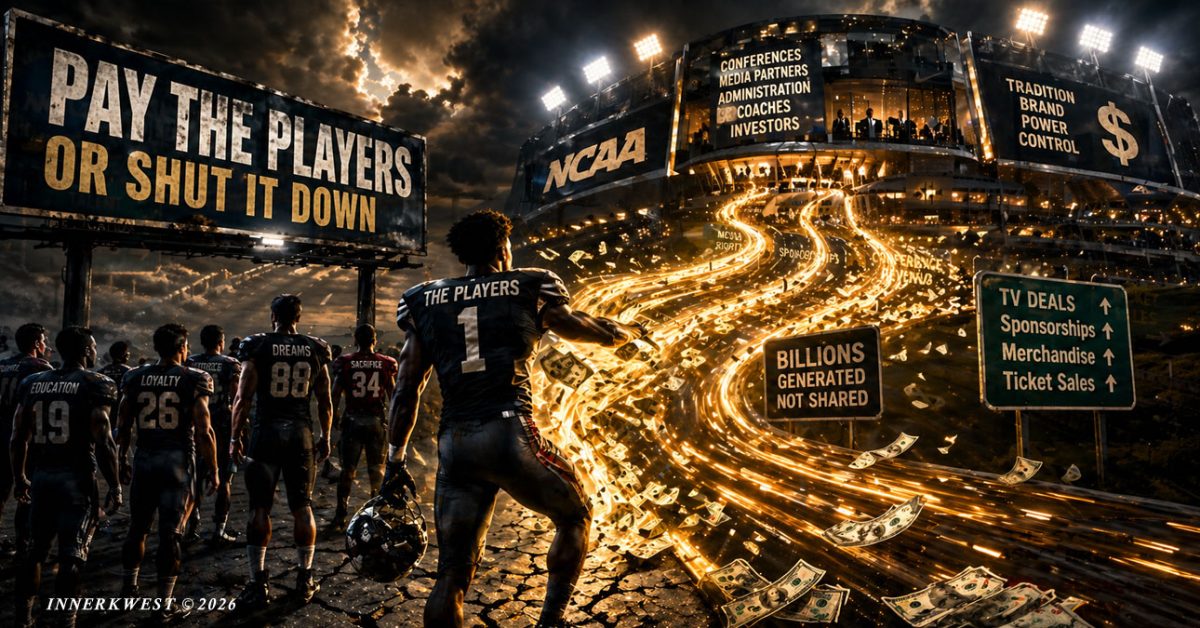
College athletes helped build a billion-dollar industry while being shut out of the profits. With NIL reshaping the economics of college sports, that imbalance is collapsing—and the institutions that benefited most are scrambling to adapt.
By Intelligence Desk | InnerKwest
May 2026
For decades, college sports sold the public a story.
It was about education.
It was about tradition.
It was about amateurism.
Meanwhile, billions of dollars moved quietly through the system.
Now that system is exposed—and it’s starting to fracture under its own weight.
The Business Model No One Was Supposed to Question
Let’s be direct.
College football and basketball have never been amateur in any meaningful economic sense.
- Multi-billion-dollar media contracts
- Stadiums that rival professional franchises
- Coaches earning salaries on par with corporate executives
And the players—the core product—were told their compensation was “opportunity.”
That wasn’t a philosophy.
It was a structure.
One designed to keep value flowing upward.
The National Collegiate Athletic Association didn’t stumble into that model.
It maintained it.
Now the Players Are Getting Paid—and the System Is Reacting
NIL changed everything.
For the first time, athletes could monetize what was always theirs:
- their name
- their image
- their performance
And the results were immediate.
- Players earning millions while still in college
- Strategic decisions to delay professional entry
- A market forming where none was allowed before
What had been tightly controlled became fluid.
Related Article: Why High-School and College Athletes Deserve a Real Share of the Game
And the reaction was just as immediate.
Rules. Limits. Definitions of “fair value.”
Not to stop the money entirely—but to shape how it moves.
The Coaching Hypocrisy Was Never Subtle
If amateurism had ever been the guiding principle, it would have applied across the board.
It didn’t.
- Coaches became some of the highest-paid public employees in the country
- Conferences evolved into media power brokers
- Universities scaled operations around athlete-driven revenue
None of that triggered a crisis.
But when athletes began capturing a share of the value they created, the tone shifted overnight.
The contradiction wasn’t exposed.
It was revealed.
The Real Fear: Mutual Leverage and a New Gravitas
What’s happening now goes beyond compensation.
It’s about leverage.
For decades, the system held it all:
- control over eligibility
- control over exposure
- control over the path to professional leagues
Now that leverage is changing hands.
Athletes are no longer operating from dependency.
They’re operating from position.
That creates something fundamentally different:
Mutual leverage.
And with it, a new kind of gravitas—no longer concentrated within institutions, but shared with the individuals who generate the value.
That shift isn’t cosmetic.
It changes how decisions get made.
When Control Slips, Systems Respond
The current wave of rule enforcement and policy attention isn’t happening in isolation.
It reflects a system attempting to re-calibrate.
Because when leverage becomes mutual, control becomes conditional.
And institutions that once dictated terms must now negotiate them.
That’s a structural change—not a temporary disruption.
Related Article: The End of the One-Way Money Highway
When Regulation Becomes Redirection
The conversation is no longer confined to the NCAA.
It’s expanding.
As broader policy interest begins to focus on college athletics, the question is evolving from whether athletes should be compensated to how that compensation is defined and governed.
Historically, when large-scale systems draw regulatory attention, the outcome is rarely neutral.
Boundaries are introduced.
Incentives are reshaped.
And markets begin to operate within new constraints.
The money doesn’t disappear.
But it stops moving freely.
This Isn’t Reform—It’s a Transition
What we’re watching isn’t a minor adjustment.
It’s a shift from one model to another.
- From controlled amateurism → to open monetization
- From unilateral power → to negotiated leverage
- From closed system → to contested marketplace
That transition doesn’t happen cleanly.
And it rarely happens quietly.
So Let’s Be Honest About What Comes Next
There are only a few paths forward:
1. Structured Revenue Sharing
A formal system where athletes receive a defined share of the billions they generate.
2. Managed NIL Economy
A regulated marketplace where compensation exists—but within boundaries set by institutions and policy.
3. System Fragmentation
Top programs and athletes move beyond the traditional structure entirely.
What’s not on the table anymore?
Going back.
Pay the Players—or Admit What This Is
Because the underlying truth hasn’t changed:
College sports is a revenue engine.
If it depends on athlete performance to generate billions, then limiting their ability to participate in that economy isn’t preservation—it’s control.

The End Zone
For years, college sports operated on a one-way money highway:
- value created at the bottom
- wealth captured at the top
That highway is breaking down.
What replaces it will determine more than who gets paid.
It will determine who holds the leverage.
And in the next version of this system, that leverage is no longer guaranteed to flow in one direction.
At InnerKwest.com, we are committed to delivering impactful journalism, deep insights, and fearless social commentary. Your cryptocurrency contributions help us execute with excellence, ensuring we remain independent and continue to amplify voices that matter.
To help sustain our work and editorial independence, we would appreciate your support of any amount of the tokens listed below. Support independent journalism:
BTC: 3NM7AAdxxaJ7jUhZ2nyfgcheWkrquvCzRm
SOL: HxeMhsyDvdv9dqEoBPpFtR46iVfbjrAicBDDjtEvJp7n
ETH: 0x3ab8bdce82439a73ca808a160ef94623275b5c0a
XRP: rLHzPsX6oXkzU2qL12kHCH8G8cnZv1rBJh TAG – 1068637374
SUI – 0xb21b61330caaa90dedc68b866c48abbf5c61b84644c45beea6a424b54f162d0c
and through our Support Page.
InnerKwest maintains a revelatory and redemptive discipline, relentless in advancing parity across every category of the human experience.
© 2026 InnerKwest®. All Rights Reserved | Haki zote zimehifadhiwa | 版权所有. InnerKwest® is a registered trademark of Inputit™ Platforms Inc. Global. No part of this publication may be reproduced, distributed, or transmitted in any form or by any means without prior written permission. Unauthorized use is strictly prohibited. Thank you for standing with us in pursuit of truth and progress!