
May 12, 2026
Growth is visible. Belonging is not.
By InnerKwest Intelligence Desk
What It Looks Like—and What It Feels Like
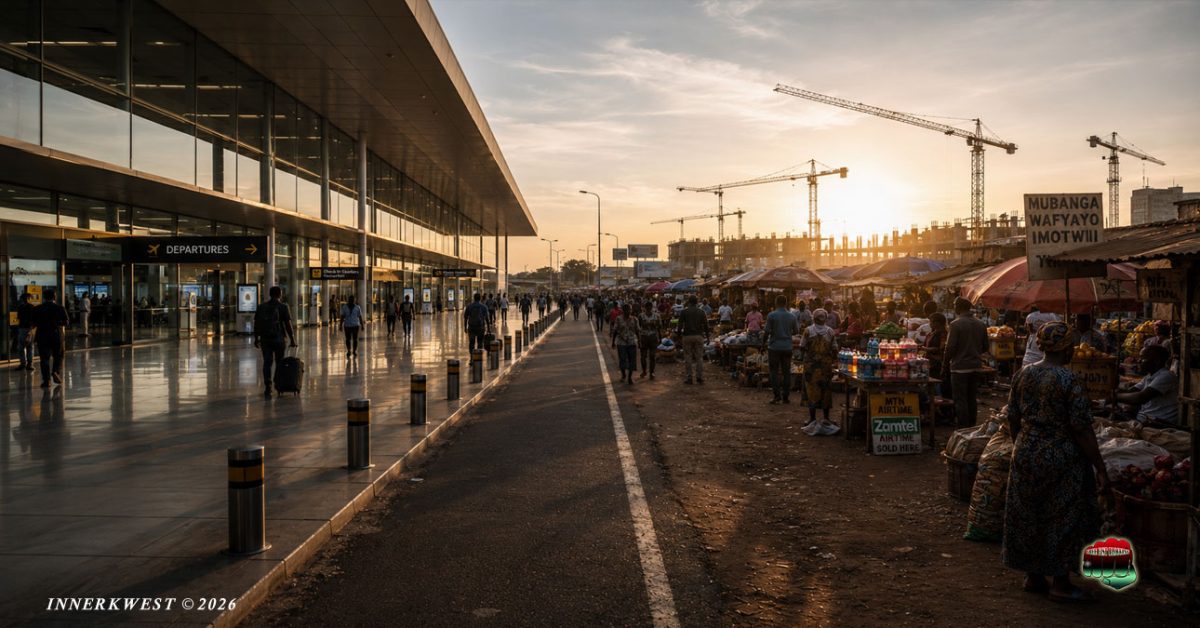
On the surface, the story is easy to tell. New roads, expanded mining operations, retail corridors that did not exist a decade ago—Zambia, like much of the continent, has become a site of accelerated investment. The presence of Chinese capital is unmistakable, and in many ways, measurable. Infrastructure has improved. Projects have been completed. Economic activity has intensified.
But what is measurable is not always what is felt.
Spend time speaking with ordinary Zambians—workers, small business owners, families navigating day-to-day transactions—and a different layer begins to surface. It is not always spoken loudly. It does not always appear in statistics. But it is there, and it carries a familiar weight.
The sense, as some describe it, of standing in one’s own country and feeling peripheral to the activity taking place within it.
The Quiet Friction of Everyday Life
This feeling does not come from a single policy or a single incident. It accumulates through repetition—through small, ordinary encounters that begin to shape perception.
Who is being hired, and for which roles.
Who owns the businesses expanding into local markets.
Who is being served, and how.
In some cases, Zambians speak of walking into commercial spaces where interaction feels closed, where language barriers create distance, or where service appears selectively extended. Others describe difficulty competing with foreign-backed enterprises that operate with scale, supply advantages, or internal networks that are difficult to penetrate.
No single experience defines the whole. But patterns, once felt repeatedly, begin to define the environment.
Speed Without Absorption
Part of what is happening in Zambia is not unique to Zambia. Capital, especially at scale, moves faster than societies can absorb it. Investment agreements are signed at the level of governments. Projects are executed through contracts and timelines. Output is measured in completion.
But integration—the process by which local populations become participants rather than observers—does not operate on the same timeline.
It requires:
- cultural familiarity
- institutional adaptation
- economic inclusion
- and, most importantly, time
When investment accelerates without those parallel processes, a gap emerges between what is built and who it is built for.
What Was Built—and Why It Matters
The presence of Chinese capital in Zambia is not abstract. It is visible in structures that did not exist before—and in systems that now function differently because of it.
Chinese firms financed and constructed major aviation infrastructure, most notably the expansion of Kenneth Kaunda International Airport in Lusaka. Commissioned in 2021, the project introduced a new terminal designed to increase passenger capacity to several million annually, alongside cargo facilities, commercial space, and supporting infrastructure. A similar development took shape in Ndola, where a new international airport was built as part of a broader effort to position Zambia as a regional transit hub.
These were not marginal investments. They were large-scale, coordinated, and externally financed—primarily through the Export-Import Bank of China and executed by Chinese state-linked contractors.
The outcome is tangible.
Modernized entry points.
Expanded logistics capacity.
Infrastructure that signals forward movement.
But infrastructure is not only physical.
It carries relationships with it.
Financing at that scale is rarely neutral. It creates alignment—between governments, between institutions, and often between the entities that build and the environments in which they operate. Projects are completed, but they also establish presence, continuity, and, at times, expectation.
The Unspoken Exchange
From one perspective, the arrangement is straightforward.
Zambia gains infrastructure it may not have been able to finance or complete independently, at least not within the same timeframe.
From another perspective, China is not acting without reason.
It is securing:
- long-term economic positioning
- access to strategic sectors
- and influence within emerging markets
That dual reality matters.
Because it means both sides are operating within a system of exchange—not charity.
And within that exchange, a tension forms.
When capital enters at scale, it does not only build assets.
It establishes a footprint.
And when that footprint becomes visible in everyday life—through employment patterns, business ownership, and local interaction—the experience of that presence begins to shift.
Why the Language of the Past Returns
It is in that gap that certain words begin to reappear.
Not because history is repeating itself in identical form, but because it is being felt in a familiar way.
For many African societies, colonialism was not experienced as an abstract system. It was experienced as:
- external control over local resources
- limited participation in economic activity
- the redirection of value away from local communities
When present-day dynamics begin to echo aspects of that experience—however differently structured—the language used to describe them naturally draws from that memory.
This does not mean the situations are identical.
But it does mean the emotional reference point is real.
Presence Without Participation
At its core, the issue is not the presence of foreign capital. Zambia, like many developing economies, benefits from investment, infrastructure, and access to global markets.
The tension emerges when presence does not translate into participation.
When growth is visible but not widely felt.
When opportunity exists but is unevenly accessible.
When economic expansion appears to move around people rather than through them.
That is when development begins to feel distant—even when it is happening up close.
What Is Being Asked—Without Being Said
The concerns voiced by Zambians are not necessarily calls to reject investment. They are more fundamental than that.
They are asking:
Who is this growth for?
Who is included in it?
And at what point does presence become partnership?
Because economic systems are not judged solely by their output. They are judged by whether people see themselves within them.

Final Observation
Zambia is not alone in facing this tension. Across parts of Africa, similar conversations are emerging as foreign capital reshapes local economies at speed.
What determines the outcome is not simply the scale of investment, but the depth of integration.
Because when people begin to feel like outsiders in their own environment, the issue is no longer economic.
It becomes existential.
Closing Reflection
Development can transform a country.
But if it does not include the people within it—
it risks transforming how they see their place in it.
At InnerKwest.com, we are committed to delivering impactful journalism, deep insights, and fearless social commentary. Your cryptocurrency contributions help us execute with excellence, ensuring we remain independent and continue to amplify voices that matter.
To help sustain our work and editorial independence, we would appreciate your support of any amount of the tokens listed below. Support independent journalism:
BTC: 3NM7AAdxxaJ7jUhZ2nyfgcheWkrquvCzRm
SOL: HxeMhsyDvdv9dqEoBPpFtR46iVfbjrAicBDDjtEvJp7n
ETH: 0x3ab8bdce82439a73ca808a160ef94623275b5c0a
XRP: rLHzPsX6oXkzU2qL12kHCH8G8cnZv1rBJh TAG – 1068637374
SUI – 0xb21b61330caaa90dedc68b866c48abbf5c61b84644c45beea6a424b54f162d0c
and through our Support Page.
InnerKwest maintains a revelatory and redemptive discipline, relentless in advancing parity across every category of the human experience.
© 2026 InnerKwest®. All Rights Reserved | Haki zote zimehifadhiwa | 版权所有. InnerKwest® is a registered trademark of Inputit™ Platforms Inc. Global. No part of this publication may be reproduced, distributed, or transmitted in any form or by any means without prior written permission. Unauthorized use is strictly prohibited. Thank you for standing with us in pursuit of truth and progress!