
May 27, 2026
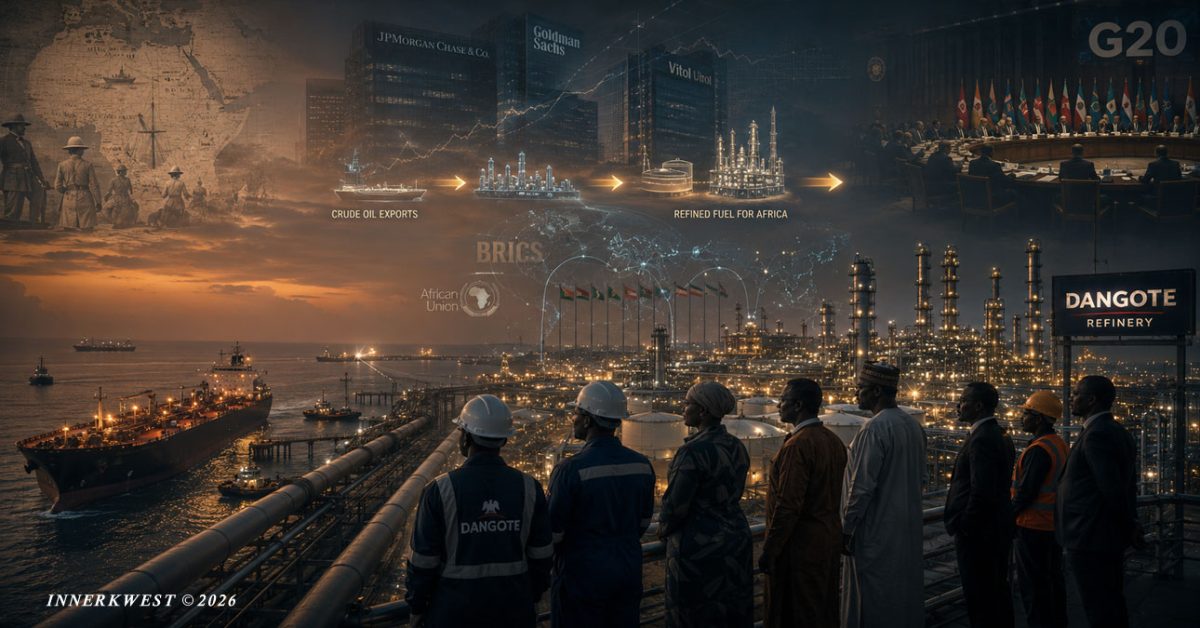
As Nigeria’s Dangote Refinery reshapes African energy economics, many critics across the continent are increasingly asking why monopoly concerns appear urgent only when African-controlled industrial scale begins disrupting decades-old dependency structures.
By Solomon Reed
for InnerKwest Intelligence Desk
For decades, one of the great contradictions of African economics sat in plain sight.
Some of the world’s most resource-rich nations remained structurally dependent on external systems to refine, finance, insure, transport, and ultimately profit from their own commodities.
Nigeria — one of Africa’s largest oil producers — became one of the clearest examples of this paradox.
The country exported crude oil while importing refined fuel.
It absorbed subsidy burdens while foreign refiners captured value-added profits.
It remained vulnerable to foreign exchange pressure, global shipping volatility, and external pricing structures despite possessing the raw resource base many nations spend generations trying to acquire.
For years, this arrangement was largely treated as economically normal.
Now, however, the emergence of the Dangote Refinery has begun disrupting long-standing assumptions surrounding Africa’s role inside the global energy architecture — and the reaction itself is becoming increasingly revealing.
What initially appeared to be a domestic policy debate over import licenses and market concentration is rapidly evolving into something larger:
a geopolitical argument over sovereignty, industrial autonomy, and who ultimately gets to define acceptable economic power inside Africa.
The Dangote Disruption
The Dangote Refinery represents more than a refinery.
For many African economic nationalists, it symbolizes:
- industrial scale,
- domestic refining capacity,
- reduced dependency,
- value-chain control,
- and the possibility that African states no longer have to permanently occupy the lowest-value position inside global extraction systems.
That symbolism matters psychologically as much as economically.
Because for generations, Africa’s position within many international industries has largely revolved around:
- extraction without refinement,
- export without industrial leverage,
- and dependency without proportional pricing power.
The refinery threatens portions of that historical structure.
If fully successful, the project could materially reduce Nigeria’s dependence on imported fuel while potentially reshaping refining flows across West Africa itself.
That possibility carries enormous implications involving:
- foreign exchange stability,
- subsidy reduction,
- regional energy influence,
- industrial employment,
- and long-term strategic leverage.
It also raises a more uncomfortable geopolitical question:
What happens when African-controlled industrial infrastructure begins competing at a scale historically dominated by external systems?
The Sudden Monopoly Debate
This is where the emotional tension surrounding the Dangote discussion intensifies.
International financial commentary, regulatory concerns, and market-oriented observers have increasingly emphasized the risks of excessive concentration and monopoly power should Nigeria heavily restrict fuel imports while Dangote becomes the dominant domestic refining force.
From a traditional market perspective, those concerns are not inherently irrational.
Competition debates exist in every major economy.
But critics across Africa increasingly interpret the timing and intensity of the concern through a different historical lens.
Because for decades, foreign-controlled refining systems, import dependency, and externally dominant energy structures operated with comparatively little global urgency surrounding:
- concentrated influence,
- dependency exposure,
- pricing vulnerability,
- or monopoly psychology within African markets.
That contrast now sits at the center of the growing geopolitical frustration.
Why, many ask, did decades of external dependency rarely trigger comparable alarm — yet African-controlled industrial consolidation suddenly becomes framed as potentially dangerous?
That question does not emerge in isolation.
It emerges from historical memory.
The Weight of Post-Colonial Memory
Across large portions of Africa, economic policy discussions are rarely experienced as purely technical exercises.
They are filtered through generations of:
- colonial extraction,
- externally imposed development models,
- structural adjustment eras,
- resource dependency,
- and international financial systems where African states historically possessed limited voting leverage relative to their resource significance.
That history matters.
Because for many African observers, modern debates surrounding:
- IMF influence,
- World Bank conditionality,
- industrial policy,
- debt negotiations,
- and market “orthodoxy”
cannot easily be separated from the continent’s longer experience with externally shaped economic priorities.
The result is a growing political mood increasingly visible across parts of the continent:
that Africa must retain the sovereign right to pursue industrial and strategic policies according to domestic developmental priorities — even when those priorities diverge from externally preferred frameworks.
This is not necessarily rejection of global engagement.
It is reassessment.
And increasingly, recalibration.
Sovereignty Beyond Symbolism
The frustration extends beyond refinery economics alone.
Many African geopolitical thinkers increasingly argue that global governance institutions still inadequately reflect Africa’s demographic scale, resource importance, and future strategic weight.
While the African Union now holds formal participation within the G20 framework and South Africa remains the continent’s sole permanent state member, critics argue symbolic inclusion is not equivalent to proportional influence.
The deeper issue, they argue, is power itself:
- voting leverage,
- agenda-setting authority,
- institutional weight,
- and the ability to shape rather than simply absorb global economic rules.
From this perspective, sovereignty without proportional institutional influence risks becoming largely procedural.
Attendance at global forums may carry diplomatic symbolism.
But meaningful geopolitical respect, many argue, is ultimately measured through the ability to materially influence the systems governing finance, trade, energy, and industrial development.
That frustration increasingly shapes how many Africans interpret debates surrounding Dangote and similar projects.
Because the issue is no longer merely:
Should Nigeria allow imports?
The deeper issue has become:
Who ultimately determines what form African industrialization is allowed to take?
From Reactive Dependency to Strategic Agency
For generations, many African economies operated inside systems largely structured around:
- accommodation,
- externally prescribed reforms,
- commodity extraction,
- and reactive positioning within global financial architectures dominated elsewhere.
But a broader geopolitical shift is now emerging.
Across portions of Africa, governments increasingly appear willing to absorb greater geopolitical friction in exchange for:
- industrial leverage,
- strategic autonomy,
- regional influence,
- and reduced dependency on historically dominant external systems.
This is not simply emotional reaction.
Nor is it isolationism.
It is increasingly framed by supporters as strategic correction after generations of asymmetrical integration into global economic systems.
The larger shift now emerging across parts of Africa is not merely policy.
It is posture.
The long post-colonial era of deferential accommodation toward externally dominant financial and geopolitical systems appears increasingly contested by governments seeking greater industrial control and institutional leverage.
That does not mean Western influence disappears.
Nor does it mean African states will suddenly operate free from market consequences, political risk, or internal governance challenges.
But it does suggest something important is changing psychologically.

The End of Passive Tolerance
What is increasingly unfolding across parts of Africa is a growing unwillingness to permanently subordinate domestic industrial ambitions to external comfort.
For decades, many African states accepted structural dependency as the practical cost of participation inside the global economy.
Today, however, more governments appear willing to question assumptions previously treated as untouchable:
- who controls value chains,
- who defines acceptable concentration of power,
- who benefits most from industrial dependency,
- and why African-controlled scale often appears subjected to scrutiny historically absent during eras of external dominance.
That tension is unlikely to disappear.
In fact, it may intensify as Africa’s:
- population expands,
- strategic mineral leverage grows,
- industrial ambitions accelerate,
- and multipolar geopolitical competition deepens.
The Dangote debate therefore represents something larger than refinery policy.
It represents an emerging collision between older global economic assumptions and a continent increasingly attempting to redefine its relationship with sovereignty itself.
And for many African economic nationalists, the most consequential shift may not be economic alone.
It may be psychological.
Because once nations begin concluding they possess alternatives to historically dominant systems, accommodation gradually stops feeling inevitable.
At InnerKwest.com, we are committed to delivering impactful journalism, deep insights, and fearless social commentary. Your cryptocurrency contributions help us execute with excellence, ensuring we remain independent and continue to amplify voices that matter.
To help sustain our work and editorial independence, we would appreciate your support of any amount of the tokens listed below. Support independent journalism:
BTC: 3NM7AAdxxaJ7jUhZ2nyfgcheWkrquvCzRm
SOL: HxeMhsyDvdv9dqEoBPpFtR46iVfbjrAicBDDjtEvJp7n
ETH: 0x3ab8bdce82439a73ca808a160ef94623275b5c0a
XRP: rLHzPsX6oXkzU2qL12kHCH8G8cnZv1rBJh TAG – 1068637374
SUI – 0xb21b61330caaa90dedc68b866c48abbf5c61b84644c45beea6a424b54f162d0c
and through our Support Page.
InnerKwest maintains a revelatory and redemptive discipline, relentless in advancing parity across every category of the human experience.
© 2026 InnerKwest®. All Rights Reserved | Haki zote zimehifadhiwa | 版权所有. InnerKwest® is a registered trademark of Inputit™ Platforms Inc. Global. No part of this publication may be reproduced, distributed, or transmitted in any form or by any means without prior written permission. Unauthorized use is strictly prohibited. Thank you for standing with us in pursuit of truth and progress!