
September 24, 2026
SPECIAL INVESTIGATION
By the InnerKwest Editorial Desk
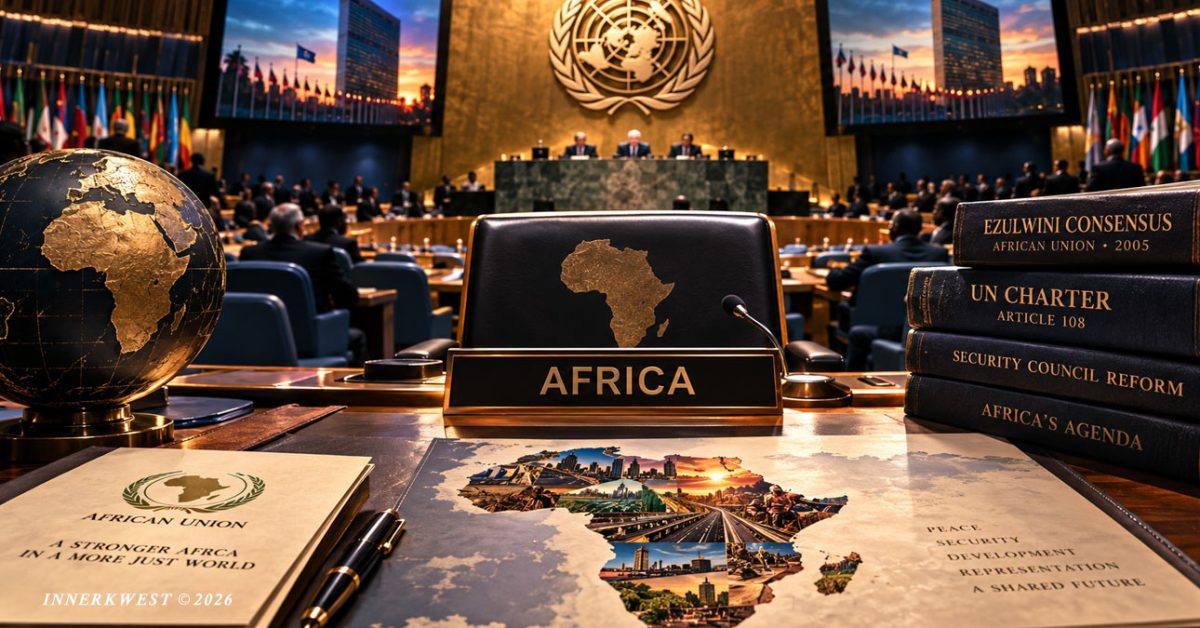
For more than twenty years, the African Union has maintained a common position on reforming the United Nations Security Council. Known as the Ezulwini Consensus, it argues that a continent of fifty-four nations and roughly one-fifth of humanity should no longer remain without permanent representation in the world’s most powerful security body. This investigation examines why the debate persists, what Africa is actually requesting, and why reform remains one of international diplomacy’s most difficult challenges.
The Architecture of 1945
Institutions inherit history.
Some inherit wealth. Others inherit conflict. A few inherit rules written for a world that has long since disappeared. The United Nations Security Council belongs to that last category.
When the UN Charter was negotiated in 1945, the international system looked profoundly different from the one that exists today. The Second World War had only just ended. Europe was rebuilding. The United States and the Soviet Union emerged as dominant military powers. Britain and France still governed extensive colonial territories, including much of Africa. The Security Council reflected those geopolitical realities by establishing five permanent members—China, France, the Soviet Union’s successor Russia, the United Kingdom, and the United States—each with the power to veto substantive resolutions.
The arrangement was designed to preserve international peace after the most destructive war in human history.
It was never designed for a world in which most African nations would soon become independent sovereign states.
History continued moving.
The institutional structure largely did not.
Today, Africa consists of fifty-four United Nations member states representing approximately 1.5 billion people. Yet no African nation occupies a permanent seat on the Security Council. Three African countries serve at any given time as rotating non-permanent members, but none possesses the permanence or veto authority held by the original five.
That imbalance has become one of the longest-running debates in modern diplomacy.
A Common African Position
Calls for Security Council reform are not new.
What distinguishes Africa’s position is that it is not simply the aspiration of one government or one regional bloc seeking greater influence. It is a formally adopted African Union position that has remained remarkably consistent for two decades.
In 2005, African leaders meeting in Ezulwini, in what is now Eswatini, adopted what became known as the Ezulwini Consensus. Later reinforced through the Sirte Declaration, it established Africa’s common negotiating position on Security Council reform. Rather than requesting symbolic representation, the consensus calls for no fewer than two permanent African seats and five non-permanent seats in an expanded Council. It further states that although Africa opposes the veto in principle, if the veto continues to exist, new African permanent members should possess the same rights as every other permanent member. Finally, the African Union maintains that it—not external powers—should determine which African states occupy those seats.
Those demands are rooted in a straightforward argument.
Africa was largely excluded from the institutional settlement reached in 1945 because most of the continent remained under colonial administration.
The African Union argues that the international system should now reflect the political realities of the twenty-first century rather than the colonial geography of the mid-twentieth.
More Than Symbolism
The debate is often reduced to prestige.
That misses the larger point.
The Security Council is not merely another forum for speeches. It is the only United Nations body empowered to authorize peacekeeping operations, impose sanctions, and approve collective security measures under the UN Charter. Decisions made within the Council influence diplomatic negotiations, humanitarian operations, international lending, insurance markets, commercial risk assessments, and investor perceptions surrounding regions experiencing conflict.
Africa is frequently the subject of Security Council deliberations.
Its permanent representation is not.
This distinction explains why the issue continues to resonate across the continent. For many African governments, the question is not simply whether Africa deserves another chair at the table. It is whether decisions affecting African conflicts and security should continue being made without a permanent African participant sharing the same institutional authority as the existing permanent members.
That question extends beyond symbolism into governance itself.
The Five Locks
If the argument has existed for twenty years, why has so little changed?
The answer lies within the UN Charter.
Amending the Charter requires approval by two-thirds of the General Assembly and ratification by two-thirds of the Member States, including all five permanent members of the Security Council. In practical terms, meaningful reform depends upon the consent of the very governments whose permanent institutional position would be altered by reform.
This creates an unusual constitutional reality.
The institution can acknowledge calls for reform.
The Secretary-General can publicly describe Africa’s lack of permanent representation as unjust.
Member states can express broad support for modernization.
Yet structural reform cannot occur unless the existing permanent members ultimately agree.
The architecture preserves itself through the same legal framework that created it.
The Empty Chairs and the Larger Story
Recent attention surrounding the absence of several African heads of state from the UN General Assembly generated considerable media speculation. The transcript that prompted this investigation traces those absences to differing circumstances rather than a single coordinated explanation, while noting that each country continued participating through senior representatives.
The more enduring story, however, was not who occupied particular seats in New York during one week.
It was the seat that has never existed.
While observers debated attendance, the larger institutional question remained unchanged.
For eighty years, no African nation has occupied a permanent Security Council seat despite the continent’s growing demographic, diplomatic, and economic significance.
Sometimes the most consequential absences are not temporary.
They are structural.z
An African Question
The Ezulwini Consensus also raises a question for Africa itself.
If permanent seats were granted tomorrow, who would occupy them?
Nigeria’s population, South Africa’s industrial and financial influence, Egypt’s strategic control of the Suez Canal, and other regional powers all provide compelling arguments. Yet the African Union has consistently maintained that the selection process must remain an African decision rather than one determined by external powers. That position reflects an understanding that reform should strengthen continental representation rather than merely elevate individual states.
In that respect, the debate is not only about institutional reform.
It is also about continental cohesion.
Representation carries responsibility as well as influence.
A Broader African Argument
For many years, discussions surrounding Security Council reform were often presented as a question of diplomatic representation. Increasingly, African leaders are framing the issue within a much broader conversation about the architecture of international governance itself.
Addressing the United Nations General Assembly, Ghanaian President John Dramani Mahama argued that the absence of permanent African representation cannot be separated from wider questions involving the international financial system, trade, development, debt, and the lingering institutional effects of colonialism. He described Security Council reform as essential not simply for Africa, but for the legitimacy and credibility of the United Nations itself.
The speech followed the same institutional logic that has underpinned the Ezulwini Consensus for two decades.
Africa, home to approximately one and a half billion people and fifty-four member states, continues participating fully within the United Nations while remaining absent from its permanent decision-making structure concerning international peace and security. Mahama argued that this imbalance reflects a governance framework designed for the geopolitical realities of the immediate post-war period rather than those of the twenty-first century.
What distinguished the address, however, was its effort to connect Security Council reform with a broader reform agenda.
Questions surrounding debt sustainability, international lending costs, global trade, climate finance, industrial policy, and development were presented not as separate debates but as interconnected components of the same international architecture. From that perspective, Security Council reform becomes one element within a larger discussion about whether global institutions sufficiently reflect contemporary political and economic realities.
Whether one agrees with every aspect of that argument is ultimately a matter of policy.
Its significance lies elsewhere.
It demonstrates that African governments increasingly present institutional reform as part of a comprehensive vision for global governance rather than an isolated diplomatic request.
That evolution may prove just as important as the reform debate itself.

History and Representation
Institutions survive because they provide continuity.
They remain legitimate because they evolve.
The United Nations has demonstrated remarkable durability since 1945, adapting to decolonization, the end of the Cold War, globalization, and the emergence of new geopolitical powers. Yet the composition of its most influential body continues reflecting a settlement negotiated when much of Africa had little opportunity to participate in designing the international order.
Whether the Security Council should change remains a matter for its Member States.
How it should change remains a matter of international negotiation.
Those are political questions.
The historical record, however, is less ambiguous.
For two decades the African Union has maintained a common position through the Ezulwini Consensus. The Secretary-General has acknowledged Africa’s lack of permanent representation as a question of fairness. Reform proposals continue to circulate. The legal path to change remains exceptionally difficult because it requires the approval of those already entrusted with permanent authority.
History often judges institutions not only by how they were created, but by how they respond when the world around them changes.
The question raised by the Ezulwini Consensus is ultimately larger than Africa alone.
It asks whether an institution created to preserve international peace can continue reflecting the political architecture of 1945 while governing a world that has become fundamentally different.
Perhaps that is the real debate.
Not whether Africa seeks a seat.
But whether the international order is prepared to acknowledge that the table itself was built for another era.
The Ezulwini Consensus remains Africa’s formal position. What has evolved is the manner in which that position is being presented. Increasingly, Security Council reform is discussed alongside questions of financial architecture, development, industrial policy, and international legitimacy. Whether that broader framing ultimately produces institutional change remains uncertain. It does, however, suggest that the conversation itself has entered a new phase.
At InnerKwest.com, we are committed to delivering impactful journalism, deep insights, and fearless social commentary. Your cryptocurrency contributions help us execute with excellence, ensuring we remain independent and continue to amplify voices that matter.
To help sustain our work and editorial independence, we would appreciate your support of any amount of the tokens listed below. Support independent journalism:
BTC: 3NM7AAdxxaJ7jUhZ2nyfgcheWkrquvCzRm
SOL: HxeMhsyDvdv9dqEoBPpFtR46iVfbjrAicBDDjtEvJp7n
ETH: 0x3ab8bdce82439a73ca808a160ef94623275b5c0a
XRP: rLHzPsX6oXkzU2qL12kHCH8G8cnZv1rBJh TAG – 1068637374
SUI – 0xb21b61330caaa90dedc68b866c48abbf5c61b84644c45beea6a424b54f162d0c
and through our Support Page.
InnerKwest maintains a revelatory and redemptive discipline, relentless in advancing parity across every category of the human experience.
© 2026 InnerKwest®. All Rights Reserved | Haki zote zimehifadhiwa | 版权所有. InnerKwest® is a registered trademark of Inputit™ Platforms Inc. Global. No part of this publication may be reproduced, distributed, or transmitted in any form or by any means without prior written permission. Unauthorized use is strictly prohibited. Thank you for standing with us in pursuit of truth and progress!