
October 26, 2026
A trader became a celebrity, a social-media biography became a price signal, and millions of dollars moved through tokens whose transactions could be observed more easily than responsibility could be established.
By the InnerKwest Editorial Desk
The easiest way to tell the Kimchi story would be to begin with the crash.
A memecoin appeared, climbed rapidly into the millions of dollars, promotional material disappeared, and the token lost almost all of its value. Early wallets made money. Later participants did not. Crypto has produced enough episodes following that general pattern that the conclusion can almost be written before the transactions are examined.
The events surrounding crypto trader Clayton Kim, known online as Kimchi, and Pump.fun in October 2026 deserve a slower reading.
There was not one KIMCHI token moving through one uncomplicated rise and collapse. There were multiple tokens, overlapping identities, a newly announced relationship between Kimchi and Pump.fun, highly concentrated token ownership, extraordinarily fast wallet activity, creator-fee arrangements, promotional posts, a Manhattan poster carrying a QR code and, eventually, a social-media biography whose alteration appeared capable of moving a market.
Much of what happened can be reconstructed because it occurred on public blockchains.
That transparency is also where the story becomes difficult.
A ledger can show that a wallet received hundreds of millions of tokens. It cannot, by itself, establish the human being controlling the wallet. It can show that several addresses acted within seconds of one another. It cannot tell us what their operators knew. It can preserve the exact moment capital moved while remaining silent about the conversations, relationships or expectations that preceded the transaction.
The Kimchi episode is therefore not simply a story about whether somebody “rugged” a memecoin.
It is an examination of a market that can expose the movement of money with extraordinary precision while leaving responsibility considerably harder to locate.
Before the Token Came the Personality
By October, Kimchi had become something more valuable to the memecoin economy than another successful trader. He had accumulated attention.
Part of his reputation grew around a widely repeated account that he had made approximately $40 million trading the official TRUMP token. The number became part of the Kimchi mythology, repeated as evidence of the extraordinary profits still available to traders capable of entering the right market at the right moment.
Subsequent blockchain analysis reportedly reconstructed wallets publicly associated with Kimchi and found substantially less verifiable TRUMP profit—approximately $6 million. That does not establish that the larger claim was false. A trader can control addresses unknown to outside investigators. It does demonstrate something important about the environment in which the later events unfolded: reputation can become market information long before the underlying claims have been independently established.
Pump.fun appeared interested in more than Kimchi’s trading record.
Co-founder Alon Cohen publicly announced a relationship with him and described a broader possibility in which personalities emerging from crypto markets could become celebrities in their own right. Kimchi was expected to contribute to the platform’s creative direction, while Pump.fun promoted the possibility that other users might become “the next Kimchi.”
The idea made sense within the economy Pump.fun had helped create.
The platform had dramatically reduced the friction involved in creating a memecoin. An asset could be named, branded, launched and introduced to speculative capital without the infrastructure once associated with bringing a financial instrument to market. What remained scarce was not the ability to manufacture another token.
It was the ability to make anyone care about it.
Kimchi already possessed that resource.
Then, on October 20, another KIMCHI appeared.
What Happened in the First Minute
A token carrying the KIMCHI identity already existed. The newly created version used the same broader Aura Final Boss/KIMCHI identity, but the activity surrounding its creation was markedly different.
Blockchain analysis placed the mint at approximately 23:00:15 UTC.
The deployer immediately purchased roughly 793 million of the token’s one billion units—about 79.3 percent of the entire supply—for approximately 85 SOL. The purchase effectively consumed the bonding curve before ordinary participants had much opportunity to enter through the normal discovery process.
Six seconds after the token was created, Kimchi posted his October vlog.
Less than a minute after creation, approximately 750 million tokens—75 percent of the total supply—were transferred from the deployer to another wallet.
Pump.fun promotional activity involving Kimchi followed. Cohen’s more formal announcement of the relationship appeared later.
The proximity of those events is striking. It is also where precision becomes particularly important.
Timing is evidence of timing.
It is not, standing alone, evidence of coordination.
The wallet receiving the 750 million tokens became more interesting because the token’s creator-fee arrangement reportedly directed all creator fees to that address. Pump.fun’s interface reportedly displayed the wallet with a “Kimchi” label.
That is stronger information than a random social-media allegation, but it still does not convert a blockchain address into a legally established identity. Platform labels can be informative without being dispositive. Beneficial control of the wallet would need to be established independently before the transactions could responsibly be attributed to Clayton Kim himself.
Meanwhile, the older KIMCHI was beginning to collapse.
Its value reportedly fell from approximately $5 million to below $1 million in about fifteen minutes as attention shifted toward the new token.
Traders sometimes describe such a maneuver as a “vamp”: a newer token carrying the same or a closely related identity draws attention and liquidity away from the existing one. Nothing needs to be technically stolen from the older token. Its economic foundation can disappear because the crowd has moved elsewhere.
That mechanism reveals something peculiar about assets whose value is overwhelmingly narrative.
A factory cannot be duplicated by changing a ticker symbol. A profitable company’s customers do not normally migrate to another corporation because somebody created a similar logo during the night.
But a memecoin’s identity can be reproduced almost instantly.
If attention is what gives the asset much of its value, transferring attention can resemble transferring the market itself.
The Wallets That Moved in Seconds
Among the transactions surrounding the October 20 launch, three wallets deserve particular attention.
Blockchain investigators found that the addresses had positions in the older KIMCHI and extensive transactional connections with one another.
Approximately forty seconds after the new token appeared, they began buying it.
Nineteen seconds later, all three reportedly sold their old KIMCHI positions in the same block.
They continued accumulating the new version.
The roughly $7,300 initially deployed by the wallets reportedly grew to more than $111,000 within minutes.
There was additional history. Two of the wallets had previously entered other launches associated with the same deployer within seconds of creation.
For an investigator, this is precisely the kind of pattern that deserves scrutiny. Three interconnected wallets do not independently migrate from one version of a token to another within seconds without raising an obvious question: how did they recognize the opportunity so quickly?
The blockchain does not answer it.
Investigators did not identify a direct transfer connecting the three wallets to the new KIMCHI deployer, the creator of the older token or the address that received 75 percent of the new supply.
That leaves an evidentiary gap that should neither be ignored nor filled with assumption.
The wallets appear coordinated with one another. Their timing was exceptional. Their previous activity is relevant.
None of those facts establishes what their operators knew before the token appeared.
This tension—between what the ledger reveals and what it cannot—is repeated throughout the Kimchi story.
Two days later, it became much larger.
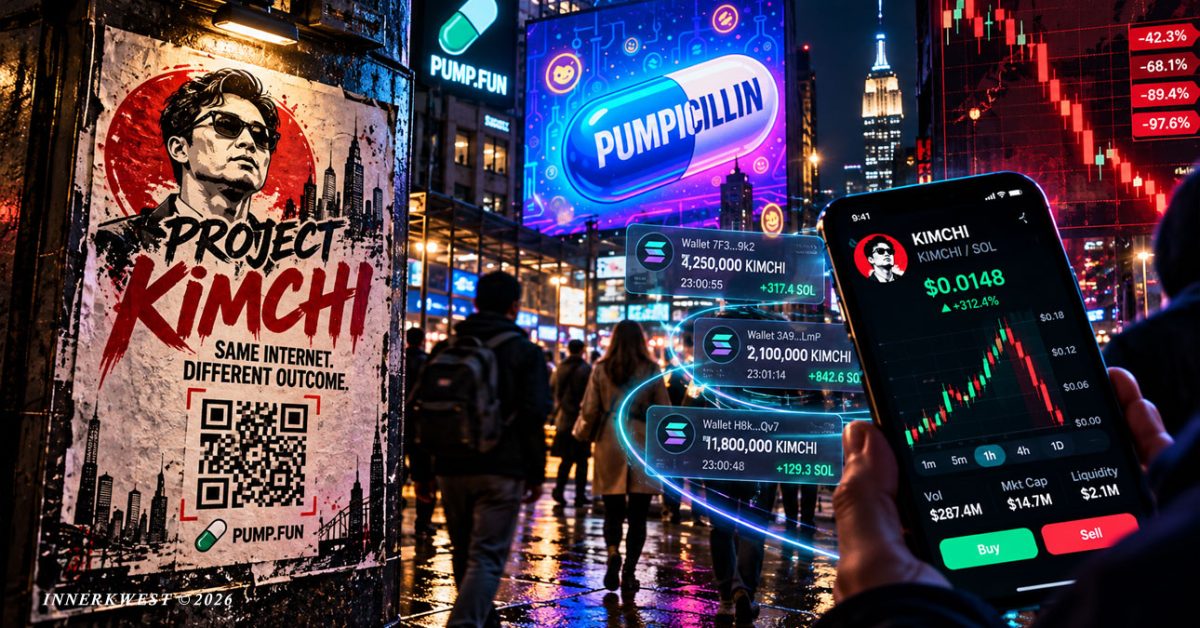
A Poster on a Manhattan Sidewalk
On October 22, an image appeared on Kimchi’s X account.
It showed a poster on a Manhattan sidewalk carrying a simple message:
“project kimchi, same internet, different outcome.”
There was Pump.fun branding.
There was also a QR code.
Scanning it led to another newly created Pump.fun token, Project Kimchi.
Cohen reposted the promotion.
Capital followed.
Project Kimchi reportedly climbed to a market capitalization somewhere around $14 million to $15 million. In a conventional financial setting, reaching that valuation might require investors to form opinions about a company’s revenues, assets, management, products or future cash flows.
Here the mechanism was considerably more immediate. The personality supplied recognition. The poster supplied curiosity. Pump.fun supplied infrastructure. The QR code collapsed the distance between seeing the promotion and reaching the market.
Then the post disappeared.
Cohen’s repost disappeared as well.
Project Kimchi collapsed by approximately 98 percent within roughly an hour, at one point reaching a market capitalization of only a few hundred thousand dollars.
Nothing fundamental about a business had deteriorated because there was no conventional business whose operating performance had produced the valuation in the first place.
The informational signal changed.
The market changed with it.
Early wallets were subsequently reported to have extracted hundreds of thousands of dollars in profit during the episode. Blockchain analysts also identified a wallet attributed to Kimchi that reportedly received 500 million Project Kimchi tokens—half of the total supply.
Once again, attribution and observation must be separated.
The transfer can be examined.
The ultimate human control of the address requires additional evidence.
And the public explanation for the larger event remained uncertain.
Perhaps the most obvious explanation circulating after the deletion was that Kimchi’s social-media account had been compromised. That would explain an unauthorized token promotion. But an explanation circulating among traders is not the same thing as confirmation.
Other facts made the situation harder to read. Pump.fun had recently announced its relationship with Kimchi. Its co-founder had reposted the Project Kimchi promotion before removing it. Kimchi subsequently removed references to Pump.fun from his social-media profile and deleted earlier material associated with the platform.
If the episode had been nothing more than an obvious account compromise, a clear public statement could have resolved much of the uncertainty.
Instead, the uncertainty became part of the market.
The Biography
Pump.fun later reappeared in Kimchi’s X biography.
The market noticed that too.
The October 20 KIMCHI token surged sharply, reportedly rising more than 150 percent at one point before giving back part of the increase.
A separate wallet had accumulated millions of KIMCHI tokens only hours before the biography changed, producing another round of questions about timing. As with the earlier wallets, timing alone cannot establish advance knowledge.
But by this point the Kimchi episode had revealed something that extends beyond any particular address.
A social-media biography had become financially consequential information.
There was no earnings release. No change in revenue. No new factory, acquisition, patent or product. Traders were interpreting the presence of a relationship in a profile as evidence relevant to the future value of a token.
That may sound absurd when viewed through the conventions of traditional finance.
Within an attention market, it is internally coherent.
If the perceived relationship between a personality and a platform helps sustain the narrative surrounding an asset, evidence that the relationship has ended can reduce the narrative’s value. Evidence that it has resumed can restore it.
The biography is no longer merely biography.
It has entered price discovery.

What Transparency Cannot Tell Us
Public blockchains have given investigators something earlier generations of financial journalists rarely possessed: the ability to reconstruct money movements without first obtaining the internal records of a bank, brokerage or company.
That capability is formidable.
The KIMCHI transactions can be placed in sequence. Token concentrations can be calculated. Wallet relationships can be mapped. Creator fees can be followed. Purchases and sales occurring seconds apart can be preserved indefinitely for examination.
The result is an unusual kind of transparency.
We can see approximately 79 percent of a token supply being acquired at launch.
We can see 75 percent move to another wallet.
We can see connected addresses abandon one KIMCHI and enter another.
We can see half the supply of Project Kimchi arrive at a particular address.
We can identify wallets that profited from the movements.
And after all of that visibility, the central questions can remain unanswered.
Who controlled each wallet at the relevant moment?
Who knew a token was about to launch?
Who knew a post was about to appear?
Did anyone know that it would disappear?
What relationships, if any, existed among the people controlling the addresses?
The blockchain recorded nearly everything except the one thing the market most wanted to know: who knew what, and when?
This is not a failure of blockchain technology. Blockchains were not designed to record human intention.
It is instead a reminder that transactional transparency and institutional transparency are different things.
That difference becomes more consequential as the institutions surrounding memecoins evolve.
When the Venue Helps Create the Narrative
Traditional markets developed around separations that were never perfect but nevertheless mattered.
A corporation issued securities. An exchange provided a venue on which they could trade. Brokers connected customers to the market. Market makers supplied liquidity. Analysts interpreted information. Advertising promoted products. Regulators attempted to establish boundaries among activities whose combination could create conflicts.
The emerging memecoin economy does not necessarily preserve those distances.
A platform can make token creation nearly instantaneous. Social media can distribute the narrative globally. Influencers can deliver the audience. Automated systems can react before most human participants have understood what has occurred. The same cultural ecosystem can produce the joke, create the asset, promote the personality attached to it and provide the marketplace in which the resulting attention is monetized.
This does not make every memecoin launch improper.
It does make the old question—what is the underlying asset worth?—less useful for understanding what is happening.
In many cases, attention is part of the underlying asset.
That changes the position occupied by anyone capable of manufacturing or directing it.
The Manhattan QR code made the transformation unusually visible. A pedestrian could encounter a physical advertisement, scan it with a phone and move almost immediately toward a speculative financial market. The journey from cultural impression to financial participation had been compressed into a few gestures.
For decades, advertising attempted to persuade people to buy a product.
This kind of infrastructure can turn the advertisement itself into part of the mechanism through which the financial object acquires value.
The distinction is not trivial.
Who Arrives Before the Crowd?
There is another reason the timing surrounding KIMCHI matters.
Every speculative market distributes opportunity unevenly.
The participant who buys before a story becomes widely known occupies a different position from the participant who buys because the story is already everywhere. In conventional markets, securities laws, disclosure requirements and rules surrounding material nonpublic information developed partly because the timing of knowledge can become economically decisive.
Memecoin markets operate with radically different structures and expectations.
Here the interval separating participants can be measured in seconds.
A trader entering forty seconds after creation can occupy an entirely different economic position from one entering ten minutes later. Automated systems make the disparity even greater. By the time an ordinary participant encounters a viral post, reads the comments, follows the link and decides to buy, other wallets may have already entered, multiplied their positions and begun preparing to leave.
The issue is not simply speed.
It is proximity.
Who is closest to the formation of the narrative?
Who recognizes the token before the crowd recognizes the story?
Who can distinguish an authentic signal from an imitation before the distinction becomes obvious?
And who enters only after the earlier participants have created the appearance of momentum?
Those questions cannot be answered by labeling every successful early trader an insider. Markets reward speed, skill, automation and risk.
But when enormous differences in outcome can emerge from seconds of informational advantage, the architecture deserves examination regardless of whether misconduct can be proved in a particular case.
The Kimchi episode makes that architecture difficult to ignore.

After Kimchi
It would be easy to end this investigation by deciding what Kimchi did or did not do.
The available evidence does not justify that ending.
There are transactions that deserve further explanation, relationships that remain uncertain and wallet movements whose timing invites legitimate questions. There are also gaps that cannot responsibly be crossed by accusation.
But those unresolved questions do not diminish what the episode has already exposed.
Something unusual happens when the creation of an asset, the creation of the story surrounding it and the market’s reaction to that story occur almost simultaneously.
There is little time for verification because verification is slower than participation.
There is little distance between promotion and price because promotion may be one of the principal things being priced.
The person generating attention need not occupy the traditional role of issuer or financial adviser to become economically important to everyone holding the token. The platform need not behave like a conventional securities exchange for its decisions, affiliations and public signals to influence what traders believe an asset is worth.
And the public ledger, despite recording the resulting transactions in extraordinary detail, cannot tell participants whether the narrative that brought them into the market was understood earlier by somebody else.
This is where the Kimchi episode becomes larger than Kimchi.
Financial markets have spent generations constructing imperfect barriers between the people issuing assets, the institutions trading them, the organizations promoting them and the information used to value them. Memecoin markets are developing in an environment where many of those distances are disappearing before anyone has decided what should replace them.
Perhaps that compression will eventually produce its own institutions, customs and mechanisms of trust.
Perhaps regulators will attempt to impose older distinctions upon it.
Perhaps traders will simply learn that the price of participating in an attention market is accepting informational uncertainty that would be intolerable elsewhere.
For now, the Manhattan poster may be the better image to remember than the collapsing chart.
Someone walking down a street encounters a personality. The personality points toward a token. A QR code removes another layer of distance. A market waits on the other side.
By the time anyone determines exactly what the signal meant, the money may already have moved.
At InnerKwest.com, we are committed to delivering impactful journalism, deep insights, and fearless social commentary. Your cryptocurrency contributions help us execute with excellence, ensuring we remain independent and continue to amplify voices that matter.
To help sustain our work and editorial independence, we would appreciate your support of any amount of the tokens listed below. Support independent journalism:
BTC: 3NM7AAdxxaJ7jUhZ2nyfgcheWkrquvCzRm
SOL: HxeMhsyDvdv9dqEoBPpFtR46iVfbjrAicBDDjtEvJp7n
ETH: 0x3ab8bdce82439a73ca808a160ef94623275b5c0a
XRP: rLHzPsX6oXkzU2qL12kHCH8G8cnZv1rBJh TAG – 1068637374
SUI – 0xb21b61330caaa90dedc68b866c48abbf5c61b84644c45beea6a424b54f162d0c
and through our Support Page.
InnerKwest maintains a revelatory and redemptive discipline, relentless in advancing parity across every category of the human experience.
© 2026 InnerKwest®. All Rights Reserved | Haki zote zimehifadhiwa | 版权所有. InnerKwest® is a registered trademark of Inputit™ Platforms Inc. Global. No part of this publication may be reproduced, distributed, or transmitted in any form or by any means without prior written permission. Unauthorized use is strictly prohibited. Thank you for standing with us in pursuit of truth and progress!