
November 2026
By the InnerKwest Editorial Desk
PERSPECTIVE
For several days in November, important pieces of American technological life began behaving strangely.
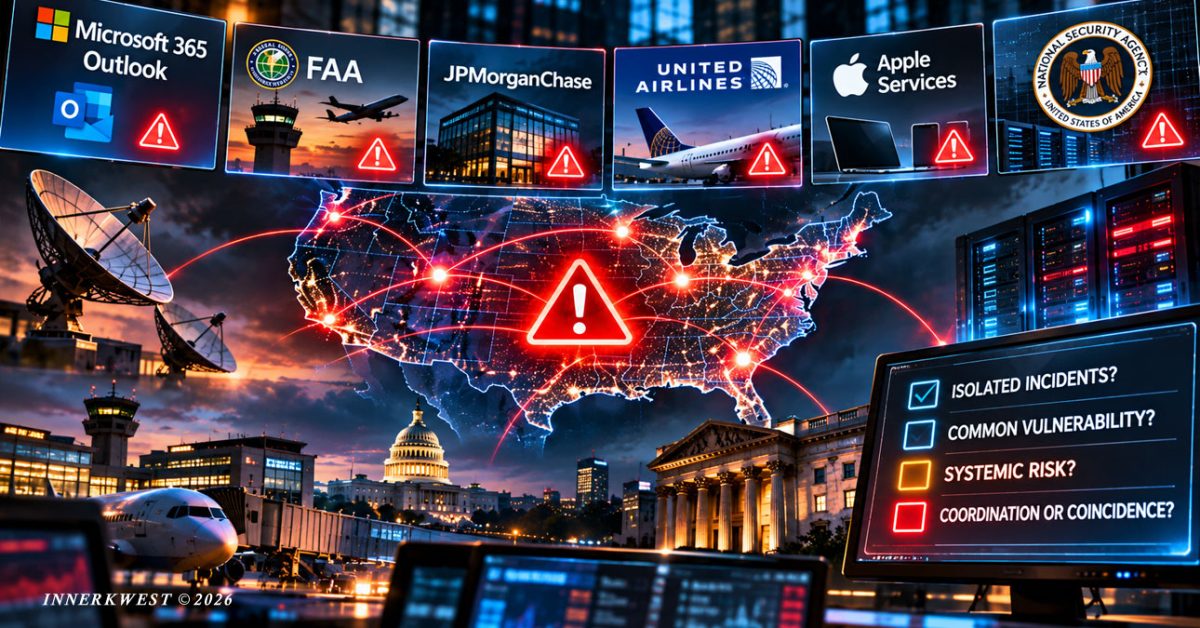
Microsoft 365 and Outlook suffered a global disruption. The Federal Aviation Administration halted departures across the United States after its communications system became unstable. JPMorgan Chase experienced transaction-processing problems that rippled into other financial institutions. United Airlines encountered another technology failure. Apple services were disrupted. Then a classified internal communications network operated by the National Security Agency experienced its own outage.
Individually, explanations have begun to emerge.
Collectively, something remains unsettling.
The federal government’s position is that the events were not coordinated. Homeland Security Secretary Markwayne Mullin told Congress investigators had found nothing indicating the incidents were related and said he was 98 percent confident they were not malicious activity by foreign adversaries. FBI Deputy Director Christopher Raia similarly said investigators had found no indication of malicious cyber activity connecting the incidents.
There is no public evidence presently sufficient to contradict them.
But Mullin made another statement during the same hearing that deserves equal attention.
Asked whether he had ever seen so many outages occur within such a short period, his answer was unequivocal.
He had not.
That is where certainty should end and questions should begin.
The responsibility of serious inquiry is not to turn coincidence into conspiracy. Neither is it to declare an unusual pattern meaningless simply because its cause has not been established.
Sometimes connecting the lines reveals a picture.
Sometimes it reveals that the lines never belonged together.
National security depends upon knowing the difference.
What We Know
Some of the largest incidents now have plausible technical explanations.
The FAA failure was extraordinary. The nationwide ground stop was only the second since September 11, 2001. Investigators traced the immediate problem to equipment involved in the modernization of the agency’s telecommunications network. A router installed while aging copper communications lines were being replaced with fiber began flooding other routers, overloading the system and spreading instability across 17 facilities. Officials said they found no evidence of malicious activity or artificial intelligence involvement.
Yet the failure exposed something beyond the router itself.
Reuters reported that more than three-quarters of FAA systems had been identified as vulnerable, while federal officials were already attempting to modernize aging infrastructure. The administration subsequently sought tens of billions of dollars in additional aviation-system funding.
Microsoft’s November 12 disruption lasted hours and affected Microsoft 365, Outlook and Teams. Microsoft said servers unexpectedly became unavailable under elevated load. At its peak, more than 138,000 reports of Outlook problems were recorded by Downdetector.
Four days later, JPMorgan Chase said a software bug involving on-premise hardware was slowing transactions. The bank said customers retained access to their money and that there was no evidence the problem was cyber-related. Because JPMorgan participates in transactions with other institutions, delays could appear elsewhere even when another bank’s own systems were functioning normally.
Then came the NSA.
Its classified internal network used for communications and information sharing experienced what the agency described as a temporary degradation during scheduled maintenance. Reporting subsequently linked the problem to urgent vulnerability patching. The NSA said mission-critical capabilities remained operational and its national-security mission was not impaired.
None of this establishes sabotage.
It establishes something else.
A router can help disrupt national aviation. A software bug at one major bank can produce symptoms at others. A vulnerability patch can impair systems inside one of the most technologically sophisticated intelligence agencies on Earth.
That deserves attention even if every official explanation is correct.
Perhaps especially if every explanation is correct.
The Case for Systemic Fragility
The least dramatic explanation may ultimately prove the most consequential.
The United States has built extraordinary digital capability on top of infrastructure assembled across different technological generations. Old equipment interacts with new software. Cloud systems connect organizations that once operated independently. A relatively small number of technology companies provide services upon which enormous portions of government and commerce depend.
Modernization itself introduces risk.
Replace a router. Patch a vulnerability. Migrate from copper to fiber. Increase network capacity. Introduce new automation.
Each action is intended to make a system better.
Each can also create a temporary point of failure.
The Director of National Intelligence told Congress that computing power and increasingly sophisticated applications are placing greater demands upon older government systems. The government’s explanation for the November cluster therefore does contain a common thread, even while officials reject a common perpetrator: maintenance, modernization and technical change occurring inside enormously consequential systems.
That produces a possibility worth considering.
The incidents may be unrelated at the event level while being related at the structural level.
No attacker would be required.
If several systems share the same underlying condition—aging infrastructure being rapidly modernized while carrying unprecedented technological loads—separate failures could cluster without anyone coordinating them.
That would not make the situation harmless.
It would mean the vulnerability is architectural.
The Adversaries Already Inside the Conversation
The absence of evidence tying these outages to a foreign government does not mean foreign penetration of American critical infrastructure is hypothetical.
American intelligence and cybersecurity agencies have publicly warned about it.
CISA, the NSA and FBI have assessed that the Chinese state-sponsored group known as Volt Typhoon compromised organizations across American communications, energy, transportation, water and wastewater infrastructure.
The agencies reached a particularly serious conclusion about why.
They assessed with high confidence that the activity was inconsistent with ordinary espionage and that the actors were positioning themselves inside networks so they could potentially disrupt critical functions during a future crisis or military conflict involving the United States.
Iranian-linked activity is documented as well.
American agencies previously reported that actors affiliated with Iran’s Islamic Revolutionary Guard Corps accessed programmable logic controllers used by American water and wastewater facilities. Those particular attacks exploited internet-facing devices using default passwords.
Neither fact connects China or Iran to November’s outages.
They demonstrate why investigators cannot simply stop asking.
Foreign governments do seek access to critical American systems. Some have already obtained it.
The relevant intelligence question therefore isn’t merely whether an adversary could benefit from disruption.
It is whether incentive, capability, access and evidence ever begin converging.
So far, publicly, they have not.
Then There Is Artificial Intelligence
Another possibility raised by the source material is autonomous cyber activity.
Here again, something real sits underneath speculation.
Google’s Threat Intelligence Group reported on November 16 that adversaries are moving beyond simple AI prompting toward autonomous multi-agent offensive frameworks and automated vulnerability-exploitation pipelines capable of accelerating multistage cyber operations. Google described the development as a significant threshold in adversarial AI.
That matters.
It does not mean autonomous AI caused the FAA failure, Microsoft’s outage, JPMorgan’s software problem or the NSA disruption. Officials have specifically rejected AI involvement in the FAA event.
But the security environment has changed.
Defenders increasingly face machines that can help discover vulnerabilities while other machines are being used to patch them. Attack timelines can contract. Defensive timelines must contract with them.
That introduces an uncomfortable possibility for the years ahead: systems may sometimes fail not because AI attacked them, but because institutions are changing systems more rapidly in response to threats that AI has accelerated.
The distinction could become increasingly difficult for outsiders to see.

The Question of Israel Is Different
Israel occupies a different category from China, Iran or Russia.
It is a close American ally.
That is precisely why the institutional question surrounding Israel is different.
The United States and Israel already maintain extensive military, intelligence and technological cooperation. Congress is now considering provisions that would deepen that relationship further.
Proposed FY2027 defense legislation would establish expanded cooperation in critical and emerging technologies, including artificial intelligence, cybersecurity, robotics, quantum technology and automation. Congressional Research Service analysis describes proposed frameworks that could include joint ventures, licensing agreements, co-production and manufacturing partnerships with Israeli industry.
Separate intelligence legislation would expand intelligence sharing with Israel and require the president to document the national-security rationale for materially reducing that cooperation.
That proposed relationship has generated unusual opposition inside Congress.
In November, Senators Chris Van Hollen, Patty Murray, Ron Wyden, Bernie Sanders, Jeff Merkley, Brian Schatz, Elizabeth Warren, Ed Markey, Tammy Duckworth, Tina Smith, Peter Welch and Andy Kim urged congressional leaders to remove several provisions.
Their argument was not that Israel caused America’s technological disruptions.
They argued that deeper integration could create long-term technological dependency and give another government leverage over future American decisions. Their letter noted that the United States does not co-produce some of these sensitive technologies even with certain NATO and treaty allies.
Republican Representative Thomas Massie has approached the issue from another direction, describing the proposed defense arrangement as a “betrayal of American sovereignty” because of the degree to which it would integrate military technology and supply chains. Democratic Representative Ro Khanna joined him in seeking to remove the provision.
Supporters dispute that characterization.
Defense specialists examining the legislation have noted that it would not create a joint military command, integrate troops or transfer operational control of American forces. Similar forms of technological coordination exist with other allies. Advocates argue that cooperation gives American forces faster access to jointly developed and combat-tested technology.
That disagreement should not be collapsed into the November outage question.
There is presently no public evidence connecting Israel to those disruptions.
The supplied source material acknowledges as much before advancing its own theory, stating that there is no direct evidence establishing Israeli responsibility.
But the broader question it raises should not disappear with the unsupported accusation.
When does strategic partnership become strategic dependency?
A country protects itself against an adversary by limiting access.
Protecting itself within an alliance is more complicated because access is often the purpose of the relationship.
Trust becomes part of the security architecture.
And allies do not possess identical national interests merely because they cooperate.
That principle applies to Israel and every other country upon which the United States depends for semiconductors, software, communications, cybersecurity, manufacturing or defense technology.
The question is sovereignty.
How much critical technological capability can a nation share before changing policy becomes prohibitively expensive?
How much foreign-developed code can reside inside essential systems before dependency itself becomes a national-security consideration?
And who ultimately controls a jointly developed technology when the interests of the participating governments diverge?
Those questions existed before November.
The outages merely make them harder to ignore.

Incentive Is Not Evidence. It Is a Question.
The most dangerous analytical mistake would be to begin with a beneficiary and work backward until a perpetrator appears.
Many institutions can benefit from a crisis they did not create.
Cybersecurity companies can receive new contracts after an attack.
Technology companies can receive modernization money after a failure.
Governments can acquire emergency authority following disruptions.
Political movements can use uncertainty to advance existing agendas.
Foreign adversaries can amplify public distrust surrounding an outage they had nothing to do with.
Investors can profit from volatility they did not cause.
And allies can gain strategic leverage from dependencies they did not maliciously create.
Who benefits remains worth asking.
It simply cannot answer who did it.
A more disciplined sequence is required:
Incentive. Capability. Access. Evidence.
Who wanted an outcome?
Who could produce it?
Who could reach the affected systems?
What evidence demonstrates that they actually did?
Until those four begin intersecting, a theory remains a theory.
But refusing to construct theories creates its own danger.
Intelligence analysis cannot wait for certainty before considering possibilities. A country that investigates only threats already proven to exist is investigating yesterday.
The obligation is to speculate carefully enough to discover emerging threats without becoming so committed to a theory that contradictory evidence becomes inconvenient.
Perhaps There Is No Single Answer
The source material presents several possibilities as though one may ultimately explain the pattern.
There is another possibility.
Several may be operating simultaneously.
The FAA may genuinely have suffered an infrastructure failure.
Microsoft may genuinely have experienced capacity problems.
JPMorgan may genuinely have encountered a software bug.
The NSA may genuinely have disrupted its own network while urgently patching vulnerabilities.
At the same time, Chinese actors may remain positioned inside unrelated American infrastructure. Iranian groups may continue probing exposed systems. Criminal organizations may be searching for monetizable vulnerabilities. AI agents may be accelerating vulnerability discovery. Governments may be expanding cyber capabilities. American agencies and corporations may be patching systems faster because the threat environment demands it.
Nothing requires these realities to share a command center.
That may be what makes the present moment difficult to interpret.
The distinction between attack and accident becomes less comforting when the same technological complexity contributes to both.

Connecting the Lines
The federal government has now given the public an answer.
Officials say the November outages were separate technical events. They have found no evidence of a coordinated cyberattack or foreign adversary connecting them. Individual investigations have produced explanations that support significant portions of that assessment.
That evidence deserves to be taken seriously.
So does the anomaly.
The Homeland Security secretary himself acknowledged that he had never seen this many outages occur in such a compressed period.
Those statements are not contradictory.
They describe the limits of what is presently known.
Perhaps the most important lesson from November is therefore not that somebody attacked America’s critical infrastructure.
There is no evidence establishing that.
It may instead be that Americans briefly saw how many systems upon which ordinary life depends can become unstable without anyone attacking them at all.
A router.
A software bug.
A capacity problem.
A vulnerability patch.
Four mundane explanations can become something extraordinary when attached to aviation, money, communications and national security.
That should not produce panic.
It should produce questions.
Which systems share vendors?
Which share software?
Which depend upon aging hardware?
Which foreign governments or companies participate in their technological supply chains?
Where has redundancy been sacrificed for efficiency?
Where has modernization itself created new vulnerability?
Which adversaries already possess access that has not yet been used?
And which systems could fail tomorrow without an adversary doing anything?
There is a difference between connecting lines and drawing lines that are not there.
The first is analysis.
The second is invention.
The difficulty is that national security sometimes depends upon connecting the lines before everyone can see the picture.
At InnerKwest.com, we are committed to delivering impactful journalism, deep insights, and fearless social commentary. Your cryptocurrency contributions help us execute with excellence, ensuring we remain independent and continue to amplify voices that matter.
To help sustain our work and editorial independence, we would appreciate your support of any amount of the tokens listed below. Support independent journalism:
BTC: 3NM7AAdxxaJ7jUhZ2nyfgcheWkrquvCzRm
SOL: HxeMhsyDvdv9dqEoBPpFtR46iVfbjrAicBDDjtEvJp7n
ETH: 0x3ab8bdce82439a73ca808a160ef94623275b5c0a
XRP: rLHzPsX6oXkzU2qL12kHCH8G8cnZv1rBJh TAG – 1068637374
SUI – 0xb21b61330caaa90dedc68b866c48abbf5c61b84644c45beea6a424b54f162d0c
and through our Support Page.
InnerKwest maintains a revelatory and redemptive discipline, relentless in advancing parity across every category of the human experience.
© 2026 InnerKwest®. All Rights Reserved | Haki zote zimehifadhiwa | 版权所有. InnerKwest® is a registered trademark of Inputit™ Platforms Inc. Global. No part of this publication may be reproduced, distributed, or transmitted in any form or by any means without prior written permission. Unauthorized use is strictly prohibited. Thank you for standing with us in pursuit of truth and progress!