
June 9, 2026
By InnerKwest Guest Analysis: Solomon Reed
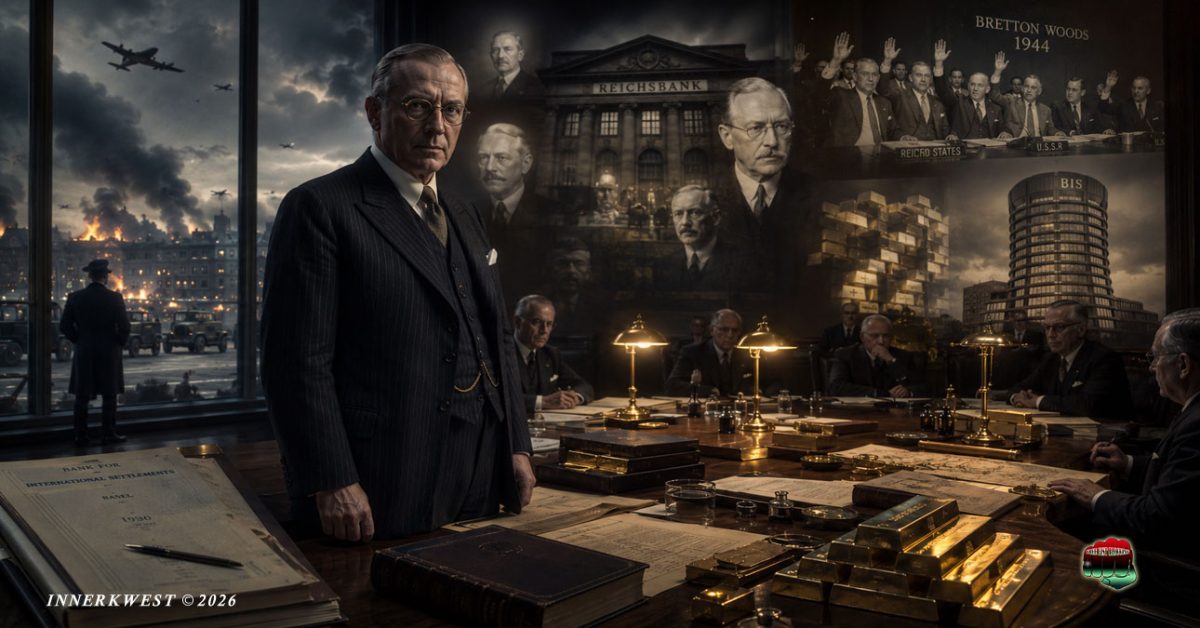
In the spring of 1943, while Europe remained engulfed in the deadliest conflict in human history, an American banker traveled through Nazi Germany, met with officials of the Reichsbank in Berlin, and departed under arrangements that allowed him to safely return to neutral Switzerland.
German U-boats reportedly had standing instructions not to interfere with his passage.
His name was Thomas McKittrick.
He was not a diplomat.
He was not a military officer.
He was the president of the Bank for International Settlements.
The story sounds improbable.
Yet it is not a conspiracy theory.
The institutions existed.
The meetings occurred.
The records remain.
Much of the documentation sits in archives, government memoranda, wartime investigations, and the historical record surrounding the Nuremberg era.
The more interesting question is not whether these events happened.
The question is what they reveal about the relationship between finance and power during one of history’s darkest periods.
The Institution in the Middle
Founded in 1930 and headquartered in Basel, Switzerland, the Bank for International Settlements (BIS) was designed to facilitate cooperation among central banks and assist with international financial settlements.
Its creation reflected a belief that financial systems required continuity even when political relationships deteriorated.
That principle would face its greatest test during World War II.
As armies crossed borders and governments collapsed, the BIS remained operational.
Representatives from nations at war with one another continued to participate in aspects of the international financial system.
The institution occupied a unique space between diplomacy, finance, and geopolitics.
For some observers, that neutrality represented stability.
For others, it represented something far more troubling.
When War and Finance Follow Different Rules
The wartime activities of Thomas McKittrick remain among the most controversial episodes in the institution’s history.
Historians continue to debate where neutrality ended and accommodation began.
Supporters of the BIS argued that preserving financial communication during wartime could assist post-war reconstruction and maintain channels necessary for future stability.
Critics saw a different reality.
To them, the spectacle of international bankers maintaining relationships while millions died across Europe illustrated a disturbing separation between financial necessity and moral responsibility.
The controversy surrounding McKittrick was never simply about one individual.
It was about whether certain institutions operated according to rules unavailable to ordinary citizens, soldiers, and governments.
The question remains relevant today.
The Business of War
The BIS was not the only institution to face scrutiny.
Throughout the war and in the decades that followed, historians, congressional investigations, journalists, and researchers examined the activities of numerous corporations with pre-war or wartime ties to Germany.
Among the most frequently discussed were:
- Standard Oil and patent-sharing controversies involving synthetic fuel technologies.
- Chase National Bank’s operations in occupied Paris.
- ITT’s business relationships within Germany.
- Various multinational firms navigating commercial interests before and during the conflict.
The details remain complex.
Not every allegation proved accurate.
Not every relationship constituted collaboration.
Yet the broader reality remains difficult to ignore.
Global finance and multinational business rarely move in simple alignment with national borders.
Profit, commerce, and geopolitical loyalty do not always travel together.
That uncomfortable truth was visible long before the first Allied troops entered Berlin.
Gold Through Basel
No aspect of the BIS legacy generates more controversy than the question of gold.
During the war, the Reichsbank transferred gold through international channels, including transactions that passed through the BIS.
Subsequent investigations raised questions about whether some of that gold originated from assets seized by Nazi Germany from occupied nations.
The issue became particularly explosive after evidence emerged that portions of Europe’s looted reserves had moved through financial systems that continued operating despite the conflict.
The debate was not simply about bookkeeping.
It was about accountability.
How much did institutions know?
What should they have known?
And at what point does neutrality become complicity?
Historians continue to debate the answers.
What remains beyond dispute is that the controversy damaged the reputation of the institution and intensified calls for reform.
The Prescott Bush Question
Another recurring figure in discussions of wartime finance is Prescott Bush, grandfather of future presidents George H.W. Bush and George W. Bush.
In 1942, the U.S. government seized assets associated with Union Banking Corporation under the Trading with the Enemy Act.
The historical record surrounding those actions has generated decades of debate, speculation, and political interpretation.
Some claims have been exaggerated over time.
Others remain firmly documented.
What makes the episode significant is not the political lineage that followed.
It is the reminder that wartime economic networks often extended beyond the simplistic narratives nations later preferred to tell about themselves.
History is rarely as clean as victory speeches.
The Vote to End the BIS
Perhaps the most remarkable chapter came not during the war, but near its conclusion.
At the 1944 Bretton Woods Conference, delegates gathered to design the architecture of the post-war financial order.
The conference would ultimately produce the International Monetary Fund and the World Bank.
Less remembered is another development.
A resolution was introduced calling for the liquidation of the Bank for International Settlements.
The argument was straightforward.
Critics believed the institution’s wartime conduct had discredited it and that the emerging post-war system no longer required its existence.
The resolution passed.
On paper, the BIS was supposed to disappear.
It never did.
Behind the scenes, central bankers, financial officials, and influential policymakers pushed back.
Over time, the liquidation effort quietly faded.
The institution survived.
That outcome raises one of the most fascinating questions in modern financial history:
Why was the BIS too important to kill?
The Architecture Beneath the War
Hitler’s Reich collapsed.
The BIS did not.
That fact alone explains much about the nature of institutions.
Political systems often appear powerful.
Yet financial architecture frequently proves more durable.
Governments rise and fall.
Borders change.
Wars begin and end.
Institutions adapt.
The survival of the BIS suggests that those responsible for rebuilding the post-war world ultimately concluded that central-bank coordination mattered more than punishing a controversial institution.
Whether that judgment was wise remains open to debate.
What is clear is that continuity prevailed.
The institution remained.
The system endured.
What Economic History Actually Looks Like
Popular history often focuses on generals, presidents, battles, and treaties.
Economic history follows different paths.
It examines incentives.
Relationships.
Institutions.
Networks.
The uncomfortable reality is that financial systems frequently survive the political crises that surround them.
The story of Thomas McKittrick, the BIS, wartime finance, and Bretton Woods is not evidence of a hidden conspiracy controlling world events.
It is something arguably more revealing.
It is evidence that institutions often possess lives of their own.
Long after leaders disappear, those institutions continue operating, adapting, and influencing the world around them.
The archives preserve the record.
The question for future generations is what lessons they choose to draw from it.

The Doctrine of Neutral Capital
Beneath the controversies surrounding wartime banking lies a deeper philosophical question that extends far beyond the Second World War.
For much of modern financial history, a recurring assumption appears to have guided the behavior of major institutions: that capital itself is neutral.
Under this view, money is a tool rather than a moral actor. Financial systems exist to facilitate transactions, allocate resources, maintain liquidity, and preserve stability. The responsibility for how those resources are ultimately used belongs to governments, militaries, corporations, and political leaders—not to the institutions that move capital through the system.
Critics have long challenged that assumption.
They argue that capital is never entirely neutral because it shapes outcomes. Loans influence governments. Credit enables industries. Financial access determines who expands, who contracts, who survives, and who collapses. From that perspective, the institutions managing capital cannot fully separate themselves from the consequences of the systems they sustain.
The debate remains unresolved. Yet the survival of institutions such as the Bank for International Settlements suggests that post-war policymakers largely accepted the premise that preserving financial continuity outweighed the risks associated with dismantling the architecture through which that continuity was maintained.
Whether that represented wisdom, necessity, or moral compromise remains one of the enduring questions of modern economic history.
At InnerKwest.com, we are committed to delivering impactful journalism, deep insights, and fearless social commentary. Your cryptocurrency contributions help us execute with excellence, ensuring we remain independent and continue to amplify voices that matter.
To help sustain our work and editorial independence, we would appreciate your support of any amount of the tokens listed below. Support independent journalism:
BTC: 3NM7AAdxxaJ7jUhZ2nyfgcheWkrquvCzRm
SOL: HxeMhsyDvdv9dqEoBPpFtR46iVfbjrAicBDDjtEvJp7n
ETH: 0x3ab8bdce82439a73ca808a160ef94623275b5c0a
XRP: rLHzPsX6oXkzU2qL12kHCH8G8cnZv1rBJh TAG – 1068637374
SUI – 0xb21b61330caaa90dedc68b866c48abbf5c61b84644c45beea6a424b54f162d0c
and through our Support Page.
InnerKwest maintains a revelatory and redemptive discipline, relentless in advancing parity across every category of the human experience.
© 2026 InnerKwest®. All Rights Reserved | Haki zote zimehifadhiwa | 版权所有. InnerKwest® is a registered trademark of Inputit™ Platforms Inc. Global. No part of this publication may be reproduced, distributed, or transmitted in any form or by any means without prior written permission. Unauthorized use is strictly prohibited. Thank you for standing with us in pursuit of truth and progress!