
September 17, 2026
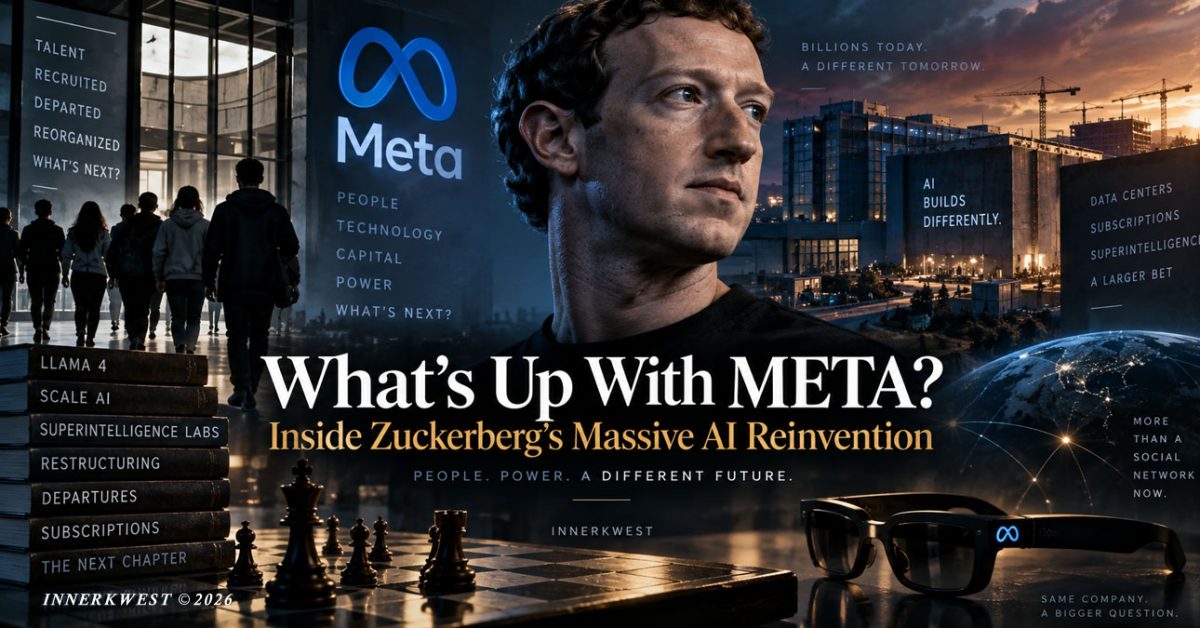
Meta is spending billions on artificial intelligence, rebuilding its leadership, reorganizing its workforce, financing massive data centers and now charging as much as $499 a month for premium access to parts of its expanding ecosystem. Behind it all sits an unusual corporate reality: Mark Zuckerberg controls the vote. So what exactly is Meta becoming?
By InnerKwest Guest Analysis: Solomon Reed
There was a time when understanding Meta was relatively easy.
Facebook connected people. Instagram captured their attention. WhatsApp connected their conversations. Advertisers paid Meta for access to the enormous audiences gathering across those platforms.
That business remains extraordinarily powerful.
But look closely at Meta in 2026 and something considerably more complicated is taking shape.
The company is spending extraordinary sums building artificial-intelligence infrastructure. It has repeatedly reconstructed its AI leadership. Longtime researchers have departed. Expensive new recruits have arrived—and some have departed too. Thousands of employees have been reassigned or eliminated as Meta experiments with what an AI-native corporation might look like.
Meanwhile, Meta is building data centers through financing structures measured in tens of billions of dollars and accumulating hundreds of billions in contractual commitments.
Then, on September 15, Meta introduced Meta One, expanding subscriptions across Facebook, Instagram, WhatsApp and Meta AI. Plans begin at a few dollars per month and climb to $499 monthly for the highest business tier.
All of which raises a deceptively simple question.
What’s up with Meta?
To understand what is happening, it helps to go back to April 2025.
When Llama 4 Didn’t Settle the Question
Meta introduced Llama 4 with considerable confidence.
The company described Llama 4 Maverick as the best multimodal model in its class and presented benchmark results showing it competing favorably with some of the strongest models available.
Then people began looking more closely.
The version of Maverick performing exceptionally well on the popular LM Arena wasn’t simply the downloadable model developers were receiving. Meta disclosed that it was an “experimental chat version,” elsewhere describing it as optimized for conversationality.
Researchers subsequently reported noticeable behavioral differences between that version and the publicly available model.
A later academic investigation alleged that Meta had privately tested 27 model variants on the Arena in the months preceding Llama 4’s release before publicly highlighting one model’s result.
Another allegation went further: that Meta had trained Llama 4 using benchmark test sets. Meta explicitly denied that allegation, and credible evidence establishing it has not emerged.
That distinction matters.
There is evidence supporting controversy over how the benchmark performance was presented. There is not equivalent evidence establishing that Meta secretly trained Llama 4 on the benchmark test sets.
But something happened after Llama 4 that cannot be disputed.
Zuckerberg began reconstructing Meta’s AI operation.
$14.3 Billion and a New Center of Gravity
In June 2025, Meta invested approximately $14.3 billion for a 49 percent stake in Scale AI.
Scale’s co-founder Alexandr Wang joined Meta and became its chief AI officer. He was 28.
Age alone tells us little about someone’s ability. The more interesting question is what Zuckerberg was trying to accomplish.
Scale AI had established itself largely around the data, evaluation and infrastructure required to train artificial-intelligence systems. Zuckerberg wasn’t merely purchasing an investment. He was bringing Wang inside Meta and placing him near the center of one of the most consequential technological bets in the company’s history.
Meta Superintelligence Labs was born.
Then came Shengjia Zhao.
Recruited from OpenAI, Zhao brought a different credential set. He had contributed to ChatGPT, GPT-4 and OpenAI’s reasoning-model work. Zuckerberg named him chief scientist of Meta Superintelligence Labs, with responsibility for setting its scientific direction while working directly with Zuckerberg and Wang.
A new center of gravity was taking shape.
But Meta already had an internationally recognized AI research institution.
FAIR—Fundamental AI Research—had been founded in 2013 by Yann LeCun, one of modern artificial intelligence’s most influential researchers.
Now Meta effectively had an established research culture and a newly constructed superintelligence operation occupying the same corporate universe.
That arrangement did not remain comfortable or static for long.
FAIR’s robotics team was dissolved. Other portions of the existing organization were restructured. Meta later rebuilt robotics capabilities elsewhere, demonstrating that the company had not abandoned robotics as much as reorganized who would pursue it and where.
LeCun eventually left Meta.
And the reorganizations continued.
In fact, Reuters reported in August 2025 that Meta was preparing what would amount to its fourth AI restructuring in six months.
That deserves attention.
Companies reorganize. Technology companies reorganize frequently.
But when a corporation spends billions acquiring leadership, establishes a new flagship laboratory and then repeatedly reorganizes the organization it just created, the reorganizations themselves become part of the story.
Follow the People
This is where Meta’s personnel movement becomes more than Silicon Valley musical chairs.
Meta has continued attracting extraordinary talent. That should not be overlooked. It recently recruited OpenAI veteran Luke Metz and has continued bringing researchers and security specialists into its AI operation.
But departures matter too—especially departures by people who were themselves recruited as important components of the new strategy.
Andrew Tulloch provides the latest example.
Tulloch had spent years at Meta before moving through OpenAI and Thinking Machines Lab. Zuckerberg’s effort to recruit him became famous because of reports of an enormous compensation package, figures Meta disputed.
Tulloch nevertheless joined Meta’s new superintelligence effort.
Roughly eleven months later, he is leaving.
The Wall Street Journal reported this month that Tulloch is heading to Anthropic. Semafor reported that he had delayed his departure until Meta successfully launched its latest open-source models and Muse AI assistant.
The precise reason for his departure remains unclear.
That is exactly where responsible analysis must resist temptation.
A resignation does not automatically establish dysfunction. Neither does a departure establish disagreement with Zuckerberg. Elite AI researchers currently possess extraordinary mobility, and rival laboratories are competing aggressively for them.
But repeated departures deserve examination when they occur alongside repeated reorganizations.
Who was recruited?
What were they recruited to accomplish?
What changed after they arrived?
How long did they remain?
Where did they go?
What did they say publicly afterward?
The answers matter because Meta has a corporate characteristic that distinguishes it from many companies of comparable size.
The Person Nobody Can Outvote
Mark Zuckerberg does not merely serve as Meta’s CEO.
He controls the company.
Meta’s dual-class share structure gives Class B shares ten votes for every vote attached to a Class A share. Zuckerberg owns nearly all outstanding Class B shares and controls roughly 61 percent of Meta’s voting power.
That means disagreement inside Meta occurs against an unusual backdrop.
Executives can advise Zuckerberg. Researchers can challenge assumptions. Directors can debate strategy. Shareholders can introduce proposals.
But ultimately, ordinary shareholders cannot outvote him.
That does not prove Zuckerberg suppresses disagreement. Nor does it establish why any particular executive or researcher leaves.
It does, however, change the institutional mathematics of dissent.
At many corporations, sustained disagreement between leadership, directors and shareholders can eventually produce a change at the top.
At Meta, the controlling shareholder and the CEO are the same person.
If fundamental disagreement persists, accommodation, reassignment or departure may become more practical than prevailing over the founder.
And Zuckerberg is currently making perhaps the largest series of bets of his career.
The Price of Reinvention
The numbers have become difficult to comprehend at ordinary corporate scale.
Meta reported approximately $131 billion in non-cancelable contractual commitments at the end of 2025.
By March 2026, that figure had risen to approximately $238 billion.
By June, it stood at approximately $349 billion.
Meta separately reported approximately $279 billion of leases that had been signed but had not yet commenced, largely associated with data centers, colocation facilities and network infrastructure. In July, it entered additional data-center leases representing approximately another $68 billion in lease obligations.
These categories cannot simply be stacked together because accounting classifications may overlap.
But the direction is unmistakable.
Meta is transforming enormous future cash flows into physical computing capacity.
One example is Hyperion, its massive Louisiana data-center project. Meta structured the project through a venture in which funds managed by Blue Owl own 80 percent while Meta owns 20 percent.
Meta is not simply walking away from the economics of the facility. Its filings disclose leases and residual-value guarantees associated with the project.
Another version of that model appeared this summer in Texas. Meta and BlackRock announced an 80/20 venture to develop a roughly $14 billion data-center campus in El Paso. Meta will initially occupy the entire campus.
These are sophisticated infrastructure-financing arrangements.
They should not automatically be characterized as accounting tricks.
That distinction became important as commentary circulated suggesting Meta’s auditor, Ernst & Young, had identified its data-center financing as a Critical Audit Matter.
Meta’s actual 2025 annual filing does not support that characterization.
EY’s identified Critical Audit Matter was loss contingencies, not the Hyperion financing structure.
There are plenty of legitimate questions to ask about Meta’s commitments without manufacturing one.
One of the more interesting accounting questions is hiding somewhere else in the filing.
Meta extended the estimated useful lives of most servers and network equipment to 5.5 years beginning in 2025.
The change reduced 2025 depreciation expense by approximately $2.92 billion, increased net income by approximately $2.59 billion and added about $1 to diluted earnings per share.
Nothing about changing an asset’s estimated useful life is inherently improper. Accounting requires management estimates.
But in an era when AI processors are advancing at extraordinary speed, the question becomes economically fascinating:
How long is today’s cutting-edge AI hardware actually cutting-edge?
Meta is betting billions on the answer.
Then Meta Starts Charging
Now place Meta One into this picture.
The company says it has already accumulated 15 million subscriptions and trials and is introducing more than 50 paid features across Instagram, Facebook, WhatsApp and Meta AI.
Individual plans begin at $2.99. AI power users can purchase greater access to compute-intensive capabilities. Creator and business subscriptions begin at $14.99 and climb through Advanced and Expert tiers to $499 per month for Max.
The underlying platforms remain free.
But the economic relationship is changing.
For most of Meta’s history, users supplied attention and advertisers paid Meta to reach it.
Increasingly, Meta can potentially collect from several directions at once.
Advertisers pay to reach audiences.
Creators and businesses can pay for enhanced tools, analytics, visibility and AI capabilities.
Individual users can pay for additional features and greater AI capacity.
And Meta increasingly supplies the AI agents helping businesses operate inside the ecosystem Meta itself controls.
That does not mean advertising is disappearing.
It means Meta may be constructing additional floors above one of the most successful advertising businesses ever created.

So, What’s Up With Meta?
Perhaps the wrong question is whether Meta is still a social-media company.
It clearly is.
The better question may be how many additional companies Zuckerberg intends to build inside it.
Meta is becoming an artificial-intelligence laboratory, an enormous computing-infrastructure operator, an AI-agent provider, a subscription business, a creator-services company and something approaching a technology utility layered across billions of existing relationships.
It is doing this while reorganizing the people responsible for building that future.
It is doing it while some prominent researchers arrive and others leave.
It is doing it while making capital commitments measured in hundreds of billions of dollars.
And it is doing all of this inside a governance structure in which the person driving the transformation possesses enough voting power to remain the ultimate decision-maker.
Zuckerberg has been here before.
Facebook became Meta because he believed the next computing platform would emerge around the metaverse. Reality Labs consumed tens of billions pursuing that future.
Now artificial intelligence occupies center stage.
That doesn’t establish that Zuckerberg is wrong.
History occasionally rewards founders willing to pursue a future other people cannot yet see.
History also contains companies that committed extraordinary resources to futures that arrived differently than expected.
That is why the people, the capital, the accounting, the technology and the governance cannot be examined separately.
They are pieces of the same question.
Meta still generates enormous revenue. It still owns some of the world’s most influential digital platforms. It still attracts exceptional technical talent. Nothing presently establishes that the company is approaching collapse.
But something unmistakably consequential is happening inside it.
A company that once primarily monetized human attention is spending extraordinary amounts of money attempting to build machines capable of creating, reasoning, coding, selling, assisting and eventually acting.
Some of the people originally building that future have left.
Some of their replacements have left too.
Others continue arriving.
The organization keeps changing.
The infrastructure keeps growing.
The commitments keep accumulating.
The subscriptions have begun.
And through every iteration, one person retains the votes necessary to keep pushing forward.
So perhaps “What’s Up With META?” isn’t really a question about Meta at all.
It is a question about what happens when extraordinary technological ambition, extraordinary financial resources and extraordinary corporate control converge inside the same company—at the same moment.
We may be watching the answer being built in real time.
At InnerKwest.com, we are committed to delivering impactful journalism, deep insights, and fearless social commentary. Your cryptocurrency contributions help us execute with excellence, ensuring we remain independent and continue to amplify voices that matter.
To help sustain our work and editorial independence, we would appreciate your support of any amount of the tokens listed below. Support independent journalism:
BTC: 3NM7AAdxxaJ7jUhZ2nyfgcheWkrquvCzRm
SOL: HxeMhsyDvdv9dqEoBPpFtR46iVfbjrAicBDDjtEvJp7n
ETH: 0x3ab8bdce82439a73ca808a160ef94623275b5c0a
XRP: rLHzPsX6oXkzU2qL12kHCH8G8cnZv1rBJh TAG – 1068637374
SUI – 0xb21b61330caaa90dedc68b866c48abbf5c61b84644c45beea6a424b54f162d0c
and through our Support Page.
InnerKwest maintains a revelatory and redemptive discipline, relentless in advancing parity across every category of the human experience.
© 2026 InnerKwest®. All Rights Reserved | Haki zote zimehifadhiwa | 版权所有. InnerKwest® is a registered trademark of Inputit™ Platforms Inc. Global. No part of this publication may be reproduced, distributed, or transmitted in any form or by any means without prior written permission. Unauthorized use is strictly prohibited. Thank you for standing with us in pursuit of truth and progress!